When crystals start to move: uncovering the hidden role of shear during magma ascent
Published in Earth & Environment

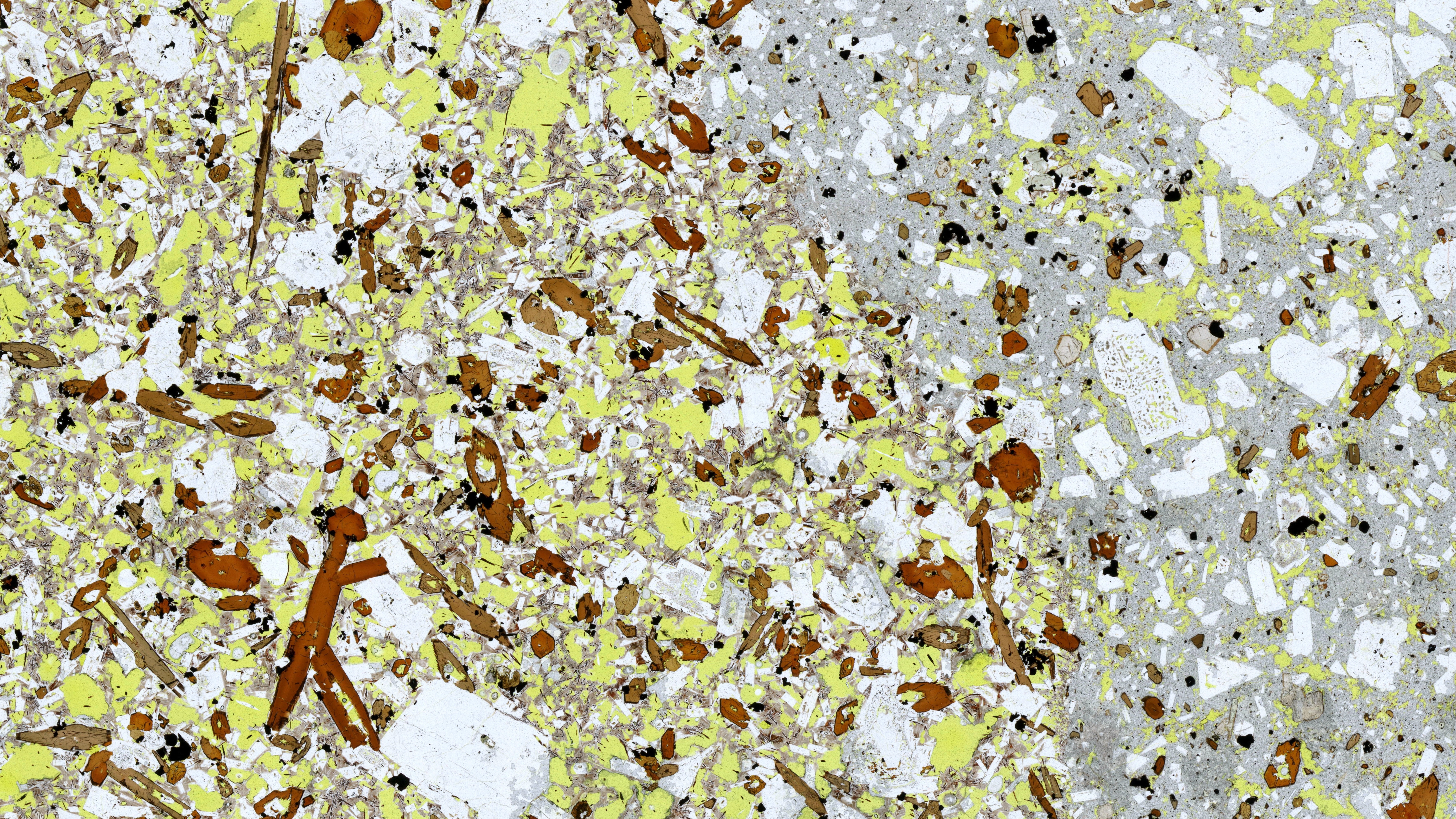




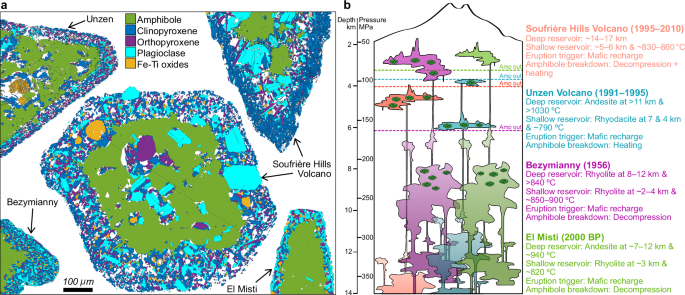

As volcanologists, we are often trying to reconstruct something we can never directly observe: how magma moves through the Earth before it erupts. For decades, one of our most trusted tools has been minerals, tiny recorders of the conditions deep beneath volcanoes. Among these, amphibole has played a particularly important role. Because it contains structurally-bound water, it is sensitive to the pressure, temperature and water content of its environment. At increasing temperature or decreasing pressure or water content, it decomposes into anhydrous minerals like pyroxene and plagioclase, and liberates its water. Due to this reactivity, amphibole breakdown textures have long been used to infer the conditions of magma storage and ascent (Fig. 1).
Like many others, I was initially drawn to amphibole for exactly this reason. My early interest was simple: can we use hydrous minerals to better understand where and how magma is stored before eruption?
A familiar texture, a new question
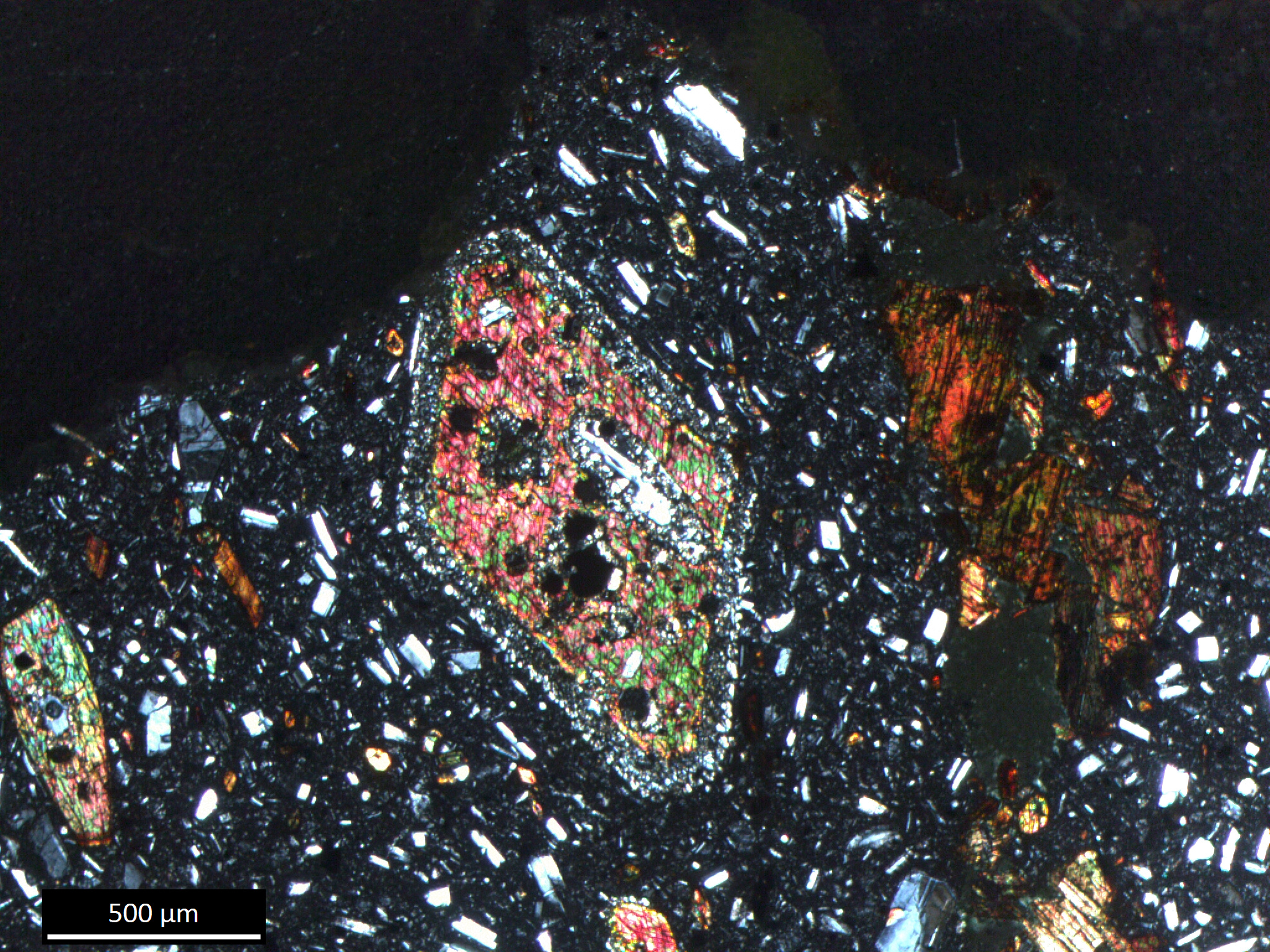
Amphibole breakdown produces what are known as reaction rims, fine-grained shells of new minerals that form as the crystal becomes unstable (Fig. 2). These rims have been studied for decades and are typically interpreted through a thermodynamic lens: decompression, heating, changes in melt composition.
Our original goal was to revisit these interpretations using a relatively new technique in volcanology: electron backscatter diffraction (EBSD). EBSD allows us to map the crystallographic orientation of minerals, essentially, how atoms are arranged and aligned within each crystal.
We initially just wanted to see whether EBSD could tell us something about how amphibole breaks down. Was it decompression? Heating? Could we distinguish between them crystallographically?
At the time, applying EBSD to magmatic reaction textures was still relatively novel. It had been used in structural geology and metamorphic systems for years, but using it to interrogate rapidly evolving magmatic processes felt like stepping into new territory.
The moment things didn’t fit
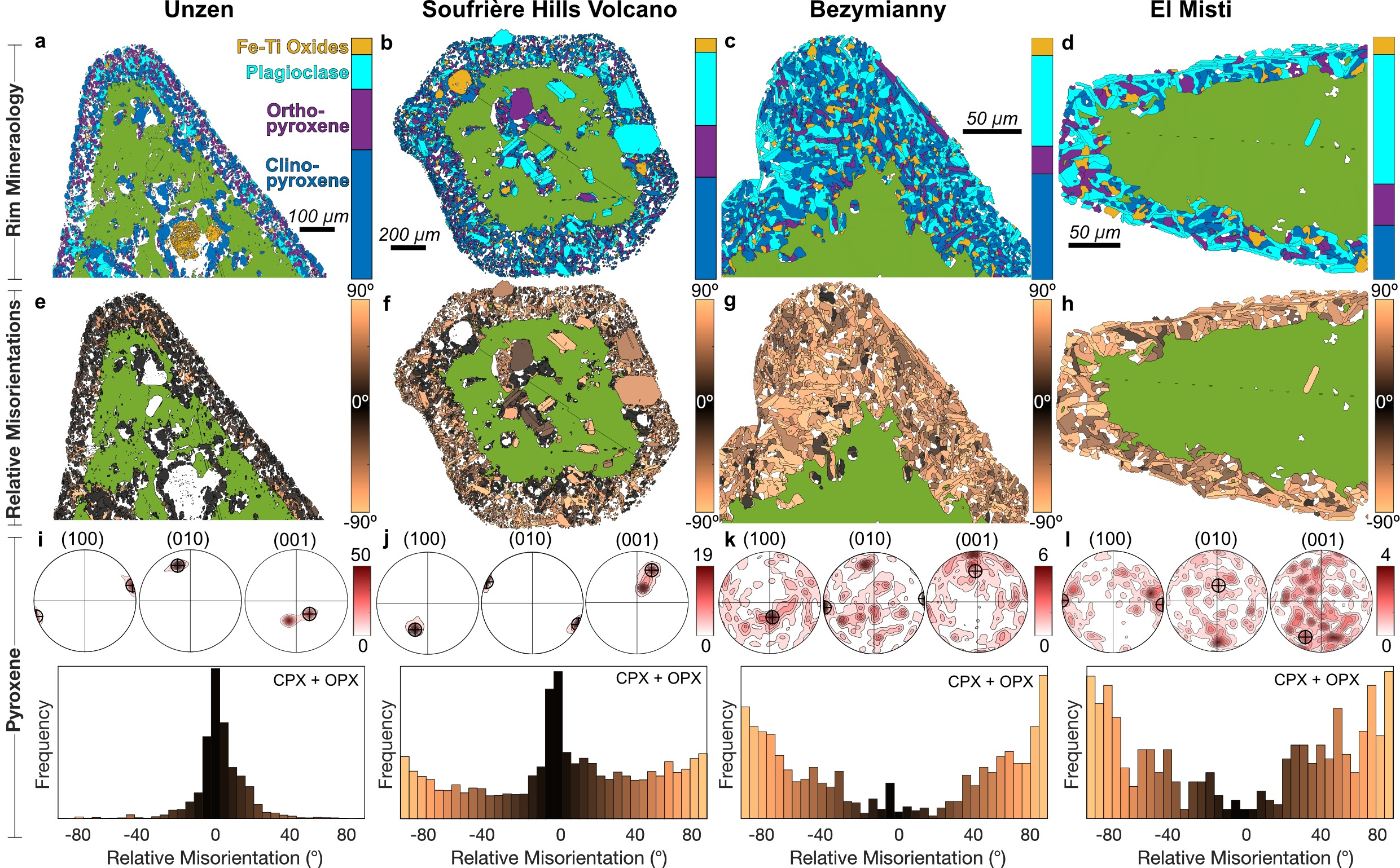
The first crystals to form during amphibole breakdown (i.e. pyroxenes) don’t grow randomly. Instead, they inherit the crystallographic structure of the amphibole itself. This process, known as topotaxy, means the new crystals are initially perfectly aligned with their parent.
What we expected to see was relatively straightforward: crystallographic patterns that might differ depending on whether amphibole broke down due to heating, decompression or some other mechanism.
What we actually found was far more striking.
In some natural samples, we indeed observe pyroxene crystals that are nicely aligned to their host amphibole. In many other cases, this alignment is not present. However, even though the pyroxenes don’t match the amphibole, they are not random in their orientations. Instead, the crystals appeared progressively rotated as a group, sometimes subtly, sometimes dramatically. The patterns were systematic, reproducible, and varied between volcanic systems.
At that point, the question shifted entirely.
If we start by assuming that all the magmatic systems start the same way: with the crystals aligned, what is rotating them in some systems and not others?
When magma flow leaves a fingerprint
The answer, we realised, was not purely chemical or thermal, it was mechanical.
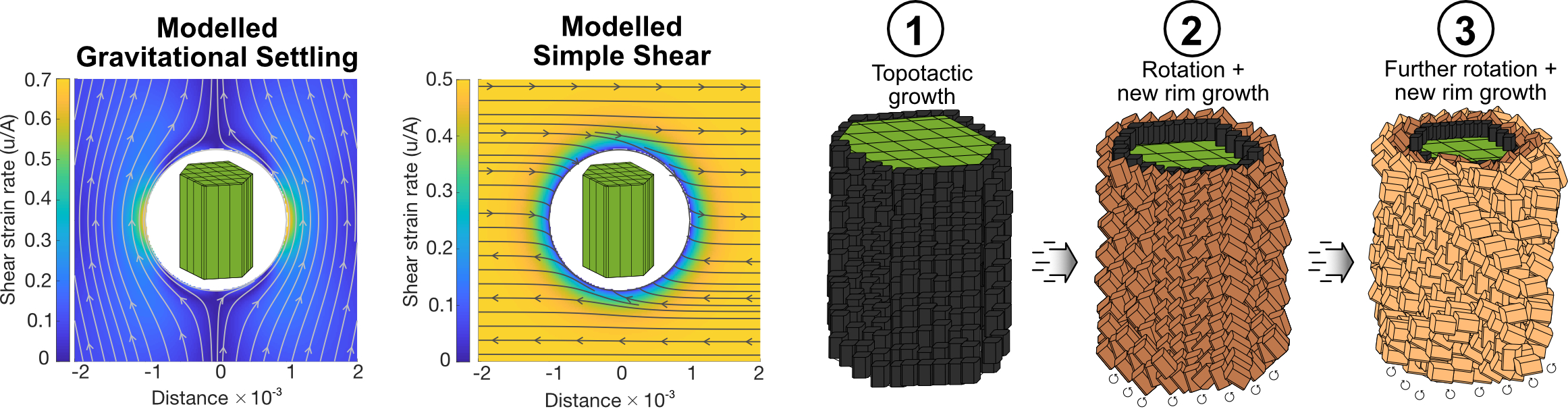
As magma ascends towards the surface, it flows. And that flow is not gentle. It involves shearing and stretching that evolve through time and space. What we show in our study is that this flow can physically rotate the newly formed crystals.
In other words, the reaction rim is not just recording when and how amphibole became unstable, it is recording how the magma was moving at that exact moment.
Using a combination of EBSD data, laboratory experiments, and numerical modelling, we demonstrate that even relatively modest amounts of shear can progressively rotate crystals away from their original topotactic alignment.
One of the most surprising aspects was that this effect appears even in experiments where no external deformation was applied. Simply allowing amphibole crystals to sink under their own gravity in a melt generates enough local flow to produce measurable crystallographic rotation.
That was a real turning point. Even in what we think of as ‘static’ experiments, the system is still moving.
A new way to read volcanic textures
What emerged from this work is a fundamentally different way of interpreting amphibole reaction rims.
Traditionally, these textures have been treated as snapshots of chemical disequilibrium, records of pressure, temperature, and composition (P–T–X). What we show is that they also encode deformation.
This transforms them into what we describe as four-dimensional recorders: P–T–X–ε (where ε represents strain).
This shift has important implications. It helps explain why similar-looking reaction rims can form under very different conditions, and why previous interpretations sometimes appeared contradictory. By incorporating deformation, we can reconcile these differences within a single framework.
It also opens the door to something quite powerful: reconstructing magma ascent not just chemically, but mechanically.
Challenges along the way
Of course, this wasn’t a straightforward path.
One of the main challenges was bridging disciplines. EBSD sits at the interface of materials science, structural geology, and petrology. Applying it to magmatic systems required adapting workflows, developing new ways to visualise the data, and, importantly, convincing ourselves that what we were seeing was real.
Another challenge was interpretation. Crystallographic data can be incredibly rich, but also ambiguous if taken in isolation. It was only by combining EBSD with experiments and numerical models that the full picture emerged.
And then there is always the challenge of letting go of established ideas.
For a long time, we’ve interpreted these textures almost entirely in terms of thermodynamics. Recognising that deformation plays a central role required a bit of a conceptual shift.
Looking forward
This study is, in many ways, just the beginning.
If crystal orientations can record strain during magma ascent, then we have a new tool for probing the dynamics of volcanic systems. This could help us better understand processes such as conduit flow, strain localisation, and even the transitions that lead to explosive eruptions.
More broadly, it highlights the importance of integrating mechanics into petrology. Magmas are not just chemical systems, they are flowing, deforming materials. Their history is written not only in compositions, but in textures and structures.
For me, one of the most exciting aspects is that this information has been there all along, hidden in plain sight within these reaction rims.
We’ve been looking at these textures for decades. But only now are we starting to see that they’re recording much more than we realised.
Follow the Topic
-
Nature Communications
An open access, multidisciplinary journal dedicated to publishing high-quality research in all areas of the biological, health, physical, chemical and Earth sciences.

Related Collections
With Collections, you can get published faster and increase your visibility.
Women's Health
Publishing Model: Hybrid
Deadline: Ongoing
Tumor Microenvironment Crosstalk and Therapeutic Implications
Publishing Model: Hybrid
Deadline: Nov 02, 2026





Please sign in or register for FREE
If you are a registered user on Research Communities by Springer Nature, please sign in