When the Atmosphere Slows the Earth: Uncovering a Subtle Signal of Climate Change
Published in Earth & Environment and Mathematics

A Question Beyond Weather
Atmospheric circulation governs weather and climate, but it also carries angular momentum. When winds shift or mass redistributes, the atmosphere can exchange momentum with the solid Earth, slightly altering the planet’s rotation rate. This is not a new concept, but what happens under long-term global warming?
Previous studies have shown that atmospheric angular momentum (AAM) is projected to increase in climate projections. However, the why remained unclear. Was it simply stronger winds? Or was there a deeper dynamical restructuring of the atmosphere?
We set out to answer this in our recently published paper at npj climate and atmospheric science (https://doi.org/10.1038/s41612-026-01382-z).
Tracing the Fingerprint of Global Warming
Using large-ensemble climate simulations from three different global models, we examined how atmospheric circulation evolves under a high-emission scenario. What emerged was a consistent and physically coherent picture:
- The Hadley cell expands poleward
- Subtropical jets intensify
- Tropical trade winds weaken
- Upper-level zonal winds strengthen
These are well-known responses to warming, but together they systematically increase AAM (Figure 1).
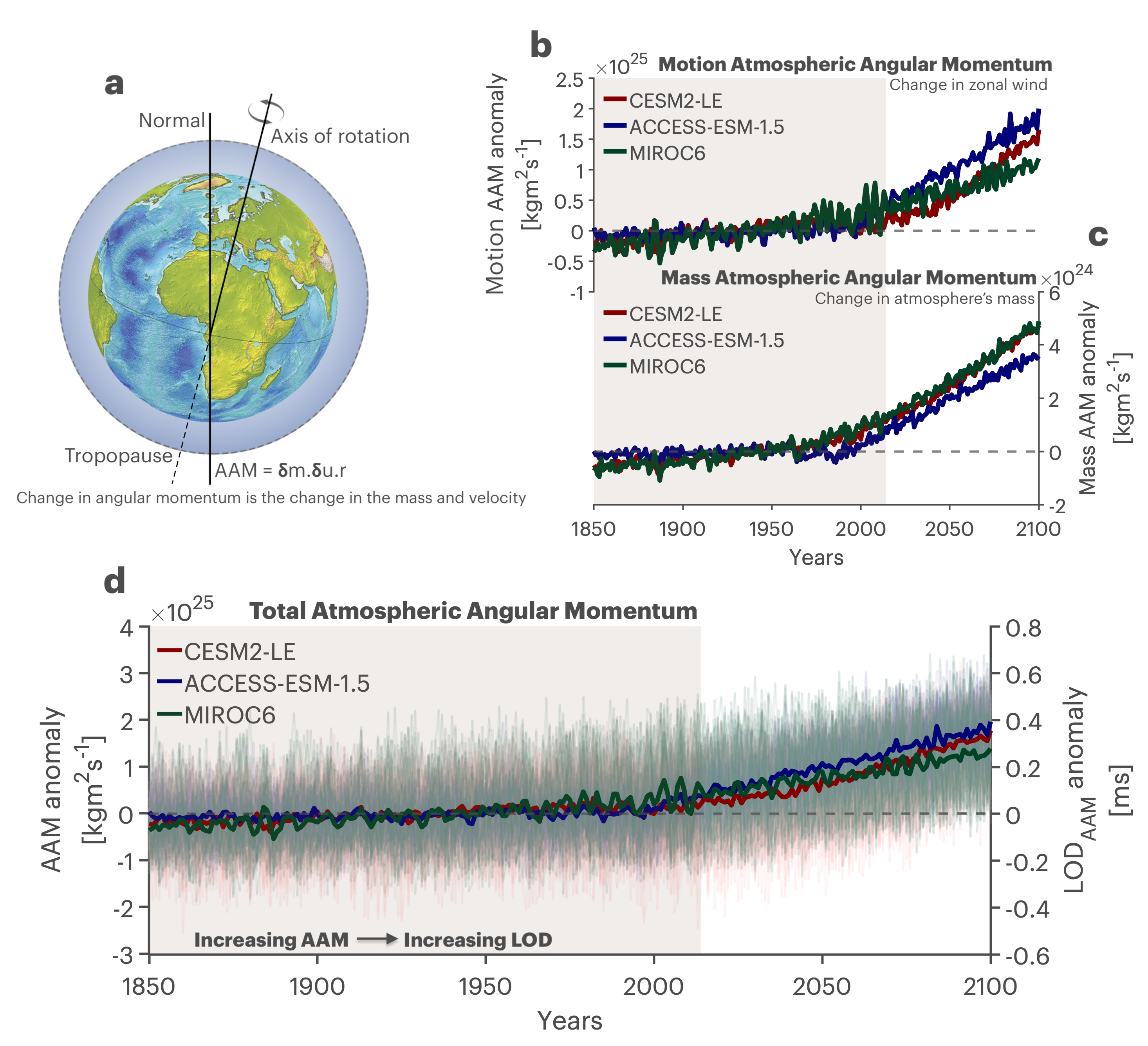
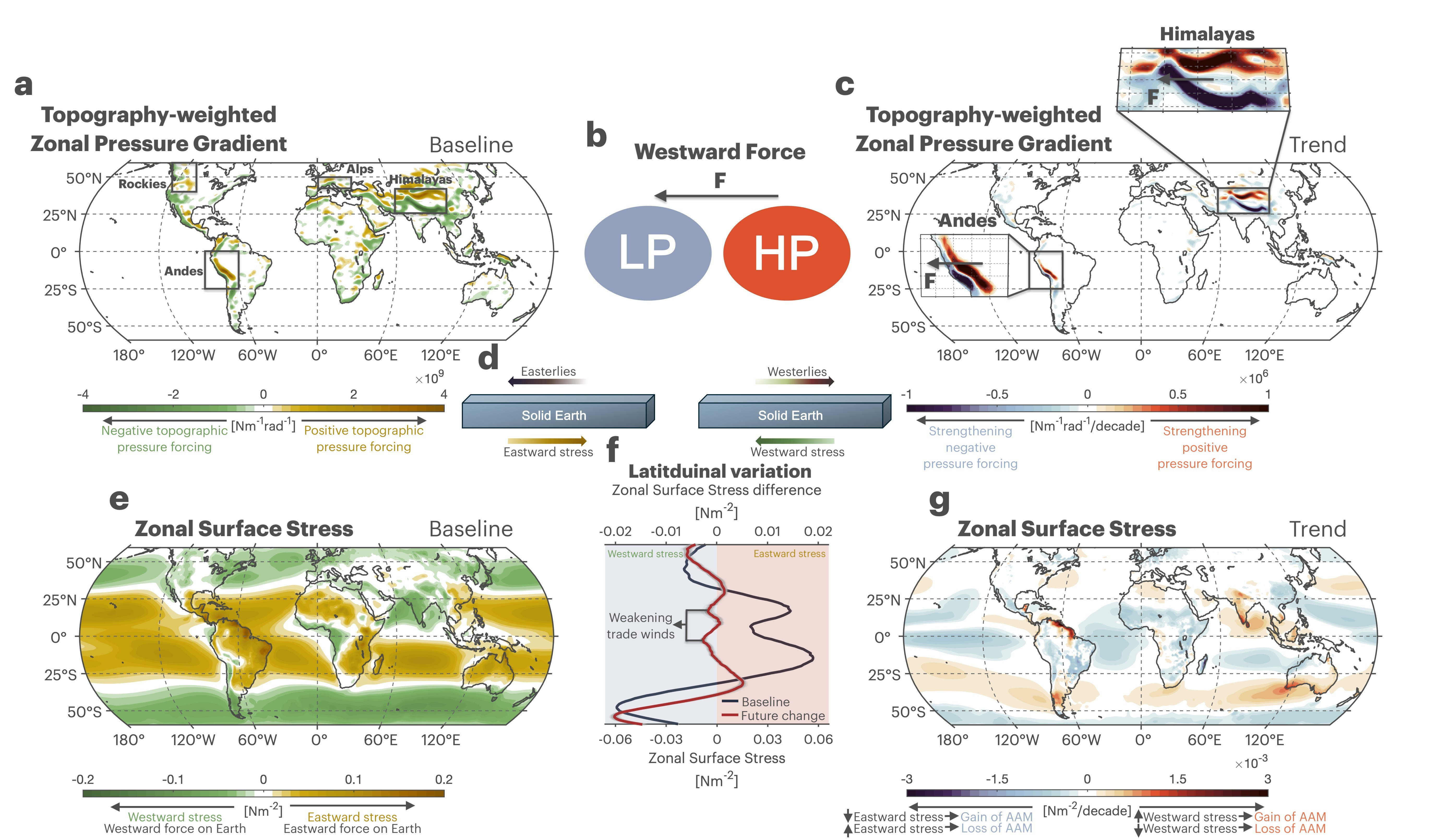
At the same time, something equally important happens at the surface: the exchange of momentum between the atmosphere and the solid Earth weakens (Figure 2). This reduces the Earth's efficiency at "keeping up" with the changing atmosphere.
The result? A slightly faster-moving atmosphere and a slightly slower-rotating Earth.
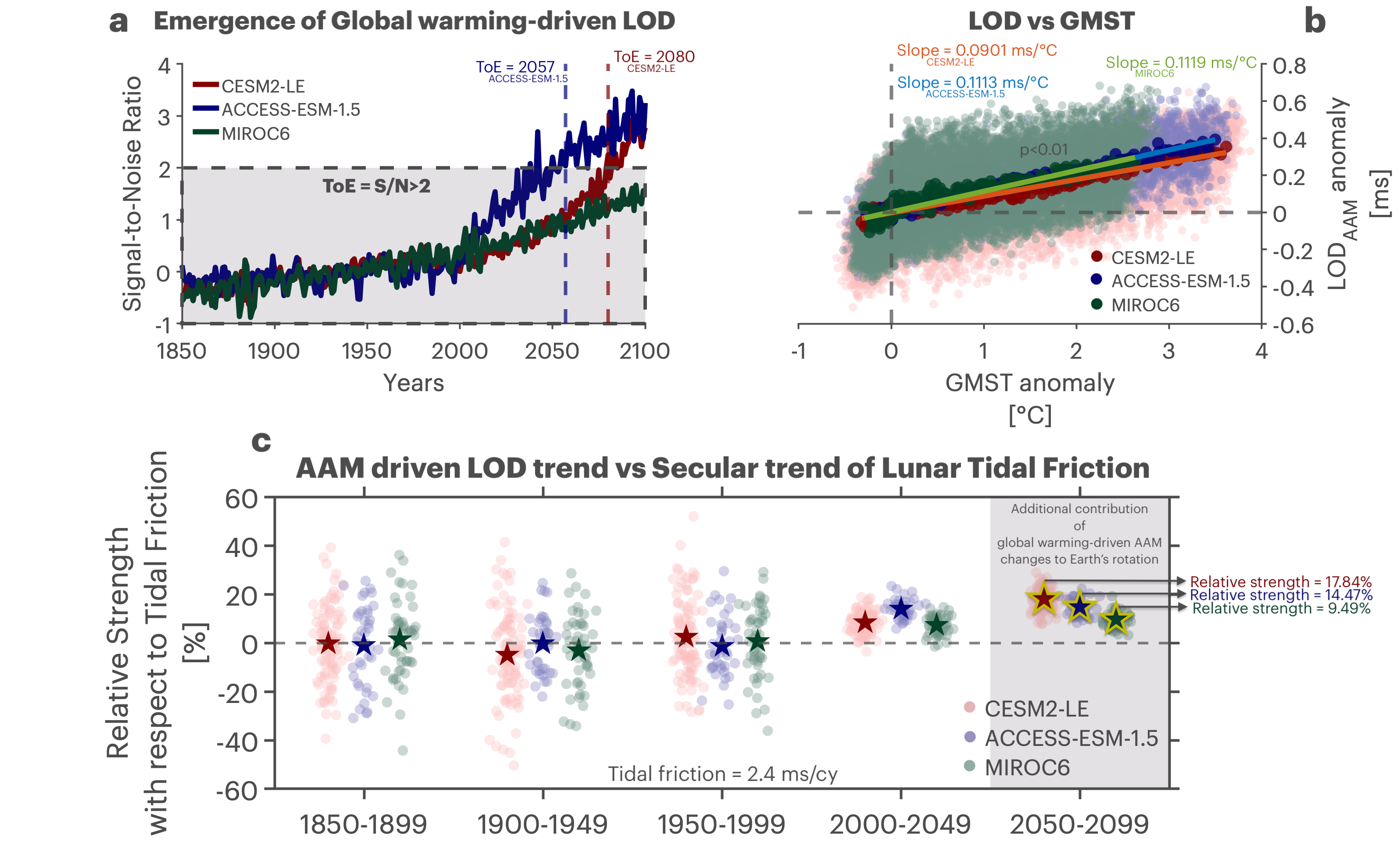
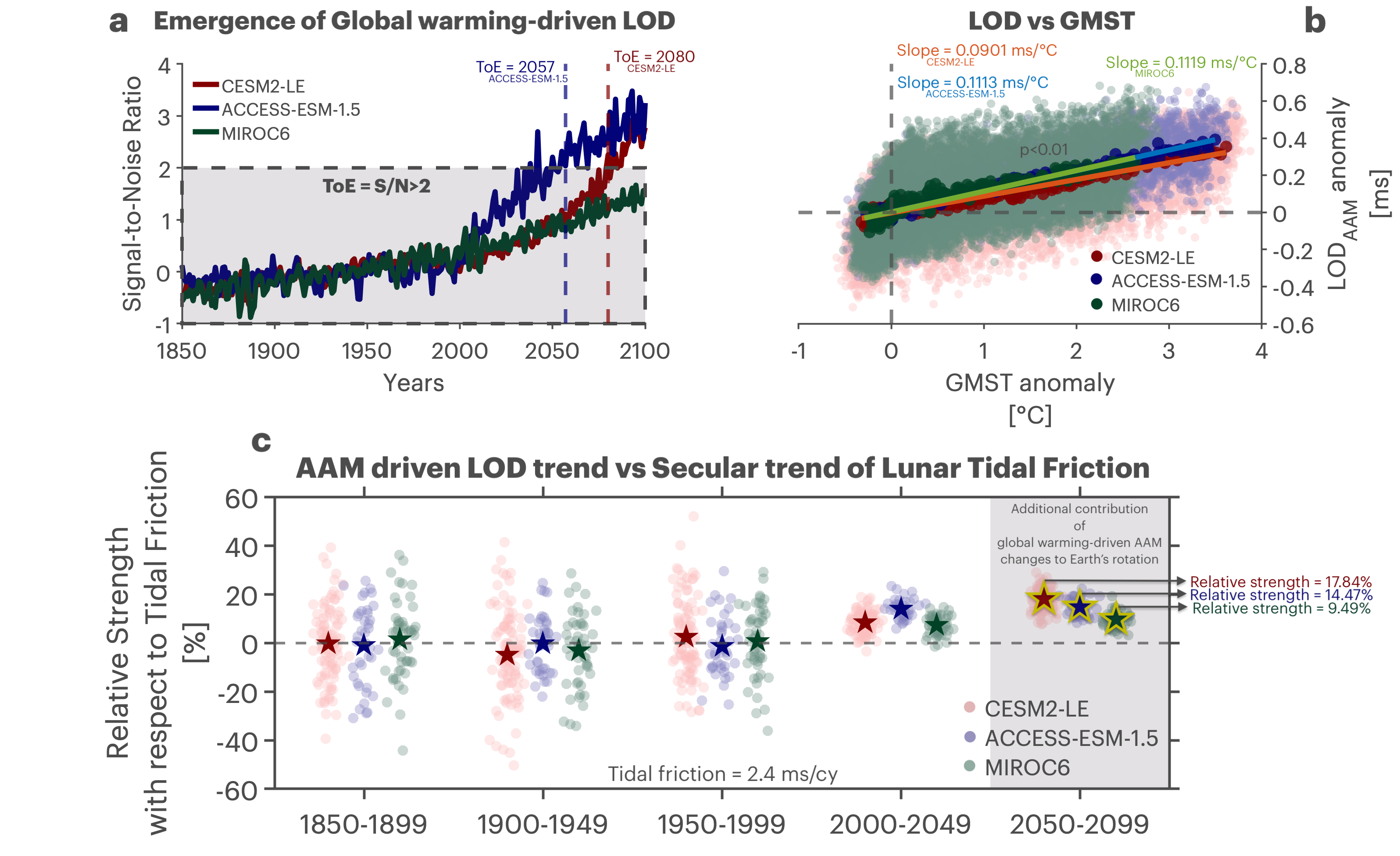
The changes we identify are subtle. By the end of the 21st century, the increase in the Length of Day (LOD) due to atmospheric changes reaches about 10-18% of the long-term tidal friction trend (Figure 3).
At first glance, this may seem modest. But it is significant for two reasons:
- It represents a systematic, externally forced signal, not just internal variability
- It emerges from well-understood dynamical changes in atmospheric circulation.
To place this in context, tidal friction has long been considered the dominant driver of long-term rotational slowing. Our comparison is not to suggest equivalence, but to provide a physically meaningful benchmark for interpreting the magnitude of the atmospheric contribution.
At the same time, the recent studies highlight that core-mantle interactions dominate the Earth's rotation variability on decadal to centennial timescales. Our results, therefore, position atmospheric changes as an additional, climate-driven component within this broader rotational system. Hence, global warming is reorganising the atmospheric circulation in a way that measurably influences Earth's rotational dynamics.
Looking Ahead
Our study highlights the broader idea: climate change is not just altering temperature, precipitation, or extremes; it is reshaping the fundamental dynamical balance of the Earth system. The atmosphere, oceans, cryosphere, and solid Earth are tightly coupled. Changes in one component inevitably propagate into others, sometimes in unexpected ways.
Understanding these connections will be crucial as we move forward.
Final Thoughts
This work began with a simple question about rotation. It evolved into a deeper exploration of how atmospheric dynamics respond to warming, and how these changes ripple through the Earth system.
The signal we identify is systematic, physically grounded, and a part of the larger story: global warming is influencing the Earth in ways that extend far beyond the climate system itself.

Follow the Topic
-
npj Climate and Atmospheric Science
This journal is dedicated to publishing research on topics such as climate dynamics and variability, weather and climate prediction, climate change, weather extremes, air pollution, atmospheric chemistry, the hydrological cycle and atmosphere-ocean and -land interactions.

Related Collections
With Collections, you can get published faster and increase your visibility.
Atmosphere-Biosphere Interactions
Publishing Model: Open Access
Deadline: Oct 31, 2026
AI-Driven Innovation in Atmospheric Chemistry and Composition–Climate Interactions
Publishing Model: Open Access
Deadline: Oct 31, 2026