When urgency meets innovation: Reinventing health education during COVID-19
Published in Social Sciences, Public Health, and Education

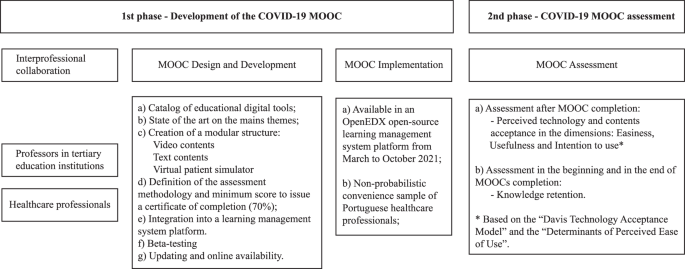

In a pandemic context, our latest study demonstrated the intention of healthcare professionals to use massive open online courses (MOOCs) in lifelong learning, as they are easy to use and useful for keeping professionals up to date on advances in medical fields, thus ensuring the safety and quality of healthcare delivery.
The research follows other studies on the subject, namely Easiness, Usefulness and Intention to Use a MOOC in Nursing Education, published in Nurse Education Today. It showed the usefulness and nurses' intention to use the educational resource in future training and yielded high average scores for perceived easiness and overall quality. It concludes that these massive courses unlock new opportunities for nursing education and lifelong learning in nursing, enhancing the safety and quality of healthcare services by supporting patients in achieving a better quality of life.
Following that study, a more comprehensive text about the process of MOOC creation in the Portuguese context was addressed in a book chapter entitled “Case Study of Two Higher Education Institutions in the Use of a National MOOC Platform Towards Sustainable Development”, published by Taylor and Francis in the book Technologies for Sustainable Global Higher Education.
The chapter briefly presents the case study based on the experience of the Nursing School of Porto. Specifically, it addresses the Ecare-COPD Training Programme, a three-level MOOC developed based on a doctoral thesis followed by a research project (Padilha, 2013; 2018), which made it possible to understand the need to equip nurses with skills for empowering patients in the self-management of COPD, listing several strategies for its implementation.
The production of MOOCs followed the Technology Readiness Levels (TRL), used as a reference for understanding the evolution of this technology-based process.
Thus, the initial action-research thesis and initial exploratory project corresponded to TRL 1 to 4, where the component was validated in a controlled environment.
To validate the concept in a relevant environment, a new educational branch of the project was created, developing the above referred Ecare-COPD MOOC in three levels, based on expert opinion using the focus group approach and tested by beta testers (TRL 5) after the initial development phase.
After these preparatory phases, a prototype was created, demonstrating the technology in a relevant environment (TRL 6), hosted by the Portuguese National Agency for Science and Technology - FCT.
This experience showed that participants rated the easiness and overall quality of the course with an average score of 4.70, and usefulness and intention to use the MOOC in the future with an average score of 4.73 on a 5-point Likert scale, proving its operability in a real environment (TRL 7).
The development phase was completed and validated by participants (TRL 8), showing that nurses with more qualifications, experience, and age rated the MOOC higher in terms of easiness and overall quality (see details here).
With the additional aim of testing the development method created in the pilot study described above in an operational environment, a new MOOC — Ecare-COVID19 — was developed and made available, thereby reaching TRL 9.
In this context, the most recent study was published in Humanities and Social Sciences Communications aiming to contribute to the state of the art by showing MOOCs’ effectiveness in promoting knowledge retention during a pandemic, demonstrating significant improvements in knowledge scores before and after completing the course modules (from 50 to 88.8%).
Advancements in information and communication technologies are revolutionizing how people interact and learn. Despite ongoing debate and controversy regarding their use in healthcare lifelong learning, the global pandemic has compelled healthcare professionals to find new solutions to ensure up-to-date knowledge for delivering care to COVID-19 patients.
Thus, the article assesses healthcare professionals’ perception of easiness, usefulness, and intention to use a MOOC as a lifelong learning educational resource to enhance knowledge and skills for providing care to COVID-19 patients.
Of the 2,629 participants, 847 successfully completed this MOOC and reported easiness, usefulness, and intention to use this educational resource in lifelong learning. Furthermore, this study opens new perspectives and raises awareness of the need to rethink certification strategies and micro-credentialing of training activities targeting a multi-professional audience.
In addition, despite high dropout rates—largely due to the challenges of self-regulated learning—this MOOC achieved a notably higher completion rate (32.2%) compared to those reported in the literature (~12%), highlighting the importance of implementing a learning experience tailored to retraining through practical, collaborative, and dynamic content.
In short, the results demonstrate that MOOCs are useful for the continuing education of healthcare professionals and are easy to use. It is worth highlighting professionals’ intention to seek this form of training in lifelong learning and its effectiveness in promoting knowledge retention, regardless of whether participants completed the entire course or only engaged partially. This may be explained by the fact that not all participants intended to complete the course, opting instead to focus on the topics most relevant to their professional needs.
Therefore, for future development of MOOCs aimed at the continuing education of healthcare professionals, we propose the following nine recommendations:
- Use a modular structure.
- Create practical content and include interactive resources.
- Integrate immersive digital simulators to develop clinical decision-making skills using digital patients.
- Include content developed by leading professionals from diverse clinical backgrounds.
- Certify the course and ensure endorsement by institutions respected by participants.
- Allow accreditation for future professional or academic training, especially through micro-certification.
- Use simple and intuitive technology.
- Personalize the learning experience based on participants’ motivations and interests.
- Include guided self-learning tools to support participants’ self-regulation during the course.
If you’re interested in our study, the full article is available [here], and a brief press summary can be found [here].
Photo by Nick Morrison at Unsplash.com

Follow the Topic
-
Humanities and Social Sciences Communications
A fully open-access, online journal publishing peer-reviewed research from across—and between—all areas of the humanities, behavioral and social sciences.
Related Collections
With Collections, you can get published faster and increase your visibility.
Environmental advocacy: psychological and behavioural dynamics
Publishing Model: Open Access
Deadline: Nov 25, 2026
Art and design in the age of AI
Publishing Model: Open Access
Deadline: Dec 11, 2026



Please sign in or register for FREE
If you are a registered user on Research Communities by Springer Nature, please sign in