Who Gets to Say How You Feel? The story behind "Formal and Computational Foundations for Implementing Affective Sovereignty in Emotion AI Systems"
Published in Social Sciences, Neuroscience, and Computational Sciences


Update, July 2026
Since this Behind the Paper was published, Affective Sovereignty has become the organizing framework for a broader empirical research program.
A PLOS ONE study of 351,734 relationship narratives showed that human emotional expression occupies a broad but structured space, while an aligned language model occupied an approximately 1.70 times smaller expressive region.
A subsequent study in Discover Artificial Intelligence introduced Algorithmic Affective Blunting, showing that affective interpretation can degrade under semantic stress even while language remains fluent.
Together, these studies sharpen the original question. Emotional AI should be evaluated not only for accuracy or apparent empathy, but also for whether it preserves expressive freedom, interpretative robustness, and contestable authority.
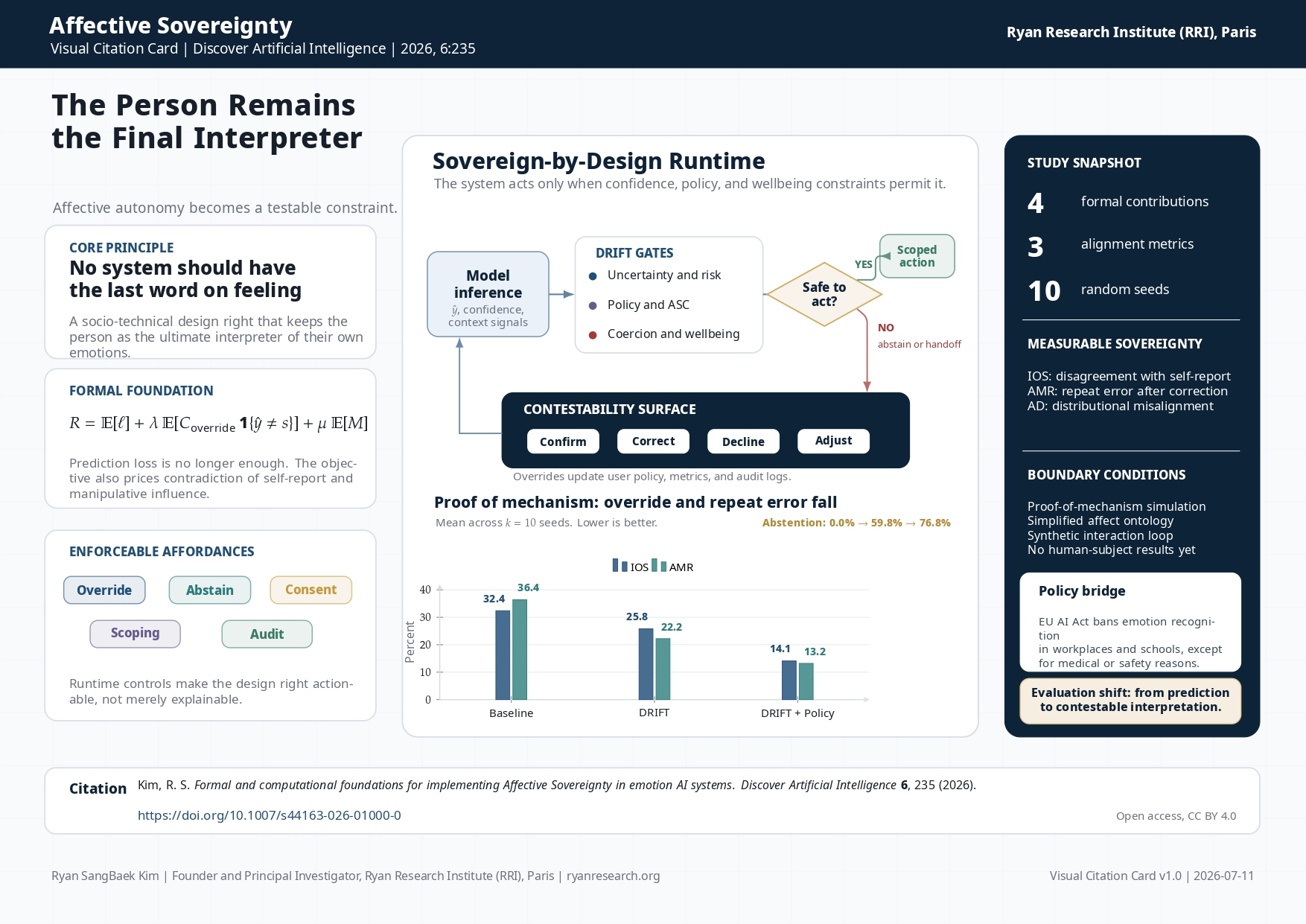
The visual citation card above summarizes the normative and technical foundation of this research program:
The person remains the final interpreter.
A few years ago, I watched a job candidate receive an automated rejection. The system had analyzed her video interview and scored her "enthusiasm" as low. She told me she had been nervous, not disengaged — and that in her culture, restraint is a sign of respect. There was no way to contest the score. No way to say, "That is not what I felt." The label was already in the file, and it outranked her.
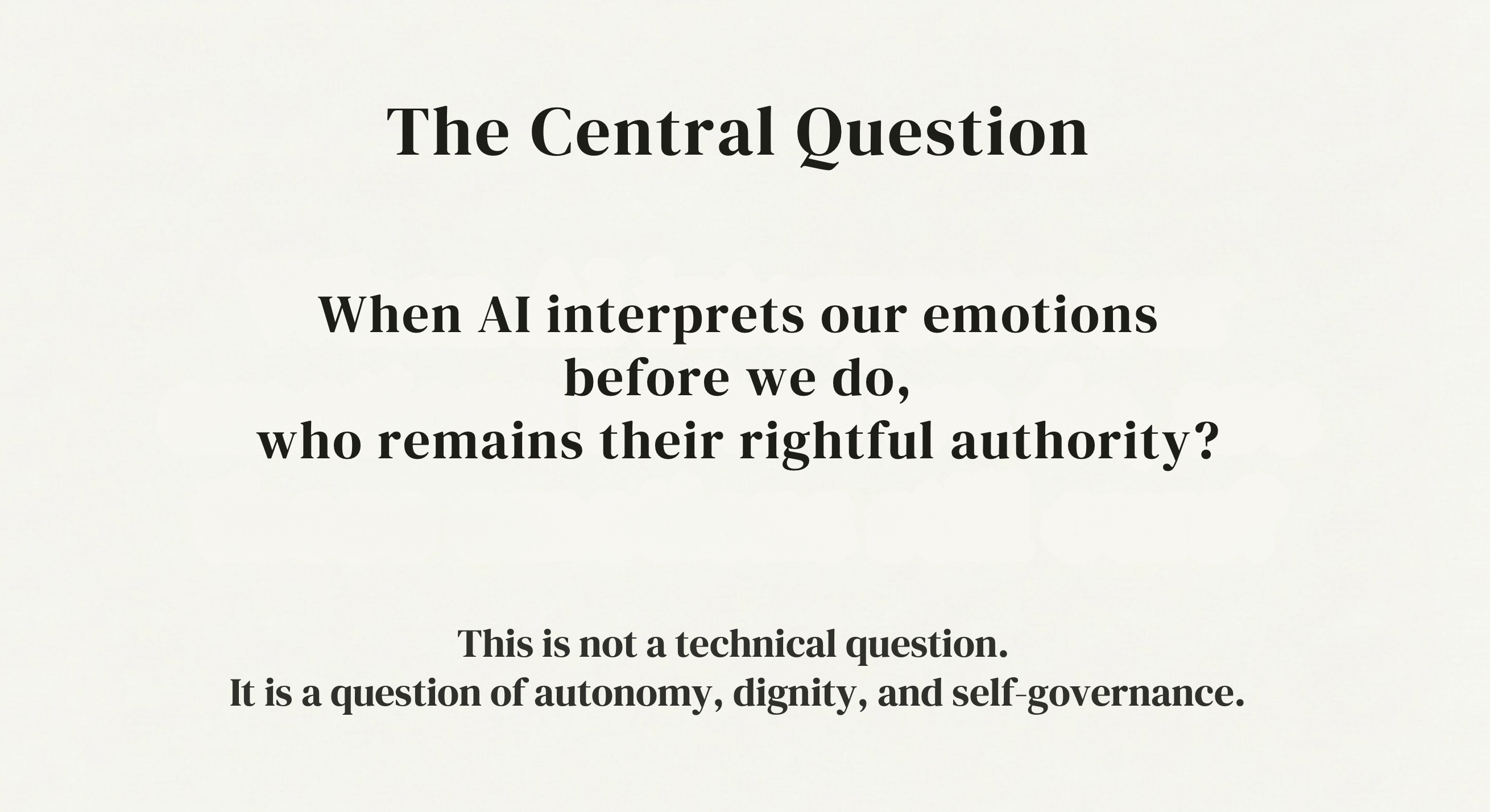
That moment did not leave me. Not because it was unusual, but because it was becoming ordinary. Emotion AI — systems that infer what we feel from our faces, voices, text, or physiology — is now embedded in hiring platforms, mental health apps, companion chatbots, driver monitoring, and customer service. The promise is personalization and care. The risk, I came to believe, is something deeper than misclassification. It is the quiet transfer of interpretive authority: the moment a system's label about your inner life begins to outrank your own.
I looked for a name for this problem. Privacy did not quite cover it — privacy protects data, but the issue here is meaning. Transparency was necessary but insufficient — knowing that a system read you as "anxious" does not give you the power to say, "No, I was tired." Fairness frameworks addressed demographic bias, but not the more fundamental asymmetry: that a statistical model was claiming to know someone's feelings better than the person themselves.
So I proposed a concept: Affective Sovereignty. The right to remain the final interpreter of one's own emotions.
From principle to formalism
The concept alone was not enough. Ethics guidelines are abundant in AI; enforcement is scarce. I wanted to ask a harder question: can you build sovereignty into the mathematics of a system — not as an afterthought, but as a structural constraint?
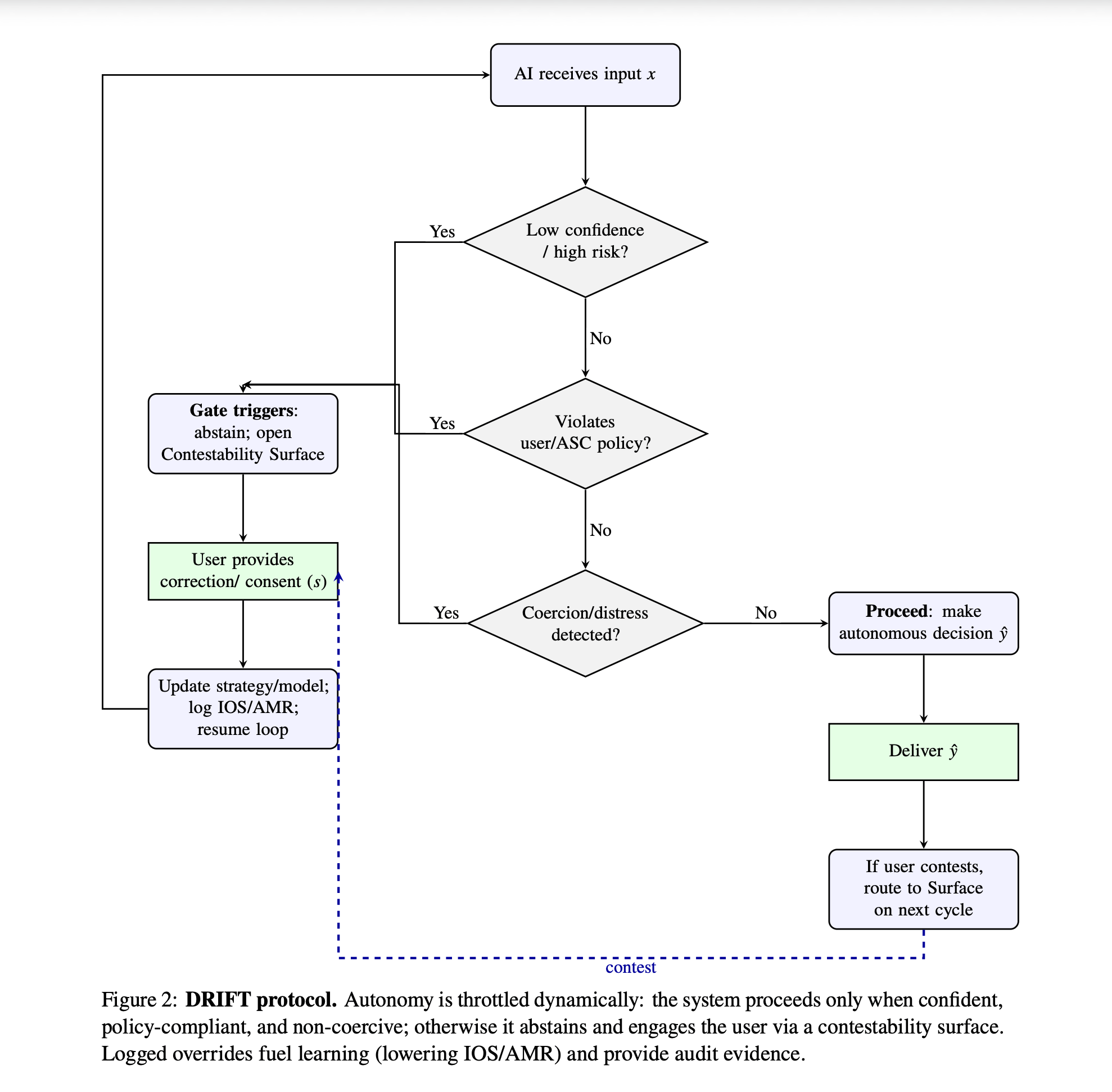
The paper that resulted, now published in Discover Artificial Intelligence, attempts exactly that. It decomposes the risk function of an emotion AI system into three terms: conventional prediction loss, an override cost that makes it expensive for the system to contradict a user's self-report, and a manipulation penalty that flags coercive or deceptive influence on emotional states. When the system is uncertain, or when a pending action would violate a user's stated preferences, the optimal policy is to abstain and ask — not to assert.
This is operationalized through what we call DRIFT: Dynamic Risk and Interpretability Feedback Throttling. DRIFT is a runtime protocol with a series of gates — uncertainty, policy compliance, coercion detection — that throttle the system's autonomy and route decisions to a contestability surface where the user can confirm, correct, or decline the system's reading.
We also introduced three alignment metrics. The Interpretive Override Score (IOS) measures how often the system contradicts the user's self-report. The After-correction Misalignment Rate (AMR) tracks whether the system repeats the same mistake after being corrected. Affective Divergence (AD) captures the distributional gap between what the model thinks you feel and what you report over time. Together, these make sovereignty auditable — not just declarable.
What the simulation showed
In proof-of-mechanism simulations, enforcing DRIFT with policy constraints reduced the Interpretive Override Score from 32.4% to 14.1%, and the repeat-error rate dropped from 36.4% to 13.2%. The cost was high abstention — roughly 70% of decisions were deferred to the user. That number might look like a flaw. I see it as the point. In domains where a system is interpreting your inner life, deferring to you is not inefficiency. It is respect.
These are simulation results, not field data. A preregistered human-subject study is planned. The claims are deliberately modest in method. But the implication is strong: when you price uncertainty and interpretive risk into the design, alignment improves without requiring any leap toward artificial general intelligence. Sovereignty is an engineering choice, not a philosophical luxury.
The road to this paper
The idea did not arrive in a single moment. It grew across disciplines — from psychoanalytic thinking about how meaning is constructed, through phenomenological accounts of first-person experience, to the regulatory architecture of the EU AI Act, which now places strict limitations on emotion inference in workplaces and schools but lacks the runtime mechanisms to enforce that prohibition at the point of inference.
I presented an earlier version of this framework at the SIpEIA Conference in Rome, under the theme "Accountability and Care." The response from philosophers, engineers, and legal scholars confirmed something I had suspected: the gap between ethical principles and technical enforcement is not just a policy problem. It is a design problem. And the design vocabulary did not yet exist.
This paper tries to supply part of that vocabulary. The Affective Sovereignty Contract (ASC) is a machine-readable policy layer that encodes user preferences and domain rules — disabling emotion inference in banned contexts, setting interruption budgets, specifying which emotions the system may even ask about. The Declaration of Affective Sovereignty, included in the paper, is not a constitutional charter but a normative design brief: eight testable tenets with measurable acceptance criteria and auditable hooks.
What this opens
The implications reach beyond emotion recognition. Any system that models, infers, or acts upon subjective human states — recommender systems shaping mood, therapeutic bots interpreting distress, companion agents managing attachment — faces the same question: who holds interpretive authority?
This paper is one element of a broader research program — one that examines how affective meaning is constructed, defended, and sometimes fractured, across computational, clinical, and narrative domains.
I believe the answer must be structural, not aspirational. Sovereignty must be embedded in objective functions, enforced at runtime, and measured over time. The person is the final arbiter of their inner life — not because self-reports are infallible, but because the alternative is a world in which machines quietly become the judges of what we feel.
Even the most perceptive AI should be counsel, never judge.

Ryan SangBaek Kim is the Founding Director and Principal Investigator of the Ryan Research Institute (RRI), Paris, and a Research Professor at Kwangwoon University in Seoul. His research examines affective and relational AI, human–AI interaction, interpretive authority, measurement validity, and the governance of computational inference.
He introduced Affective Sovereignty, a normative and design framework concerned with preserving first-person interpretive authority when AI systems infer emotions, mental states, intentions, or other features of human experience. His broader research programme investigates how such inferences are constructed, measured, stabilised, contested, and eventually converted into epistemic or institutional authority.
His peer-reviewed work has appeared in Communications AI & Computing, Acta Psychologica, PLOS ONE, Computers in Human Behavior Reports, Discover Artificial Intelligence, Machine Learning with Applications, and Data in Brief. Recent empirical work spans large-scale relationship narratives, normative-conflict behaviour in large language models, measurement dependence in emotion research, and reproducible computational approaches to affective AI.
Across this programme, one question remains central: when machines and institutions participate in interpreting human affective life, under what conditions can the person remain an active interpreter rather than merely the object of an inference?
Follow the Topic
-
Discover Artificial Intelligence
This is a transdisciplinary, international journal that publishes papers on all aspects of the theory, the methodology and the applications of artificial intelligence (AI).

Related Collections
With Collections, you can get published faster and increase your visibility.
Transforming Education through Artificial Intelligence: Opportunities, Challenges, and Future Directions
Artificial Intelligence (AI) is rapidly changing the educational field by enabling personalized learning, intelligent tutoring systems, automated assessments, learning analytics, and administrative automation.
This collection invites original research, systematic reviews, and visionary perspectives on the transformative impact of AI in education. It aims to explore how AI technologies can enhance equity, inclusion, and efficiency in educational settings across different contexts, including higher education, K-12, vocational training, and lifelong learning. This collection will address technical, pedagogical, ethical, and policy aspects, fostering interdisciplinary perspectives and evidence-based insights.
This Collection supports and amplifies research related to SDG 4 and SDG 9.
Keywords: Artificial Intelligence, AI in Education, Educational Technology, Data Analytics, AI Ethics
Publishing Model: Open Access
Deadline: Nov 30, 2026
Advanced AI Methods for Personalized Healthcare
The advancement of Artificial Intelligence (AI) technologies, especially Reinforcement Learning (RL) and Deep Learning (DL), is transforming healthcare, enabling innovative solutions for patient monitoring, diagnostics, and personalized treatment. These technologies facilitate the effective use of healthcare data and intelligent analytics, enhancing clinical decision-making and improving patient outcomes. AI is revolutionizing how healthcare is delivered, making it more proactive, efficient, and accessible. This Collection explores new methods and applications of AI for healthcare such as personalized healthcare. Contributions in this Collection showcase novel frameworks, case studies, and interdisciplinary approaches that drive the future of personalized healthcare, fostering innovations that bridge technology and patient care.
In this context, we are inviting original research articles, reviews, and perspective papers addressing (but not limited to) the following themes:
- Personalized medicine
- IRL for dynamic treatment regimes
- Wireless sensor networks for patient monitoring
- Identification and prevention of critical condition
- Monitoring systems within the medical devices contest
- Methodologies and tools for the rapid integration of WSNs, IoT and AI in health monitoring
- Behavior analysis of patients
- Personalized health-promoting interventions
- Ambient assisted living and active assisted living
- AI security and privacy models for healthcare applications
- AI methods for rehabilitation
Publishing Model: Open Access
Deadline: Feb 27, 2027