Why Are There Fewer Tropical Cyclones in the Southern Hemisphere?
Published in Earth & Environment






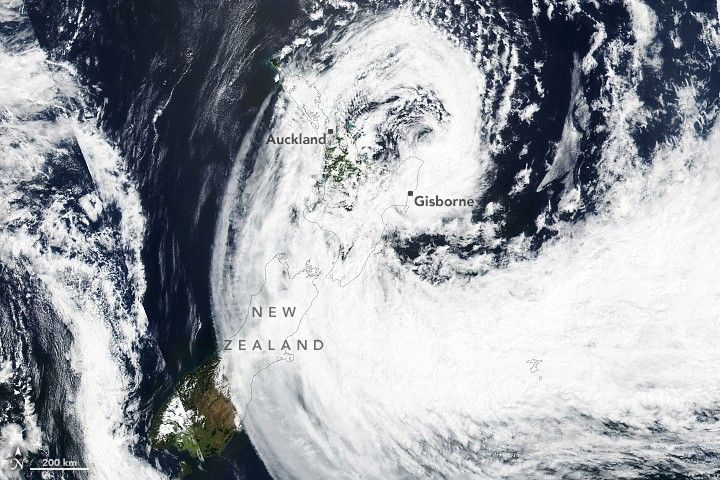
Over the past 45 years, tropical cyclones in the Southern Hemisphere have become less common. From 1980 to 2024, the number of tropical cyclones dropped by nearly 30%. This decline is much clearer than anything observed in the Northern Hemisphere.
This raises an important question: Why are there fewer tropical cyclones in the Southern Hemisphere today than there were four decades ago?
At first, we thought the answer would be straightforward. Instead, it led us down a path filled with surprises, frustration, and eventually a completely new way of thinking about tropical cyclone changes.
When the usual explanation did not work
Scientists usually explain changes in tropical cyclone numbers using large-scale environmental conditions. Factors such as atmospheric humidity, vertical wind shear, and large-scale circulation are known to influence whether tropical cyclones can form.
The logic seemed simple. If tropical cyclones were becoming less frequent, then the environment should have become less favorable for cyclone formation.
But that is not what we found.
Almost every environmental factor we examined suggested the opposite. Many of the long-term changes actually pointed toward conditions that should support more tropical cyclones, not fewer.
The results were so unexpected that we thought something must be wrong. We checked our code, repeated the calculations, and carefully examined the data. We even wondered whether we had downloaded the wrong files. To make sure, we repeated the analysis using several independent datasets from research centers in the United States, Europe, and Japan.
The answer never changed.
The traditional environmental factors could not explain the decline in tropical cyclones. In fact, they often suggested that cyclone activity should have increased.
Next, we looked at tropical cloud clusters, which are the disturbances from which many tropical cyclones develop. If cyclone numbers were decreasing, perhaps the number of cloud clusters had also declined.
Again, the observations surprised us. Satellite records showed that cloud clusters have actually become more common since the 1980s, even while tropical cyclone numbers have fallen.
Another explanation had reached a dead end.
Looking beyond the average climate
At this point, we realized that the answer might not lie in the average climate conditions.
Instead, we turned our attention to the Madden–Julian Oscillation (MJO), a large-scale tropical weather system that travels eastward around the globe every few weeks.
The MJO has active and inactive phases. During its active phase, rainfall, convection, and atmospheric circulation become stronger, creating favorable conditions for tropical cyclone formation. During its inactive phase, cyclone formation is suppressed.
Because these active and inactive phases often cancel each other out when averaged over long periods, the MJO is rarely considered a major driver of long-term tropical cyclone trends.
But we wondered whether long-term changes in the MJO active phases could be affecting tropical cyclone activity.
The answer was yes.
The missing piece of the puzzle
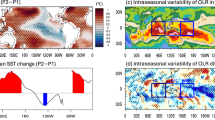
We found that the active phases of the MJO have weakened steadily since 1980, especially over the South Indian Ocean and South Pacific Ocean, where many Southern Hemisphere tropical cyclones form.
As the MJO weakened, the atmosphere became less favorable for cyclone development. Low-level cyclonic rotation weakened, upward motion decreased, and the middle atmosphere became drier.
These changes made it harder for tropical cyclones to form.
Most importantly, about 80% of the observed decline in tropical cyclone frequency occurred during the active phases of the MJO. Although these active phases account for only a relatively small fraction of total days, they explain most of the long-term decrease in cyclone numbers.
Why did the MJO weaken?
Once we identified the MJO as the key factor, we wanted to know why it had weakened.
The evidence points to changes in the tropical Pacific Ocean. Since 1980, the central and eastern Pacific have experienced cooling. This cooling reduced the heat and moisture available to support strong MJO activity. As a result, the circulation associated with the MJO gradually weakened.
A weaker MJO means weaker atmospheric circulation, less favorable conditions for cyclone formation, and ultimately fewer tropical cyclones.
A new way of understanding tropical cyclone change
Our findings suggest that long-term changes in tropical cyclone activity cannot always be explained by changes in average climate conditions alone. Short-term climate variations can also play a major role when their characteristics change over time.
In the Southern Hemisphere, the weakening of the MJO appears to be the main reason why tropical cyclone numbers have declined over the past four decades.
This discovery provides a new perspective on how climate variability can influence tropical cyclones. It also highlights the importance of accurately representing the MJO in climate models, which will help us better predict how tropical cyclone activity may change in the future.
Follow the Topic
-
Communications Earth & Environment
An open access journal from Nature Portfolio that publishes high-quality research, reviews and commentary in the Earth, environmental and planetary sciences.

Related Collections
With Collections, you can get published faster and increase your visibility.
Ecological resistance and resilience under global change
Publishing Model: Open Access
Deadline: Apr 07, 2027
Hazards in Mountain Regions
Publishing Model: Open Access
Deadline: Nov 02, 2026


