"Why study rain where it hardly rains?"
Published in Social Sciences, Earth & Environment, and Agricultural & Food Science





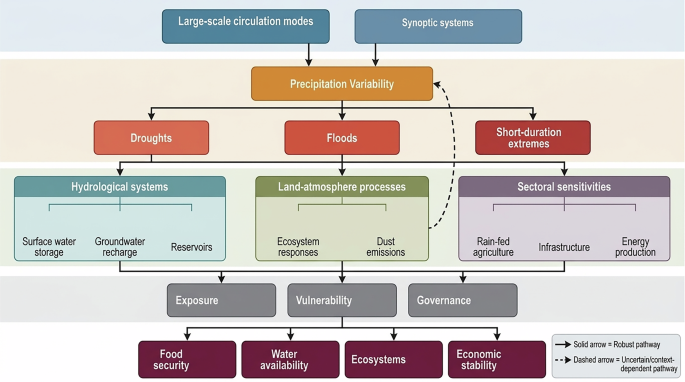

North Africa contains one of the driest regions on Earth, so why spend years studying its rainfall? The answer gradually became the central message of this paper.
In North Africa, rainfall is never just rainfall. A single storm can replenish an oasis, recharge an aquifer, trigger a flash flood, or determine the success of an agricultural season. In places where annual rainfall is measured in only a few tens of millimetres, every rainfall event matters.
Looking beyond drought
When climate risks in North Africa are discussed, drought naturally dominates the conversation. Yet, as we reviewed the literature, many studies describing water shortages, crop losses or flood disasters were actually telling a broader story. Their results depended on precipitation variability, not simply on drought.
Despite this, precipitation variability was rarely treated as a research topic in its own right. Atmospheric scientists studied circulation patterns, hydrologists focused on runoff and groundwater, agronomists on crop production, and ecologists on ecosystem responses. Each discipline was examining part of the same picture in different scales and contexts.
This review grew from a simple question: what can we learn by placing precipitation variability at the centre of the discussion?
A region of contrasts
Working on this review also reminded us how diverse North Africa really is. The region is often reduced to the image of the Sahara, yet it encompasses Mediterranean mountains, Atlantic coastlines, semi-arid steppes, oasis systems and one of the world's largest deserts.
This diversity is reflected in its climate. Mediterranean cyclones, Atlantic storm tracks, cut-off lows, Rossby wave breaking, tropical moisture intrusions and the Sahara Heat Low interact to produce remarkable contrasts in rainfall across the region. Understanding precipitation variability meant constantly linking atmospheric dynamics with their impacts on water resources, agriculture, ecosystems and society.
The challenge of speaking several scientific languages
One of the biggest challenges was bringing together disciplines that rarely communicate with one another. Atmospheric scientists, hydrologists, agronomists and social scientists often use different concepts, methods and terminology, even when studying the same events.
One objective of this review was therefore to connect these perspectives and show how atmospheric processes cascade through natural and human systems.
A manuscript that kept evolving
Like many papers, this review changed considerably during peer review. The reviewers encouraged us to clarify the conceptual framework, strengthen the discussion of atmospheric mechanisms and improve the overall structure. The process was long, but the manuscript became much stronger because of it.
A different perspective
By the time we completed the review, I found myself answering that original question differently.
Why study precipitation in places where it hardly rains? Because these are precisely the places where every rainfall event can have disproportionate consequences. North Africa reminds us that climate is not defined only by averages. It is also shaped by variability, by extremes and by the way atmospheric processes interact with human societies. As climate change alters not only the amount of rainfall but also its timing and intensity, understanding precipitation variability becomes increasingly important.
I hope this review encourages readers to look beyond drought or floods and consider precipitation variability as a climate risk in its own right. Writing this review convinced me that precipitation variability deserves far more attention than it currently receives. I hope it encourages researchers from different disciplines to look beyond rainfall totals and explore the many ways in which variability shapes both natural and human systems.

Follow the Topic
-
Communications Earth & Environment
An open access journal from Nature Portfolio that publishes high-quality research, reviews and commentary in the Earth, environmental and planetary sciences.

Related Collections
With Collections, you can get published faster and increase your visibility.
Ecological resistance and resilience under global change
Publishing Model: Open Access
Deadline: Apr 07, 2027
Hazards in Mountain Regions
Publishing Model: Open Access
Deadline: Nov 02, 2026

