Need for Increased NIH Funding for Clinical Research Projects Applying ML
Published in Healthcare & Nursing
I am a research fellow interested in machine learning (ML) and artificial intelligence (AI), so I have been closely monitoring the national trend toward integrating ML and AI into clinical research and have observed the rapid growth of medical literature about applying ML techniques in clinical medicine. I am also a Hospitalist and am soon to be a cardiology fellow, and through my work, I have noted that in clinical practice in the real world, there is little application of ML and AI techniques.
Last year, I listened to a National Institutes of Health (NIH) workshop on harnessing AI and ML to advance biomedical research. In that workshop, Dr. Francis Collins, director of the NIH, stated that “The advent of artificial intelligence and machine learning, big data, cloud computing, and robotics may represent the Fourth Industrial Revolution.”
My team and I became interested in how NIH was investing in ML and AI because we realized that for ML and AI to become mainstream tools which improve clinical practice and patient care, there needed to be financial investment in research and training in these burgeoning technologies.
To ascertain what funding was already being allocated, we examined NIH’s Research Portfolio Online Reporting Tools Expenditures and Results (RePORTER) to determine NIH-funded clinical research projects applying ML techniques in 2017. We focused on projects that used population and clinical research data and excluded projects focused on basic sciences research.
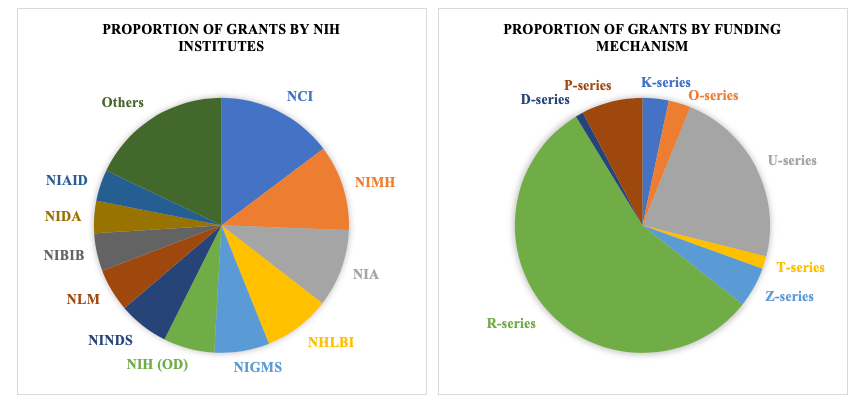
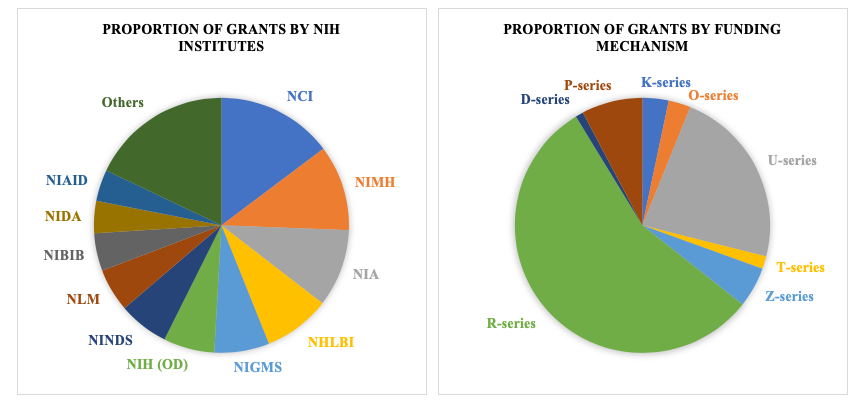
As a result, we were able to identify 535 clinical research projects that had applied ML in 2017. We found that these projects received a total of $264 million, accounting for only 2% of NIH’s $12,695-million extramural budget for clinical research, and only 15 of 27 agencies of the NIH funded more than 10 ML-applying projects. Furthermore, ML projects that focused on training the next generation of scientists received relatively little support.
The graphs below break down grants by funding mechanism and by institution.
We believe that an increase in NIH funding for ML projects would result in better leveraging the potential of ML/AI and could support the advance of ML research in clinical medicine. Additionally, training and career development awards in ML are crucial to provide time and funds for early-career scientists and physicians to acquire knowledge in applying ML in clinical research.
We hope that our study inspires increased NIH funding for clinical research projects applying ML. We will continue to monitor the ML/AI integration into projects improving clinical practice and hope to be an integral part of the progress in this field.

Follow the Topic
-
npj Digital Medicine
An online open-access journal dedicated to publishing research in all aspects of digital medicine, including the clinical application and implementation of digital and mobile technologies, virtual healthcare, and novel applications of artificial intelligence and informatics.

Related Collections
With Collections, you can get published faster and increase your visibility.
Synthetic Clinical Data and Privacy-Preserving Frameworks for Trustworthy Health AI
Publishing Model: Open Access
Deadline: Jun 03, 2027
Digital Biomarkers for Enabling Proactive Clinical Decisions
Publishing Model: Open Access
Deadline: May 18, 2027