A Crisis, A Question, A Program: The Story Behind the PRMD Moral Distress Intervention
Published in Healthcare & Nursing



The Story Behind the Paper
During the COVID-19 pandemic, Iranian hospitals—especially psychiatric wards—became arenas of intense ethical tension. Nurses found themselves trapped between knowing the morally right action and being unable to carry it out because of staff shortages, organizational constraints, overwhelming workloads, or conflicting orders. We witnessed skilled and compassionate nurses experiencing guilt, frustration, powerlessness, and emotional exhaustion as ethical dilemmas multiplied around them.
These real-world challenges raised an urgent question for us:
Why do Iranian nurses experience persistent moral distress, and what kind of intervention—rooted in local culture, conditions, and organizational realities—can truly alleviate it?
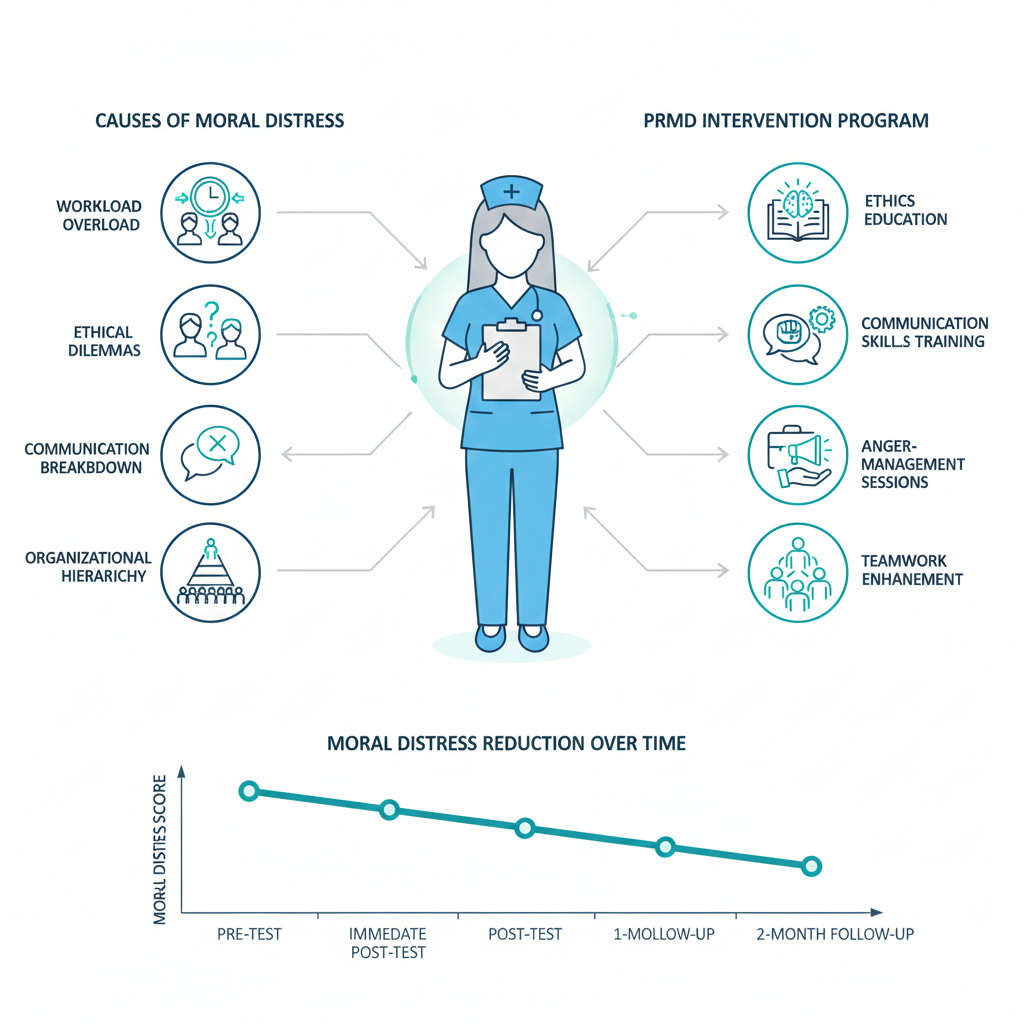
Through interviews with front-line nurses, we repeatedly heard stories of unfair workload distribution, poor communication across teams, aggressive patient behavior, hierarchical cultures that silenced nurses, and direct exposure to ethically troubling situations. These encounters were the spark that motivated us to design a structured, culturally grounded program to reduce moral distress.
Conceptual Framing—Bringing Theory to Life
Our study drew upon three guiding perspectives:
-
Professional Nursing Ethics: Highlighting how ethical knowledge, moral sensitivity, decision-making skills, and institutional support can strengthen nurses’ moral resilience.
-
Pragmatic Educational Philosophy: Emphasizing that ethics cannot be taught only through lectures; it must be practiced and reflected upon through real cases, storytelling, and interactive learning.
-
A Multidisciplinary Lens: Integrating medical ethics, nursing management, communication science, and program planning to create a multi-layered intervention.
Our premise was clear:
Moral distress is not caused by a single deficit. It is the result of interconnected individual, managerial, organizational, and relational factors. Only a multi-dimensional intervention can meaningfully reduce it.
Methodology – Systematic Design of an Educational Intervention
To explore this complexity and design a suitable solution, we adopted a multiphase mixed-methods design:
-
Qualitative Phase:
Interviews with 12 nurses revealed the roots of moral distress—deficient professional competency, inadequate communication, hierarchical organizational culture, high workload, poor task allocation, personal ethical uncertainty, and witnessing moral dilemmas. -
Program Design (PRMD):
Using the Ewles & Simnett Model, we developed an intervention that combined educational, managerial, and environmental strategies. Ethics workshops, case-based discussions, communication training, anger-management sessions, moral storytelling, and virtual learning activities were incorporated. -
Program Implementation:
Forty nurses participated in the 3-month program, which included face-to-face classes, virtual sessions, ethics discussions, managerial meetings, and scenario-based exercises. -
Program Evaluation:
Using a pre-test and repeated post-tests alongside a secondary qualitative phase, we assessed the program’s effects at four intervals.
This structured, evidence-driven process allowed us to design a culturally consistent program grounded in both empirical data and practical realities.
Key Findings—What the Evidence Revealed
-
A significant reduction in moral distress:
Quantitative results showed a steady, meaningful decline in the frequency, intensity, and total moral distress scores immediately after the intervention and at one- and two-month follow-ups. -
Moral empowerment of nurses:
Nurses reported improved ethical awareness, stronger decision-making abilities, greater confidence, and a clearer understanding of ethical principles. -
Enhanced ethical climate:
Better workload management, improved task allocation, and greater managerial involvement contributed to a more supportive, fair, and ethical work environment. -
Improved communication and teamwork:
Through discussions, scenario-based learning, and communication training, nurses experienced better interactions with colleagues and patients.
Together, these findings showed that moral distress is not simply an emotional burden—it is shaped by education, culture, management, and workplace structures.
Why This Matters—The Iranian Nursing Lens
Iran’s health system faces chronic nursing shortages, heavy workloads, and hierarchical clinical cultures. Existing international moral distress interventions do not align with local realities: they overlook cultural norms, resource limitations, and ethical expectations specific to Iranian nurses.
Our study is rooted in Iranian nurses’ lived experiences and responds directly to their needs. The PRMD program is one of the first comprehensive, evidence-based, and culturally adapted interventions for reducing moral distress in Iran.
Policy and Practice Implications—Beyond Education
One message is clear:
Moral distress cannot be reduced through education alone. Organizational transformation is essential.
We recommend:
-
Meaningful participation of nurses in clinical and managerial decision-making
-
Establishment of active ethics committees in hospitals
-
Continuous ethics education with real cases and scenarios
-
Redesigning task allocation and workload systems
-
Strengthening interprofessional communication
-
Managerial engagement in creating an ethical climate
These changes can elevate ethical quality, reduce emotional burden, and enhance the well-being of nurses and patients alike.
Why the Timing Matters
Published in 2023, this paper emerged in the aftermath of COVID-19, when nurses had endured unprecedented ethical pressures. The timing is critical: the health system must now rebuild not only its physical capacity but also the moral and psychological resilience of its frontline workforce.
Personal Motivation – A Moral Commitment
For us as researchers, this project was more than an academic endeavor—it was a moral obligation. Iranian nurses navigate complex ethical landscapes with limited support, yet they continue to strive for compassionate and just care. Many shared their pain quietly, without institutional recognition or emotional support.
We felt responsible for amplifying their voices, translating their struggles into evidence, and creating a pathway toward meaningful change.
Conclusion
This study builds bridges between nursing ethics, healthcare management, education, and organizational justice.
We hope it inspires broader conversations and future action towards a workplace where:
no nurse stands alone in ethical distress.
no moral dilemma goes unaddressed.
and ethical practice becomes a shared, supported responsibility.

Follow the Topic
-
BMC Medical Education
This is an open access journal publishing original peer-reviewed research articles in relation to the education and training of healthcare professionals. It welcomes studies on students and professionals across all levels of education; education delivery aspects; and other education-related topics.

Related Collections
With Collections, you can get published faster and increase your visibility.
Disability in medical education
BMC Medical Education welcomes submissions to our Disability in medical education Collection. As disability impacts so much of our patient population, medical curricula must evolve to address gaps in knowledge, attitudes, and clinical care. Incorporating disability-specific education strengthens inclusive education practices, reduces disparities, and prepares clinicians to deliver person-centered care. Innovative tools, assessments, and instructional approaches, from simulation training to standardized patient encounters to Universal Design for Learning, can be leveraged to improve learners’ understanding of access, communication, ethical, other considerations in clinical practice.
We welcome research covering topics including but not limited to:
• Development and integration of disability curriculum within medical education
• Teaching strategies that promote competency in caring for patients with disabilities
• The role of inclusive education and Universal Design for Learning in clinical training
• Evaluation tools and assessment methods for measuring disability-related knowledge and skills
• Use of patient narratives, simulation, and standardized patients with disabilities in clinical teaching
• Interprofessional education initiatives focused on accessibility and patient-centered care
• Addressing barriers within healthcare training environments
By emphasizing innovation and access, this work supports the development of a medical workforce equipped to deliver compassionate, equitable care for all patients.
All manuscripts submitted to this journal, including those submitted to collections and special issues, are assessed in line with our editorial policies and the journal’s peer review process. Reviewers and editors are required to declare competing interests and can be excluded from the peer review process if a competing interest exists.
This Collection supports and amplifies research related to SDG 4: Quality Education and SDG 10: Reduced Inequalities.
Publishing Model: Open Access
Deadline: Dec 07, 2026
Gamification and virtual reality in medical education and related healthcare professions - Part II
BMC Medical Education calls for submissions to our Collection, Gamification and virtual reality in medical education and healthcare professions - Part II. Fueled by the COVID-19 pandemic, digital teaching formats enhanced by interactive elements have received growing attention from higher education institutions worldwide. While the inclusion of game-based elements (‘gamification’) appears feasible in a number of contexts other than the healthcare sector, virtual reality appears to be especially appealing to medical educators. At the same time, given the potential cost, the use of gamification elements as well as sophisticated software and hardware in order to simulate clinical environments needs to be justified, particularly on the basis of concepts in learning psychology to suggest that these elements will be superior to traditional instructional formats or that they can help achieve learning outcomes that have not been covered in the past.
Most studies on gamification and virtual reality in medical education that have been published to date merely represent descriptions of innovations, and only a few present a thorough rationale for their use or present results of prospective, controlled effectiveness trials with meaningful endpoints (i.e., objective performance indicators linked to the intended learning outcomes). There is a lack of justification and clarification studies, and evaluations of innovations going beyond mere student satisfaction are needed. In order to be able to decide in favor or against the integration of game-based formats and virtual reality sessions in formal curricula, educators need to have access to original studies, reviews, and recommendations on when and how these elements should be employed.
Articles can cover the entire range of health-profession education, including but not limited to undergraduate and postgraduate medical education, nursing, midwifery, physiotherapy, pharmacology, public health, and related fields.
Key themes include:
- Application of concepts from learning psychology to medical education with a focus on gamification and/or virtual reality
- Comparison of traditional instructional formats to innovative approaches including gamification and/or virtual reality with regard to meaningful educational outcomes
- Cost-effectiveness assessments for innovative technology-based solutions compared to a traditional approach
- Constructive alignment between intended learning outcomes, use of gamification and/or virtual reality elements, and formative/summative assessments.
- Added value of gamification/virtual reality elements if used as a supplement to or as a replacement for traditional teaching; effects on curriculum structure and student workload
- Sustainability of new technologies with regard to computing power and waste management of virtual reality devices
All manuscripts submitted to this journal, including those submitted to collections and special issues, are assessed in line with our editorial policies and the journal’s peer review process. Reviewers and editors are required to declare competing interests and can be excluded from the peer review process if a competing interest exists.
This Collection supports and amplifies research related to SDG 3: Good Health and Well-Being.
Publishing Model: Open Access
Deadline: Jan 11, 2027