A fiery dance of fire and thunder: Multiphase turbulent flow explains lightning rings in volcanic plumes
Published in Earth & Environment



Volcanic eruptions can cause disasters but also captivate our imagination with their dramatic displays. While we often associate them with fiery flowing lava and gigantic plumes of ash and water vapor, one fascinating aspect of explosive eruptions is that they are frequently accompanied by lightning. Volcanic lightning is a testament to the complex interactions between volcanic activity and the Earth's atmosphere, combining different natural forces, and making the study of volcanoes a continual source of scientific questions.
Volcanic plumes can trigger a wide range of atmospheric phenomena, from lightning strikes and thunderclaps to ash rain. Lightning strikes in these volcanic storms can be more frequent and intense than in typical thunderstorms, making eruption sites even more spectacular. An eruption can unleash a chaotic blend of intense heat, water vapor, and volcanic solid particles high into the atmosphere. As these particles rise, they collide and generate static electricity, similar to what occurs to hydrometeors in a regular thunderstorm. Charge buildup can lead in turn to lightning. However, many volcanic eruptions display patterns of lightning activity with such a regular symmetry, extension, or periodicity, that are unlike any usual thunderstorm. The origin of such unusual order in volcano-atmospheric activity is not fully understood.
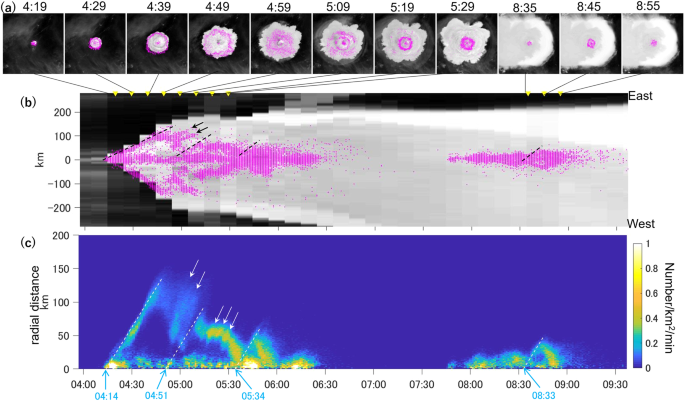
An extreme example of this phenomenon was recently given by Hunga-Tonga Hunga Ha’apai (HTHH), a submarine caldera volcano of the Tonga archipelago. HTHH generated a gigantic eruption on January 15, 2022, with unprecedented power since the advent of modern instrumental recording. Some of the record-breaking features of this eruption include the generation of a plume taller than 55 km, and umbrella cloud that expanded to a diameter of 400 km in less than one hour, and the excitation of multiple geophysical waves propagating globally through the atmosphere, the ocean, and the solid Earth. Perhaps one of the most striking phenomena in this eruption was the highest concentration of lightning events ever recorded, with almost 400,000 strokes over six hours, or more than 5,000 strokes per minute. These lightning events produced a prominent and glaring circular ring centered over the volcanic vent, which survived for long times and expanded and contracted around a well-defined mean radius.
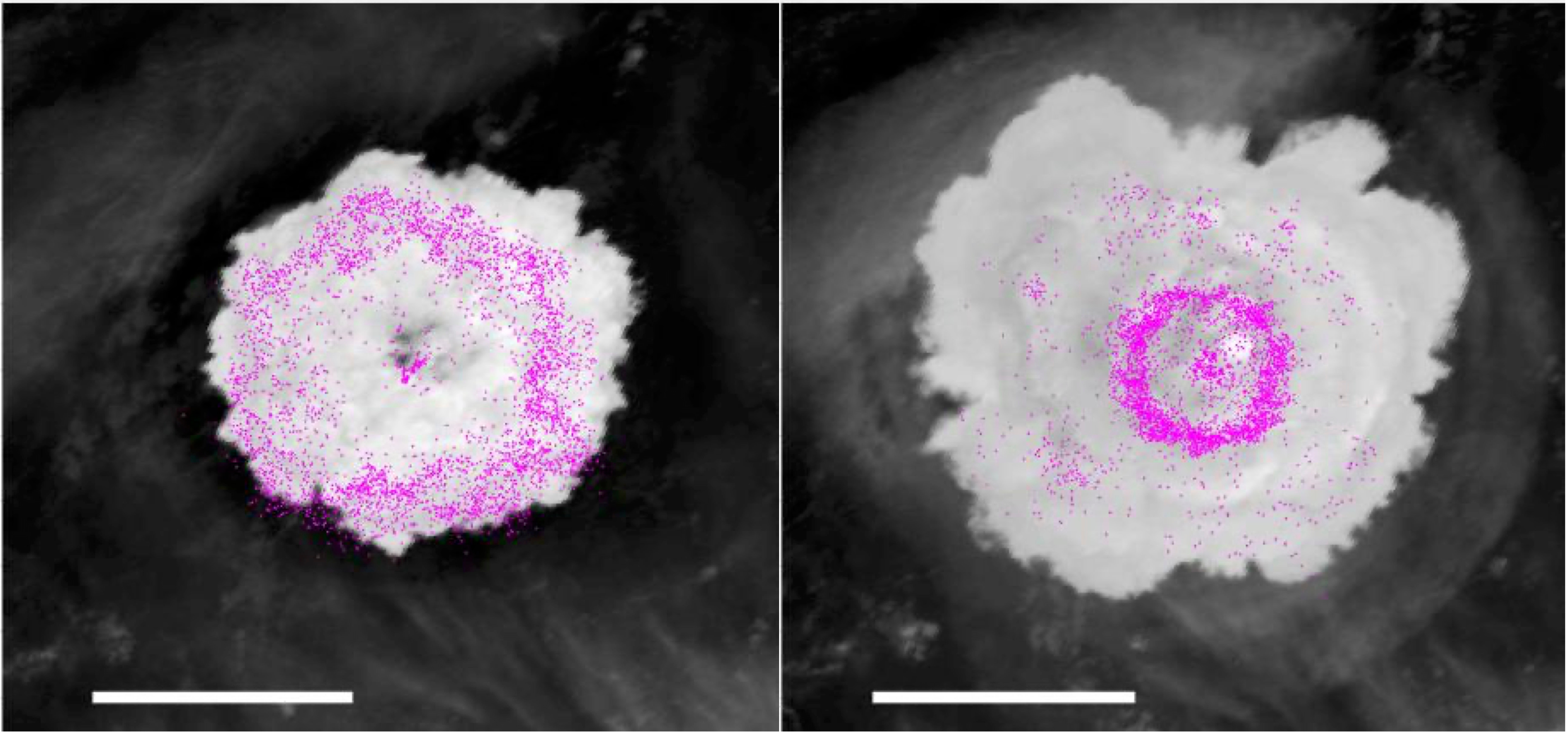
Observed lightning rings during the January 15, 2022, eruption of Hunga-Tonga Hunga-Ha’apai volcano. Lightning sources at 4:49 (left) and 5:19 (right) UTC, superposed on Himawari-8 satellite images. The volcanic cloud can be seen in light shades of gray, while lightning events are marked by magenta dots. The bottom white line shows a scale of 200 km.
A chance encounter
Opposite to these extreme events of nature, in the calm and sunny beaches of California, three of us, a volcanologist and two physicists, met at The Kavli Institute for Theoretical Physics at the University of California, Santa Barbara. We quickly recognized that our diverse backgrounds and interests, combining physical volcanology, atmospheric physics, and turbulence, were the perfect blend to tackle this interdisciplinary problem that combines Earth and atmospheric dynamics. While quickly setting up the first numerical simulations, the team had been completed by lightning specialists - a volcanologist and a meteorologist - to combine atmospheric observations, volcanic data, numerical simulations, and theory.
Our aim was to reproduce certain key features of the observations using three-dimensional numerical simulations of plumes rising in the atmosphere. The plumes had to contain different types of particles, as the collisions between particles are believed to give rise to the electrification of the umbrella cloud, in the same way electrostatic charges appear when a balloon is rubbed against our hair. Our main question was: What are the mechanisms behind the electrification and the symmetric rings observed in HTHH and other volcanic eruptions?
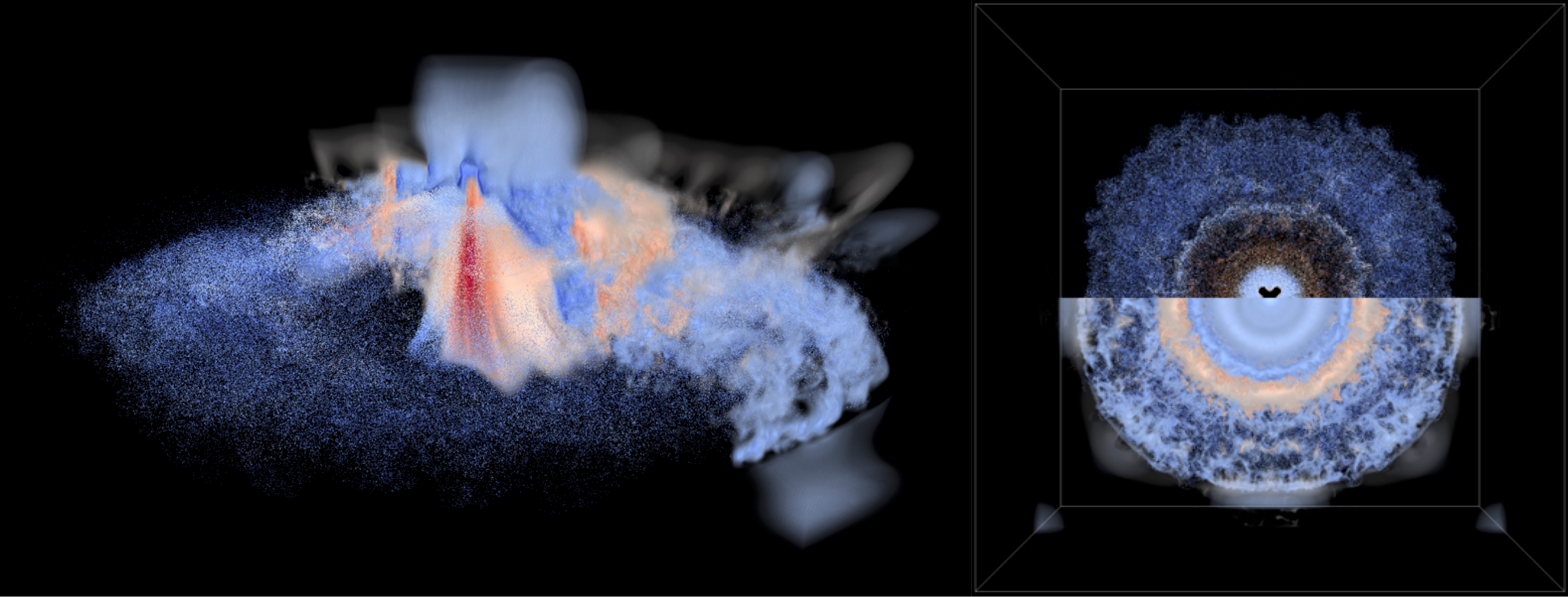
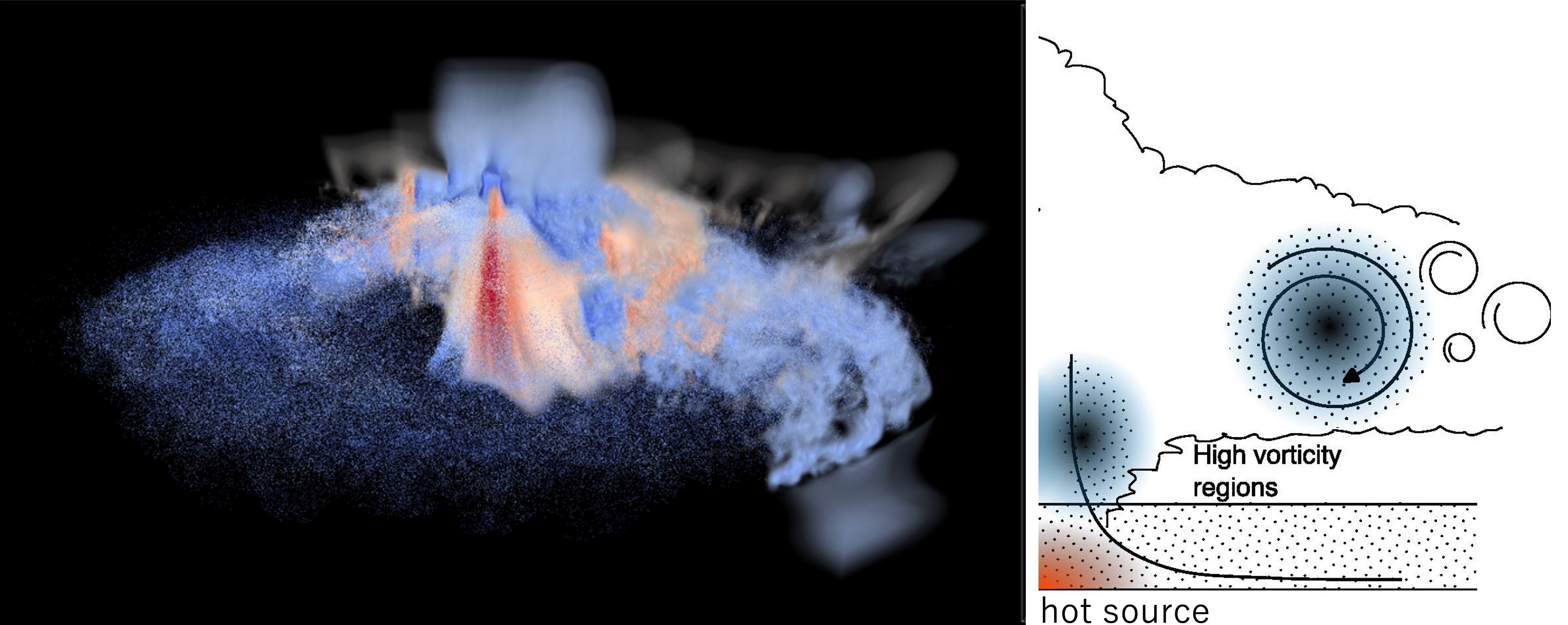
A numerical simulation of a volcanic turbulent plume rising in a stratified atmosphere, seen from the side (left) and from the top (right). The blue dots indicate particle positions, while the shaded regions indicate vertical velocities (from blue to red indicating negative to positive velocities). Note the concentric circular rings of particles.
Turbulence brings order to chaos
Turbulence is the complex and chaotic motion of fluids, characterized by irregular swirling eddies and by strong fluctuations in their velocity. In the atmosphere it often occurs when layers of air with different temperatures, densities, and wind speeds interact. In a volcanic plume, the intense differences in the velocity and density of the ejected gas-particle mixture can lead to very strong turbulence, resulting in abrupt and unpredictable changes in the system dynamics. However, although we often associate the phenomenon of turbulence with disorder, in some cases turbulence can also bring order to chaos.
This is the case of particles that are advected by a turbulent flow. While we daily use turbulent flows to mix fluids (e.g., when we stir sugar in our tea, to ensure it dissolves evenly), turbulence can also “unmix” heavy particles, segregating and separating them into clusters. When this happens particles in a cluster accumulate together, colliding more often. This is also the case in our simulations of a volcanic plume: the heavy particles raised into the umbrella cloud accumulate in a localized region of strong turbulence forming a ring, generating also an annular gap of particles between the central plume and the expanding umbrella cloud. Our simulations also reveal that this ring initially expands with the umbrella cloud, and fluctuates at 40 km while the cloud front continues to move radially outwards. Particles in this ring can then collide, possibly generating electrification unleashing lightning.
Understanding cloud electrification is a crucial problem in atmospheric dynamics, with broad implications for weather prediction and climate change. Volcanic eruptions provide an extreme example of this process, with their dazzling and dangerous thunderstorms. The volatile conditions in these storms provide new insights on the mechanisms behind cloud electrification, as well as on eruption conditions controlling the generation of hazardous geophysical events. And yet again, the intriguing phenomenon of turbulence reveals itself central for our understanding of complex processes in our environment, playing a key role in the formation of lightning rings.
Follow the Topic
-
Communications Earth & Environment
An open access journal from Nature Portfolio that publishes high-quality research, reviews and commentary in the Earth, environmental and planetary sciences.

Related Collections
With Collections, you can get published faster and increase your visibility.
Hazards in Mountain Regions
Publishing Model: Open Access
Deadline: Nov 02, 2026
Carbon Dioxide Removal
Publishing Model: Hybrid
Deadline: Jan 16, 2027



Please sign in or register for FREE
If you are a registered user on Research Communities by Springer Nature, please sign in