


Carbon is constantly moving through our planet. At Earth’s surface, it cycles through the atmosphere, oceans, rocks and living organisms. Some of this carbon, however, enters a much deeper and longer cycle. When an oceanic plate sinks into the mantle, carbon stored within the slab can be carried hundreds of kilometres into Earth’s interior.
For decades, studies of this deep carbon cycle have focused on several fundamental questions: How much carbon can be transported into the mantle? How deep can it travel? In what minerals or fluids is it stored? And how does it influence processes such as melting, redox reactions and volcanic degassing?
These questions have greatly advanced our understanding of carbon circulation between Earth’s surface and interior. Yet they leave another possibility largely unexplored: Can recycled carbon actually reorganize the minerals of the mantle strongly enough to reshape its internal structure?
A possible fingerprint deep in the mantle
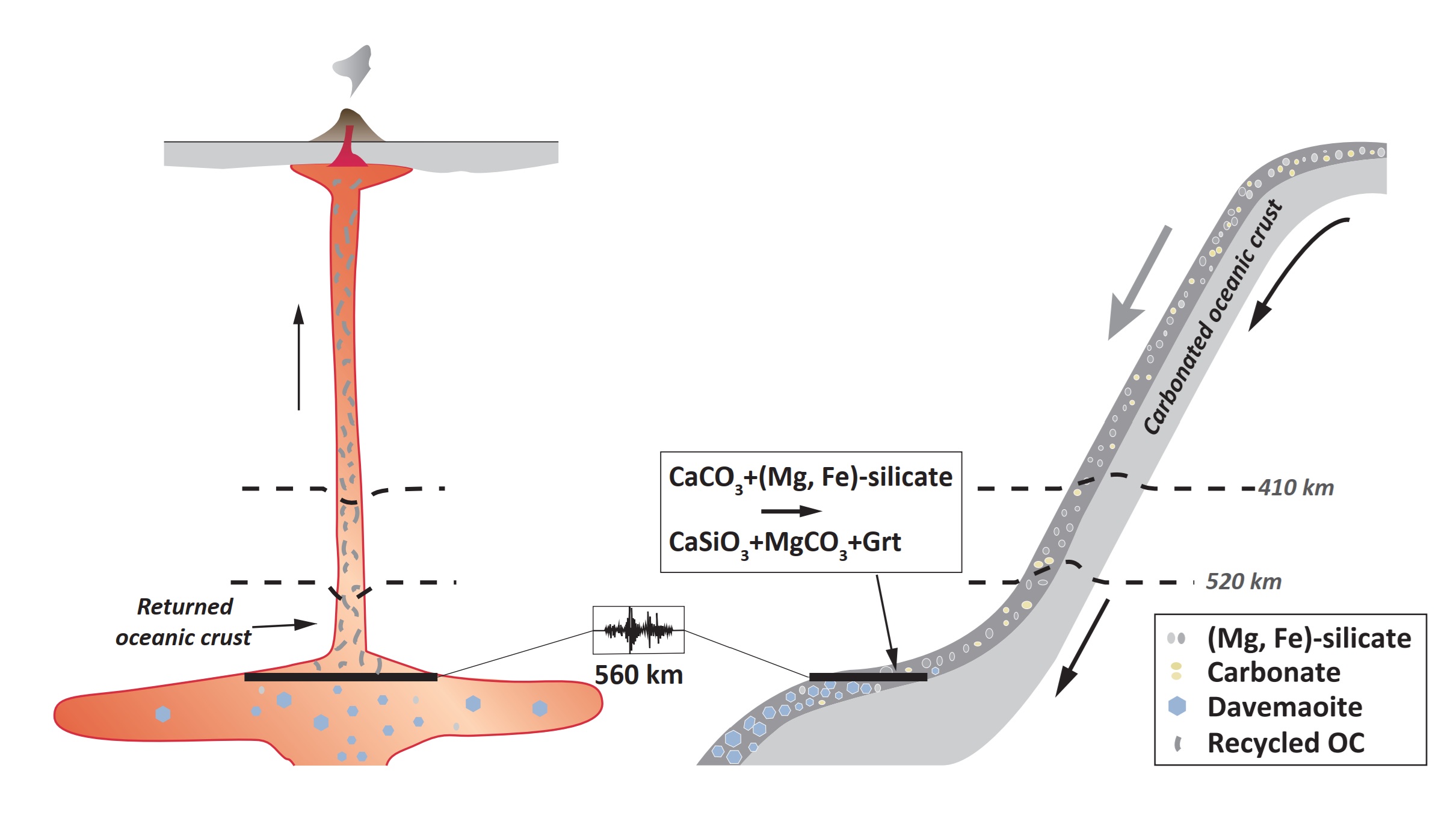
One place to look for such an effect is the mantle transition zone, where changes in mineralogy create seismic boundaries that can be detected from the surface. Most of these boundaries can be explained by well-known transformations of the major mantle minerals. But one feature has remained unusual: the 520-km discontinuity sometimes splits, producing a second seismic reflector near 560 km depth.
This secondary boundary is not global. It appears sporadically, particularly beneath subduction zones and some mantle upwelling regions. Its origin therefore offers a natural opportunity to ask whether chemical recycling, rather than temperature and pressure alone, can modify the layering of Earth’s interior.
A leading explanation for the 560-km reflector is the exsolution of davemaoite (CaSiO3) from calcium-rich garnet. Yet recent measurements created a problem: with the small amount of davemaoite expected from typical subducted oceanic crust, the predicted shear-wave impedance contrast is only about 0.5–1.3%, far below the 2–4% observed seismically.
This mismatch led us to ask a different question: could recycled carbon change the chemistry of subducted crust and produce enough davemaoite to make the 560-km boundary visible?
Testing the idea in the laboratory
To find out, we needed to recreate this carbon-rock interaction under the extreme conditions of the mantle transition zone. Using a large-volume high-pressure apparatus, we compressed basaltic materials representative of subducted oceanic crust to ~20 GPa (~560 km depth) and heated them to 1200 and 1600 °C. We then added different amounts of calcium carbonate to explore how carbonate enrichment modifies the mineralogy of subducted oceanic crust.
What we observed was not simply the addition of carbon to the mineral assemblage. Instead, carbonate triggered a substantial redistribution of major elements between minerals.
Calcium from the carbonate exchanged with magnesium in the surrounding silicates. As a result, magnesium was transferred into the carbonate to form stable magnesium-rich carbonate, while calcium moved in the opposite direction and became incorporated into the silicate minerals. This Ca-Mg exchange effectively turned carbonate into a source of calcium for the silicate system.
That redistribution proved crucial near 560 km depth. The additional calcium allowed much larger amounts of davemaoite to exsolve from calcium-rich garnet. The effect was particularly strong in iron-rich compositions, where garnet becomes less stable and davemaoite formation is further enhanced. In our experiments, carbonate-altered compositions could ultimately produce several times more davemaoite than expected in ordinary mantle materials.
The final test was whether this chemical reorganization was large enough to produce a detectable seismic signal. Our modelling showed that it was. Carbonate-altered oceanic crust can produce enough davemaoite to generate a shear-wave impedance contrast of 2–4%, matching that observed for the 560-km discontinuity. The splitting of the 520-km discontinuity can therefore be understood not simply as the consequence of a mineral phase transition, but as a manifestation of chemical changes driven by carbon recycled from Earth’s surface.
This finding adds a new dimension to our view of the deep carbon cycle. Carbon is not only transported, stored and eventually returned through Earth’s interior. Along the way, it can redistribute major elements, shift mineral equilibria and reshape the mineralogical layering of the mantle. The 560-km discontinuity may therefore represent a seismic fingerprint of deep carbon cycling, revealing how material recycled from Earth’s surface can leave a lasting imprint on the structure of the planet hundreds of kilometres below.
Follow the Topic
-
Nature Communications
An open access, multidisciplinary journal dedicated to publishing high-quality research in all areas of the biological, health, physical, chemical and Earth sciences.

Related Collections
With Collections, you can get published faster and increase your visibility.
Women's Health
Publishing Model: Hybrid
Deadline: Ongoing
Data for AI, AI for Data: cross-disciplinary cleaning, processing and analysis approaches
Publishing Model: Open Access
Deadline: Dec 31, 2026


