AI vs. the Olympiad: Can Multimodal LLMs Truly 'See' Chemistry?
Multimodal large language models are often seen as emerging scientific assistants. Using chemistry Olympiad exams as a real-world benchmark, we study how well these models reason over diagrams, tables, and text, and where their limitations still lie.
Published in Chemistry, Computational Sciences, and Education
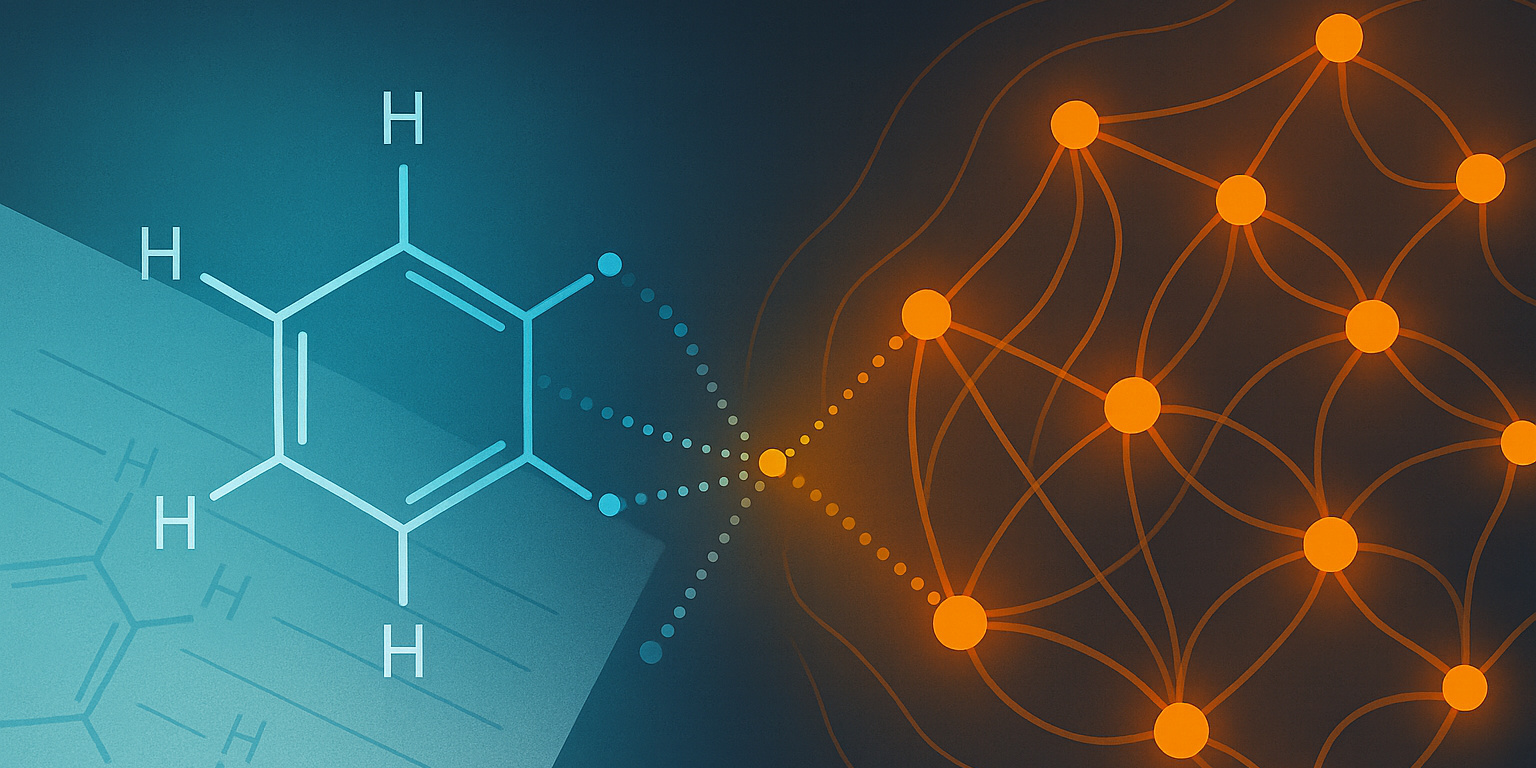



When we think of the U.S. National Chemistry Olympiad (USNCO), we think of deep spatial reasoning and careful problem-solving. As AI researchers, this led us to a simple question: if large language models are becoming scientific assistants, how do they handle the real-world setting of a chemistry exam?
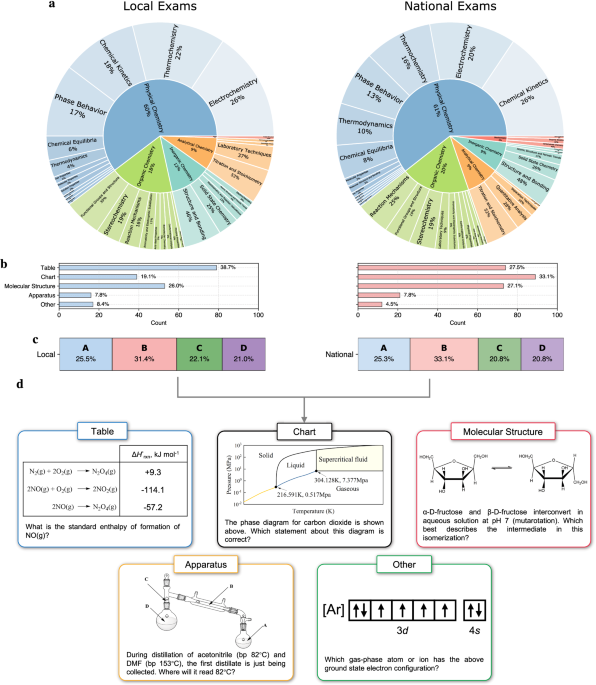
In this work, we curate a real-world chemistry benchmark from over two decades of U.S. National Chemistry Olympiad (USNCO) exams and use it to evaluate how well current multimodal models reason over text, diagrams, tables, and chemical structures. Because these problems were designed for top human students rather than machines, they offer a natural stress test for AI systems in realistic chemistry reasoning settings.
The Search for a Real-World Benchmark
Many existing AI benchmarks in science are self-constructed or automatically annotated. They are useful, but they often miss the subtlety and care that go into problems written by human experts. We chose the USNCO precisely because it serves as a genuine “blind test” for AI. It was never designed for machines, but to challenge some of the best young chemistry students in the United States.
By evaluating models such as GPT-5 and Gemini on USNCO questions, we wanted to see whether they could reason through the same diagrams, constraints, and logic that a top student faces under exam conditions.
A Surprise: Scale Over Specialization
One of the more unexpected findings, sharpened by helpful feedback from our peer reviewers, was that chemistry-specialized models do not consistently outperform general-purpose ones.
Specialized models are very strong at focused tasks such as SMILES conversion or property prediction, but they often struggle when broader reasoning is required. In contrast, large general models benefit from diverse pretraining and scale, which appear to matter more for scientific reasoning than domain-specific finetuning alone. From a chemist’s perspective, this suggests that the most capable AI assistant may not be the one trained only on molecules, but the one exposed to the widest range of human knowledge.
The "Aha!" Moment: When Less is More
Perhaps the most counter-intuitive result emerged from what we describe as a vision-language alignment gap. In earlier work on machine reading comprehension, we had noticed a familiar phenomenon: sometimes, removing part of the input actually improves performance.
We observed the same pattern here. Smaller models often rely on spurious visual cues in diagrams and become distracted by irrelevant details. In some cases, performance improved when images were removed entirely. This highlights a key limitation of current multimodal systems. While larger models are beginning to balance textual and visual information more effectively, many still struggle to truly interpret molecular structures or experimental apparatus in a human-like way.
What This Means for the Chemistry Community
Taken together, these results remind us that truly multimodal scientific AI is still at an early stage. For chemists using these tools today, it may be helpful to think of current models as brilliant but visually imperfect collaborators. They are strong at chemical logic and text-based reasoning, yet their visual understanding often lags behind.
As the field moves toward more autonomous AI systems for science, closing this vision-language gap and developing benchmarks that reflect real human problem-solving, will be an important step forward for the AI for Science community.
We hope this benchmark can serve as a useful reference point for future work, and we welcome discussion on how multimodal models can better align visual perception with chemical reasoning.
Read More
Cui, Y., Yao, X., Qin, Y. et al. Evaluating large language models on multimodal chemistry olympiad exams. Commun Chem (2025). https://www.nature.com/articles/s42004-025-01782-x

Yiming Cui
(He/Him)
Research Scientist, iFLYTEK Research
Research Scientist on AI, Large Language Models, AI for Chemistry.
Follow the Topic
Cheminformatics
Physical Sciences > Chemistry > Theoretical Chemistry > Cheminformatics
Chemistry Education
Humanities and Social Sciences > Education > Science Education > Chemistry Education
Artificial Intelligence
Mathematics and Computing > Computer Science > Artificial Intelligence
Machine Learning
Mathematics and Computing > Computer Science > Artificial Intelligence > Machine Learning
Computer Vision
Mathematics and Computing > Computer Science > Computer Imaging, Vision, Pattern Recognition and Graphics > Computer Vision
Physical Chemistry
Physical Sciences > Chemistry > Physical Chemistry
-
Communications Chemistry
An open access journal from Nature Portfolio publishing high-quality research, reviews and commentary in all areas of the chemical sciences.

Related Collections
With Collections, you can get published faster and increase your visibility.
Chemical modification of proteins
This cross-journal Collection highlights advances in methods for chemical protein modification.
Publishing Model: Open Access
Deadline: Sep 30, 2026
Soft materials for drug delivery
This cross-journal Collection highlights innovative soft materials towards drug delivery applications, including but not limited to stimuli-responsive drug delivery systems, biodegradable polymeric nanoparticles, hydrogels for sustained drug release, and liposomal formulations for targeted therapy.
Publishing Model: Open Access
Deadline: Dec 10, 2026