Ambient ultraviolet radiation and ocular melanoma incidence in the United States, 2000−2019
Published in Cancer and Public Health

What We Know:
While ocular melanoma is a rare form of cancer, affecting about 2000 new patients in the US each year, treatment options for this cancer are limited and it has a high potential to be deadly. Individuals with the diagnosis have an increased risk of metastasis leading to both vision loss and death making it imperative for researchers to identify high risk groups and understand risk factors of ocular melanoma in order to bolster strategies for primary prevention and early detection. Previous research suggests that possible risk factors for ocular melanoma include male sex, older age, light eye colour, sun-sensitive skin, higher numbers of cutaneous melanocytic nevi, ocular melanocytosis, ubiquitin carboxyl-terminal hydrolase BAP1 germline mutations, and exposure to ultraviolet radiation (UVR). When examining UVR specifically, artificial UVR has been consistently associated with increased risk of ocular melanoma, however, epidemiologic studies have been inconsistent when examining the relation between solar (ambient) UVR and ocular melanoma. Rather than investigating ambient UVR directly, previous studies tended to have surrogates for the association with ocular melanoma through place of birth, latitude, or investigating various locations with low or limited range of ambient UVR. In addition, previous studies tended to be limited in sample size which prevented investigators from seeing differences in ocular melanoma associations across anatomical sites, as well as factors such as race and ethnicity.
Our Objective:
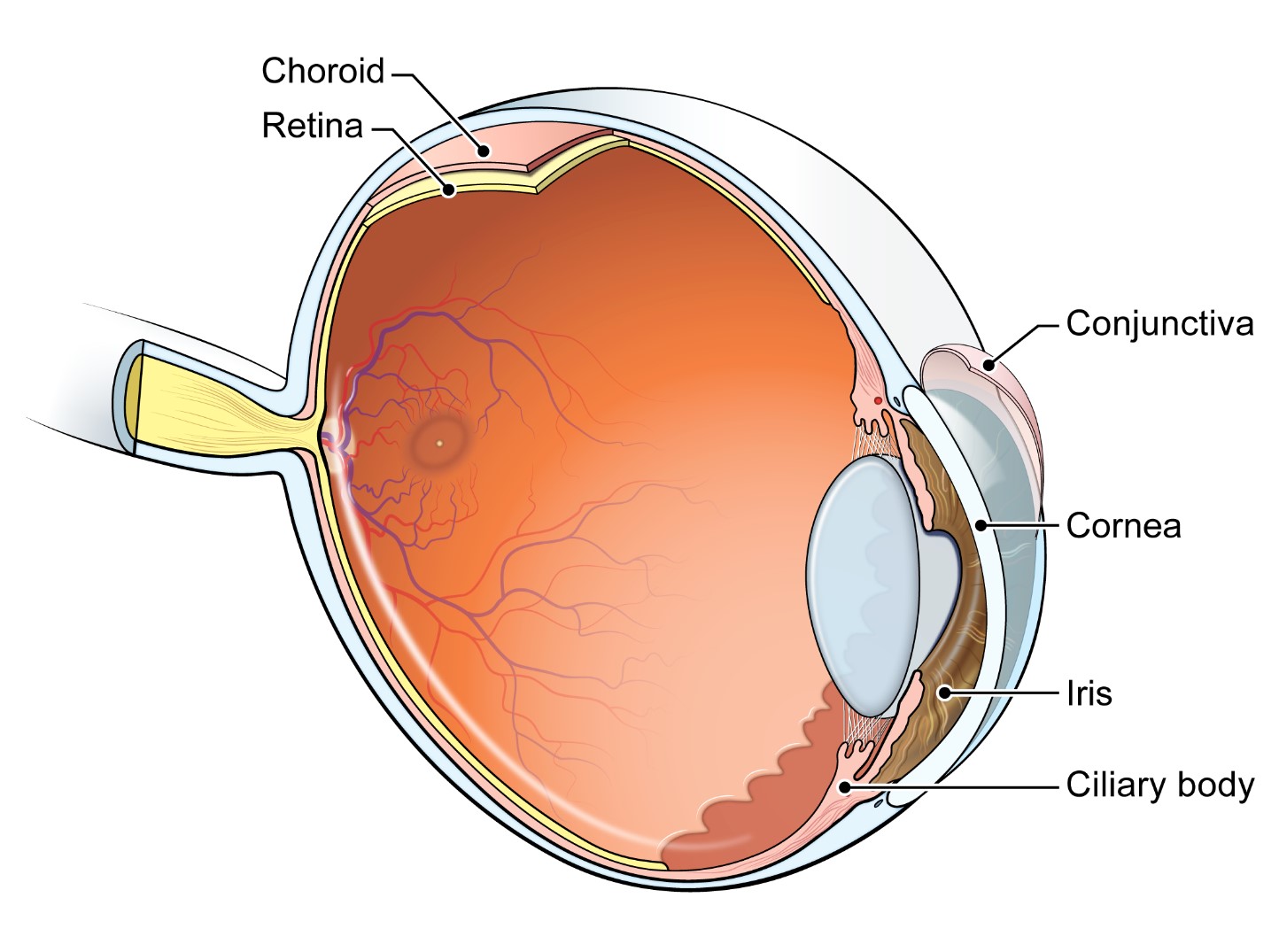
In this study, we examined the associations between ambient UVR and incidence of different anatomical sites of ocular melanoma (conjunctiva, cornea, retina, choroid, ciliary body/iris, orbit not otherwise specified [NOS], overlapping lesion of eye and adnexa, and eye NOS) by sex, age, and race and ethnicity. This is the largest study to examine this association, and the first study to examine such associations by anatomical sites and race and ethnicity.
How We Did It:
We utilized data from the National Cancer Institute’s Surveillance, Epidemiology, and End Results (SEER) programme years 2000–2019. By using SEER, we had access to in-depth patient demographic information such as age, sex, race/ethnicity, county of residence, year of cancer diagnosis, and ocular melanoma tumor characteristics. SEER covers 21 regions in the United States which is approximately 48% of the population making it very representative of the study population. Due to its large sample size, we were able to analyze ocular melanoma as a whole as well as the largest ocular melanoma subtypes and we examined them by race/ethnicity, sex, and age to see if there were any associations between ambient UVR and ocular melanoma subtypes. Our UVR exposure was linked to the county codes in SEER and then was assigned into quartiles with the first quartile having the lowest UVR exposure and the fourth quartile having the highest UVR exposure. Using Poisson models, we were able to calculate incidence rate ratios (IRRs) and 95% confidence intervals (CIs) for the UVR quartiles in order to examine associations between ocular melanoma and the level of UVR exposure.
Our Key Findings:
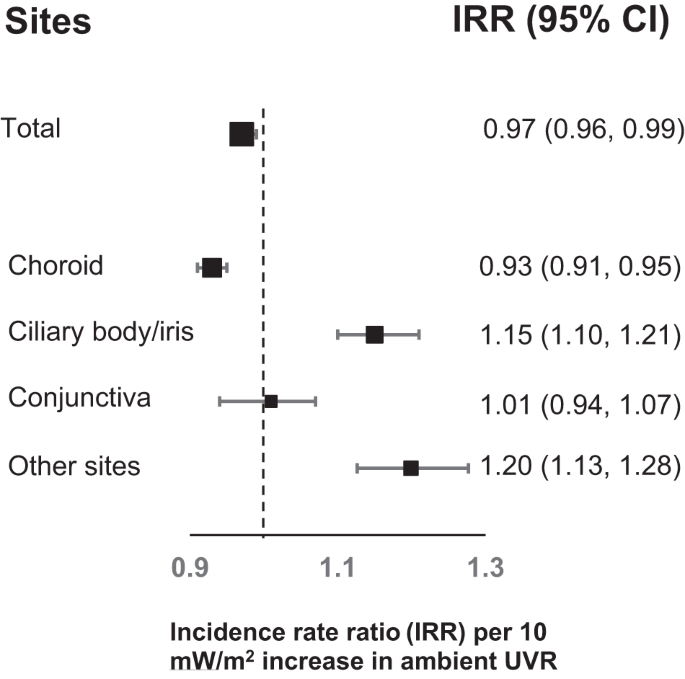
There were 18,089 ocular melanomas diagnosed between 2000 and 2019. Incidence rates of ocular melanoma and its subtypes were higher in older age groups, males, and non-Hispanic whites, and were similar by year of diagnosis and laterality. When comparing the highest quartile of UVR to the lowest, UVR was not associated with and not a risk factor for total ocular melanoma or conjunctival melanoma. When looking at continuous UVR (per 10 mW/m2), there was a negative association between UVR and lower choroidal melanoma incidence. The negative association appeared to be stronger in Hispanic whites than in non-Hispanic whites. Conversely, we saw a positive association and increased risk for the ciliary body/iris melanoma subtype in higher UVR quartiles. Further exploring this association, we found that the increased risks of ciliary body/iris melanoma applied to non-Hispanic White individuals, but not among other races and ethnicities. No associations between UVR and other subtypes were observed. In addition, the associations between continuous UVR and ocular melanoma incidence were not modified by age, sex, and race and ethnicity.
What This Means:
The lack of association when looking at total ocular melanoma could be because UVR may play different roles in different anatomical sites of ocular melanoma based on the specific positions of the structures within the eye. Depending on the wavelengths of UVR, some wavelengths would be absorbed by anterior uveal structures of the eye, while a smaller amount could reach the posterior of the eye. The conjunctiva and cornea are the most anterior segment of the eye, and the iris is the most anterior segment of the uveal tract. These anatomical sites have been suggested to almost completely absorb solar UVR. As for the positive association we found for ambient UVR and increased risk for ciliary body/iris melanoma, this could be because the iris may be a more UVR-exposed site as it is the most anterior segment of the uveal tract. This finding is consistent with previous studies of UV and risk of iris melanoma. The inverse association between UVR and reduced risk for choroidal melanoma was also consistent with other cancer registry studies and case control studies that looked at the risk of latitude and ambient UVR, but was not consistent with some case-control studies that used surrogates of UVR such as time outdoors, outdoor occupation and eye protection. Since our UVR measure is inversely correlated with latitude, our lower UVR estimates may be related to higher exposure to posterior ocular sites, which may result in the observed inverse association between ambient UVR and reduced risk for choroidal melanoma.
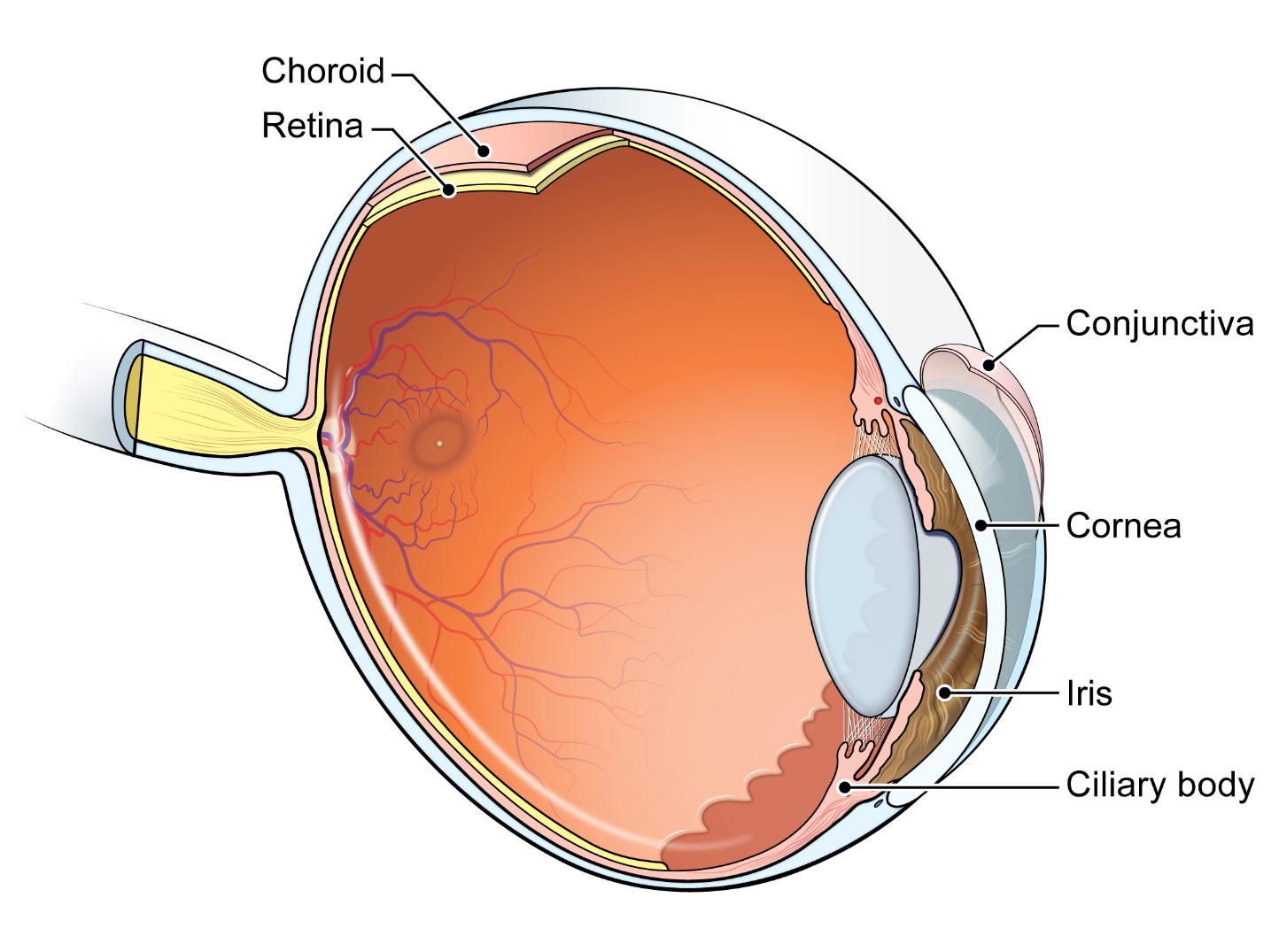
We thank Alan Hoofring of the National Institutes of Health Medical Arts Branch for the medical illustration.
Conclusion:
In summary, our study did not support UVR as a risk factor of total ocular melanoma. UVR was associated with increased risk of ciliary body/iris melanoma, but reduced risk of choroidal melanoma. Our results support and expand previous findings of associations of UVR and ocular melanoma and serve as a starting point for understanding the differences in the relationship between UVR and specific anatomical sites.

Follow the Topic
-
Eye
The official journal of The Royal College of Ophthalmologists. Eye seeks to advance the science and practice of ophthalmology with the latest clinical and scientific research for clinicians, optometrists, orthoptists, other health care professionals and researchers interested in the visual sciences.
Related Collections
With Collections, you can get published faster and increase your visibility.
Dry Eye Disease
Publishing Model: Hybrid
Deadline: Nov 25, 2026