An Emerging Liquid-Crystalline Conducting Polymer Thermoelectrics: Opportunities and Challenges
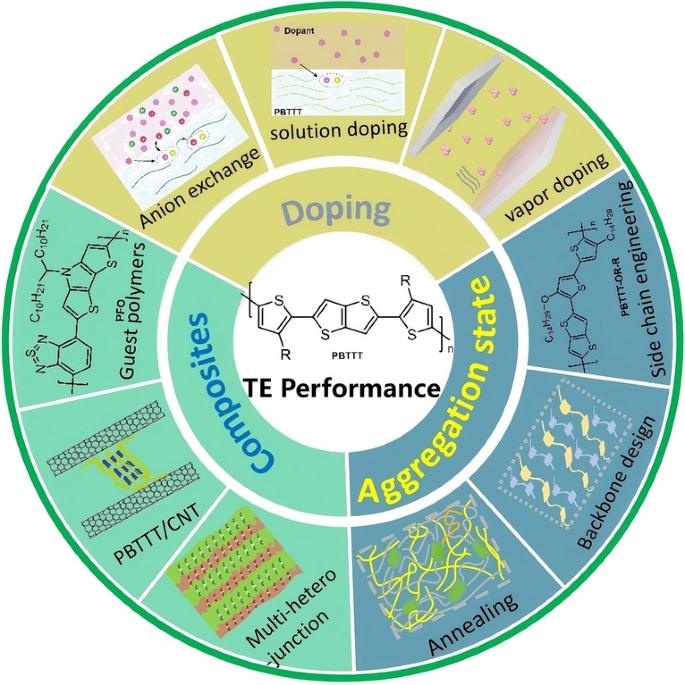

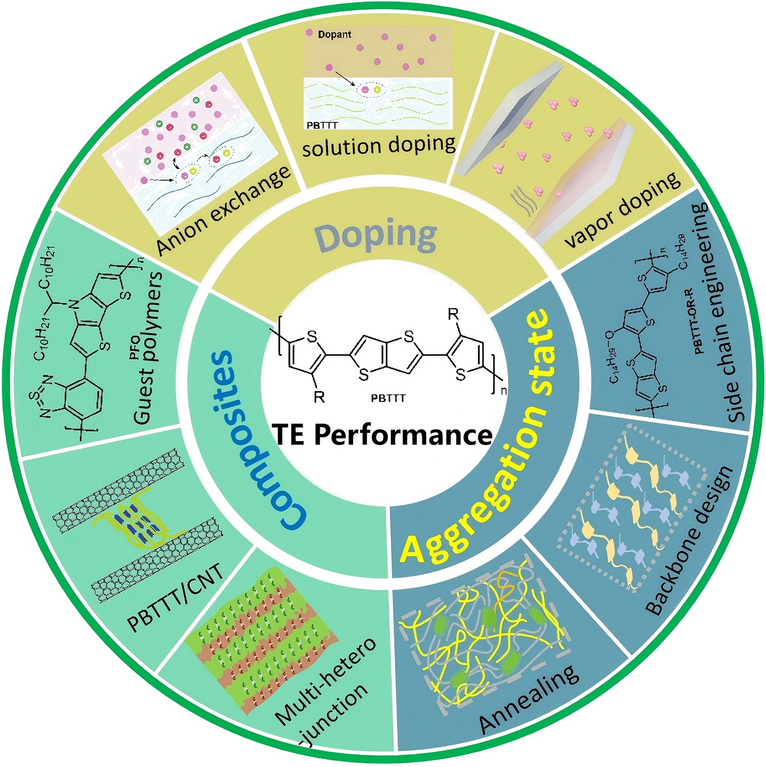

As wearable electronics and IoT sensors proliferate, the demand for flexible, melt-processable thermoelectric (TE) materials that convert body heat into electricity is soaring. Now, researchers from Shenzhen University, led by Prof. Guangming Chen, comprehensively review the latest leaps in poly(2,5-bis(3-alkylthiophen-2-yl)thieno[3,2-b]thiophene) (PBTTT)—a liquid-crystalline conjugated polymer whose figure of merit has catapulted from <0.1 to a record 1.28 at 368 K through asymmetric doping, multi-heterojunction architectures and phonon-blocking strategies.
Why PBTTT Matters
- Highest Organic ZT: 1.28 rivals inorganic Bi2Te3 yet retains mechanical flexibility and solution/melt processability.
- Scalable Processing: Compatible with roll-to-roll blade coating, floating-film transfer and high-T rubbing; 35 × 21 cm2 uniform films demonstrated.
- Melt Advantage: 140–180 °C smectic phase enables solvent-free alignment, cutting fabrication cost and environmental impact.
Innovative Design & Features
- Multi-Heterojunction Architecture: Alternating PBTTT/PDPPSe-12 nanolayers suppress out-of-plane κ to 0.06 W m-1 K-1 (55 % reduction) while preserving σ = 196 S cm-1, yielding an exceptional power factor of 628 μW m-1 K-2.
- PCET & NEII Doping: Proton-coupled electron-transfer tunes Fermi level within ±25 meV precision; nanoconfined electrochemical ion implantation achieves 100 nm spatial resolution for independent crystalline/amorphous domain control.
- Anion-Exchange Doping: Ionic-liquid mediators push conductivity to 1,120 S cm-1 without disrupting π–π stacking, maintaining high Seebeck coefficient.
Applications & Outlook
- Flexible TEGs: 522 nW output under 38 K gradient, 95 % retention after 100,000 bending cycles; 3.3 mV on human skin.
- Energy Filtering: Low-energy carrier filtering and tie-chain blending decouple σ–S trade-off, opening routes to >2 mW m-1 K-2 power factors.
- Next Steps: Integration with melt-spinning fibers and jointless p–n legs for watt-level wearable modules; AI-guided side-chain design to push ZT > 2.
This review bridges fundamental insights and scalable manufacturing, positioning PBTTT as a front-runner for eco-friendly, mass-produced organic thermoelectrics. Stay tuned for more advances from Prof. Chen’s group!

Editor of Nano-Micro Letters, which is an Open-Access, peer-reviewed journal reported papers that have at least one dimension ranging from a few sub-nanometers to a few hundreds of micrometers. The journal is published by Springer Nature and indexed by SCI, EI, SCOPUS, Pubmed, etc. The 2025 JCR Impact Factor is 38.5. The 2025 CiteScore is 58.9.
Follow the Topic
-
Nano-Micro Letters
Nano-Micro Letters is a peer-reviewed, international, interdisciplinary and open-access journal that focus on science, experiments, engineering, technologies and applications of nano- or microscale structure and system in physics, chemistry, biology, material science, and pharmacy.