An Overview of Dynamic Descriptions for Nanoscale Materials in Particulate Photocatalytic Systems from Spatiotemporal Perspectives
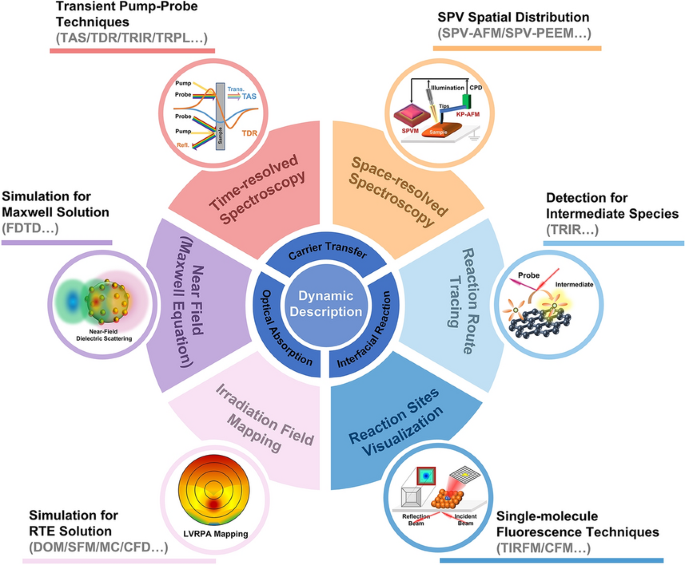

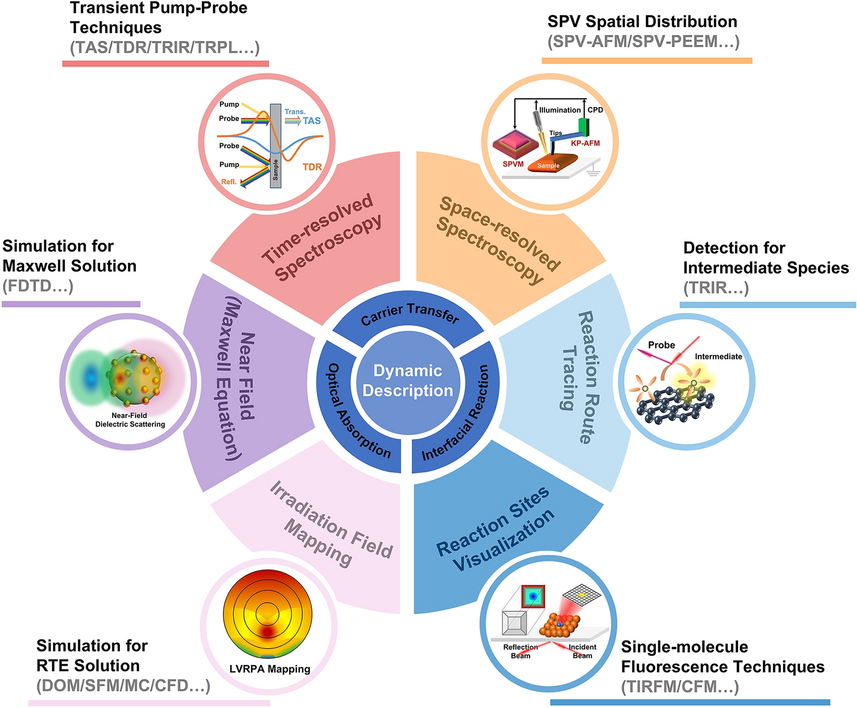

Although particulate photocatalysts have long promised clean fuels from sunlight, their true efficiency is throttled by nanosecond-scale mis-steps we have never directly watched—until now. In a 33-page roadmap in Nano-Micro Letters, Prof. Wenfeng Shangguan (Shanghai Jiao Tong University) and Prof. Chiaki Terashima (Tokyo University of Science) decode the complete dynamic “script” of light absorption, carrier separation and surface reaction inside a single nano-particle, offering design rules that could push quantum efficiencies past 20 %.
Why Dynamic Descriptions Matter
• fs-ns “Blind Spots”: 90 % of photo-excited carriers recombine before reaching the surface; only femtosecond-resolved probes can identify where and when.
• Photon Management: > 40 % of incident solar flux is lost by scattering or wrong-phase reflection; real-time field mapping guides reactor geometry.
• Interface Kinetics: Gas-bubble nucleation (ms–s) lags carrier arrival (ps–µs), causing back-reactions; single-molecule movies reveal active-site blocking.
Innovative Toolbox & Key Findings
• RTE/FDTD Simulations: Six-flux and Monte-Carlo models predict local volumetric absorption to within 5 % for CPC and flat-wall reactors, validating scaled-up deployment.
• Pump-Probe Gallery: Transient absorption (VIS-NIR), TRIR (mid-IR) and TRPL track carrier lifetime; Rh-doped SrTiO3 shows 12.5 µs electron lifetime vs 50 ns in pristine, explaining 3× H2 yield.
• SPV Nanoscopy: Kelvin-probe AFM maps surface potential at 20 nm resolution; asymmetric Cu2O cubes generate 30 mV photo-Dember field, steering holes to illuminated facets.
• Single-Molecule Fluorescence: TIRFM counts catalytic turnovers on individual TiO2 nanotubes; {101} facets convert 102 counts µm-2 min-1 vs 25 on {001}, directing facet-selective synthesis.
Applications & Outlook
• Water Splitting: TRIR captured t-butyl radical → isobutane pathway on Pt/TiO2 in 7.3 µs, guiding co-catalyst placement for 25 % faster H2 evolution.
• CO2 Reduction: fs-TRIR resolved two-electron TEOA oxidation sequence (ps then µs) on TiO2-Re molecular hybrids, enabling 92 % selectivity to CO.
• Scale-Up Link: Coupling SPV-derived surface fields with CFD radiation models delivered a 4× improvement in solar-to-H2 efficiency in a 25 L CPC reactor.
Challenges & Next Steps
The review calls for integrated “operando” platforms that synchronize fs-time resolution with nm-space accuracy under real reaction atmospheres, and for universal descriptors linking carrier separation distance to turnover frequency. Meeting these goals will transform photocatalyst design from trial-and-error into predictive engineering, accelerating the path to solar refineries.

Editor of Nano-Micro Letters, which is an Open-Access, peer-reviewed journal reported papers that have at least one dimension ranging from a few sub-nanometers to a few hundreds of micrometers. The journal is published by Springer Nature and indexed by SCI, EI, SCOPUS, Pubmed, etc. The 2024 JCR Impact Factor is 36.3. The 2024 CiteScore is 53.1.
Follow the Topic
-
Nano-Micro Letters

Nano-Micro Letters is a peer-reviewed, international, interdisciplinary and open-access journal that focus on science, experiments, engineering, technologies and applications of nano- or microscale structure and system in physics, chemistry, biology, material science, and pharmacy.
Please sign in or register for FREE
If you are a registered user on Research Communities by Springer Nature, please sign in