Beyond Fragmented Leadership Models: A Conceptual Integrated Theory of Leadership Effectiveness in a VUCA World
Published in Social Sciences, Sustainability, and Arts & Humanities




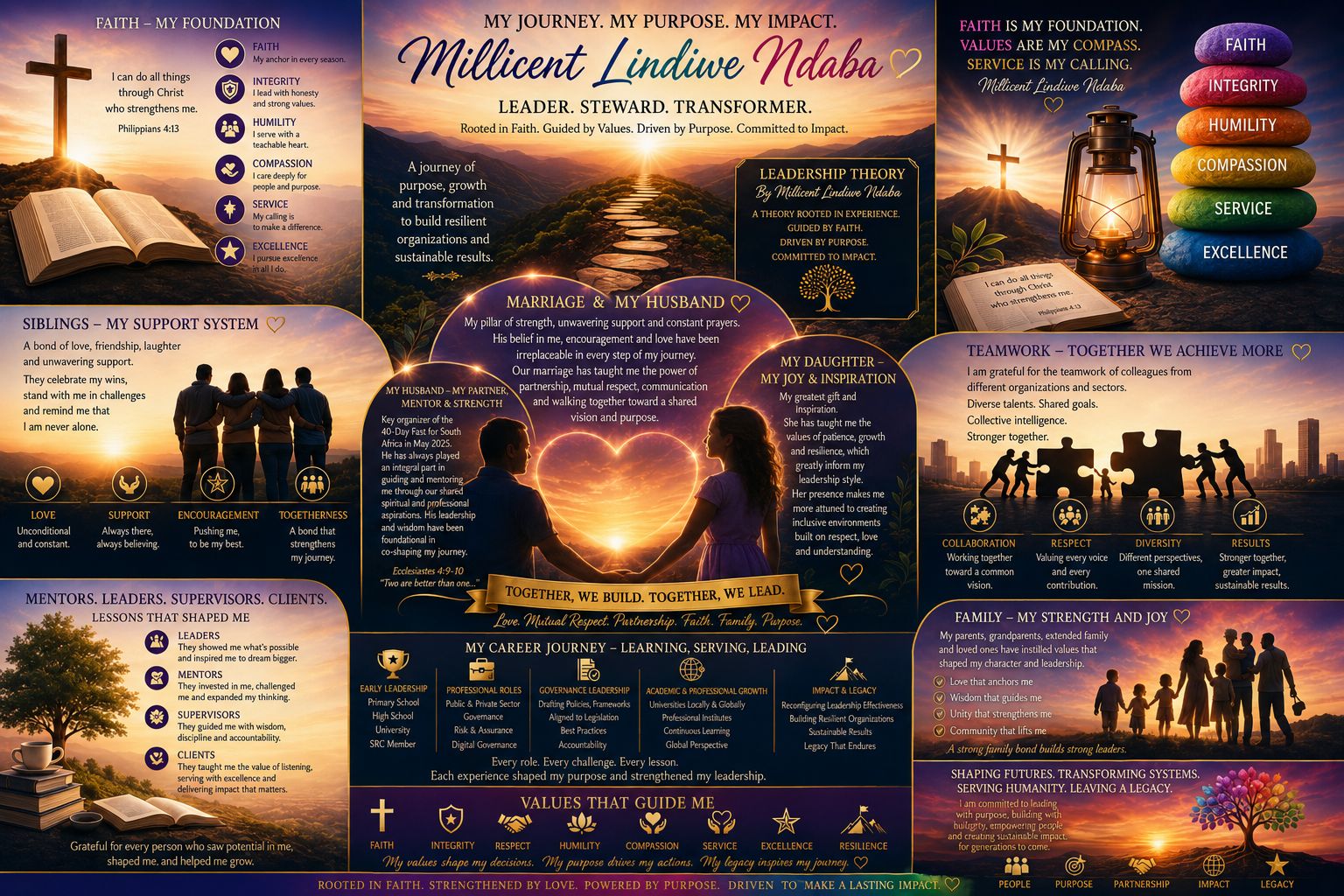
Story Behind the Article by Millicent Lindiwe Ndaba
https://doi.org/10.1007/s42087-026-00615-0
This article is not merely an academic exercise; it is the culmination of a lifelong leadership journey shaped by experience, faith, relationships, and reflection. For me, leadership has never been a position or title, it has always been a lived reality.
From an early age, I was entrusted with opportunities to lead, beginning in school and extending into student governance at university. These experiences introduced me to the responsibility of influence, the discipline of accountability, and the complexity of representing diverse voices. I learned early that leadership is not defined by being heard, but by the ability to listen, understand, and act in ways that create meaningful impact.
At the core of this journey has been my spiritual foundation. My Christian faith shaped my understanding of leadership as stewardship, an obligation to serve with integrity, humility, and purpose. This perspective became the ethical anchor of my thinking, reinforcing the belief that leadership is not about power, but about responsibility and the elevation of others.
My upbringing further deepened this orientation. As the firstborn and only daughter, I developed a strong sense of responsibility and discipline. My parents instilled in me the values of integrity, perseverance, and respect, while my grandparents grounded me in resilience, cultural identity, and faith. These formative influences nurtured a conviction that leadership is inseparable from character and that no aspiration is beyond reach when pursued with commitment and belief.
Equally, my experiences within family life and marriage revealed leadership as deeply relational. They taught me that sustainable leadership is built on trust, empathy, partnership, and shared responsibility. These insights would later shape my understanding of leadership as fundamentally human-centred.
As my professional career evolved across governance, risk management, assurance, and digital governance, I encountered the realities of organizational life. I observed that institutions do not fail because of a lack of strategy or resources alone, but because of fragmented or ineffective leadership. I witnessed how leadership culture determines whether organizations thrive or decline, especially in complex and rapidly changing environments.
It was through these experiences that a critical realization emerged: existing leadership theories, while valuable, often explain leadership in isolation, focusing separately on ethics, agility, culture, or innovation. Yet, in practice, leadership unfolds at the intersection of all these dimensions simultaneously.
This realization became the foundation of this study. The article responds to what I observed as a gap between theory and reality; a fragmentation in leadership thinking that limits its effectiveness in a volatile, uncertain, complex, and ambiguous world. As reflected in the research, leadership effectiveness cannot be understood as the product of isolated competencies, but as an emergent outcome arising from the interaction of multiple, interdependent dimensions.
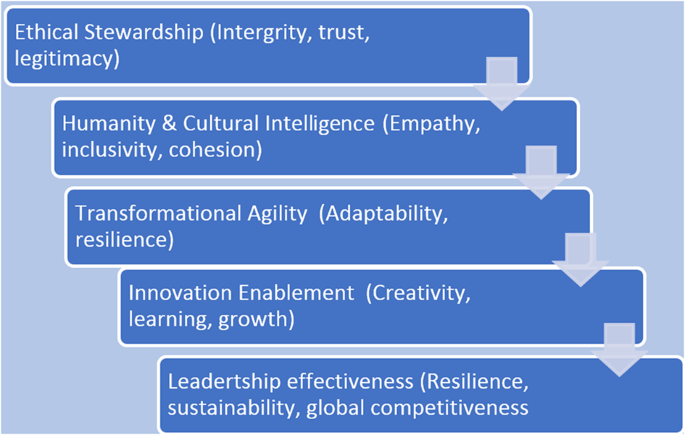
The Integrated Leadership Effectiveness Framework (ILEF) therefore emerged not only from academic synthesis, but from lived experience. It brings together ethical stewardship, humanity and cultural intelligence, transformational agility, and innovation enablement into a coherent system that reflects how leadership truly operates in practice.
Ultimately, this work is grounded in a simple but profound belief: leadership is stewardship. It is about safeguarding people, institutions, values, and future generations. It is about building trust, enabling transformative agility and innovation, and creating sustainable impact.
This article is both a reflection and a proposition: A reflection of a lived journey, and a proposition that leadership must be understood, taught, and practiced as an integrated and evolving system in order to remain effective in an increasingly complex world.
Hello colleagues,
My name is Millicent Lindiwe Ndaba, and I am honoured to join the Springer Nature research community following the publication of my article:
🔗 https://doi.org/10.1007/s42087-026-00615-0
My work, “Beyond Fragmented Leadership Models: A Conceptual Integrated Theory of Leadership Effectiveness in a VUCA World,” introduces the Integrated Leadership Effectiveness Framework (ILEF), a holistic model designed to respond to the complexity, uncertainty, and dynamism facing modern organisations.
I bring over 25 years of experience in governance, risk management, internal audit, and leadership practice, currently serving as Chief Digital Governance & CAR Audits at the City of Cape Town.
Alongside my professional work, I am a doctoral researcher in business administration, with academic grounding in leadership and governance, and an enduring passion for bridging theory and practice.
My Research Focus
- Leadership effectiveness in VUCA environments
- Integrated leadership models (ILEF)
- Governance, ethics, and organisational resilience
- Cultural intelligence and human-centred leadership
What Drives My Work
My research is shaped by a central question:
How can leaders move beyond fragmented models to create sustainable, ethical, and adaptive organisations?
This builds on my broader body of work, including my book “The Reciprocal Relationship of Culture and Leadership,” and my ongoing efforts to develop practical leadership tools and frameworks for diverse audiences.
Looking Forward to Engaging With You
I look forward to:
- Collaborating with fellow researchers and practitioners
- Exploring interdisciplinary perspectives on leadership
- Contributing to conversations on governance, ethics, and innovation
Please feel free to connect, especially if your work intersects with leadership theory, innovation, governance, or transformation in complex environments.
Warm regards,
Lindiwe Ndaba
Follow the Topic
-
Human Arenas
The aim of this journal concerns the interdisciplinary study of higher psychological functions (as topic of a general theory of psyche from the perspective of cultural psychology) in human goal-oriented liminal phenomena in ordinary and extraordinary life conditions.

Introducing the Palgrave Macmillan Campaign for the Humanities
At Palgrave Macmillan we publish cutting-edge humanities research that has real-world impact. This research community brings together the voices of our authors and editorial team to highlight and publicize the value of the humanities and humanities research in our world today.
Continue reading announcementRelated Collections
With Collections, you can get published faster and increase your visibility.
Arena of Technologies
Publishing Model: Hybrid
Deadline: Ongoing
Arena of Health
Publishing Model: Hybrid
Deadline: Ongoing

