Beyond the Mechanistic: Restoring the 'Human' in STEM Education
Published in Education and Philosophy & Religion
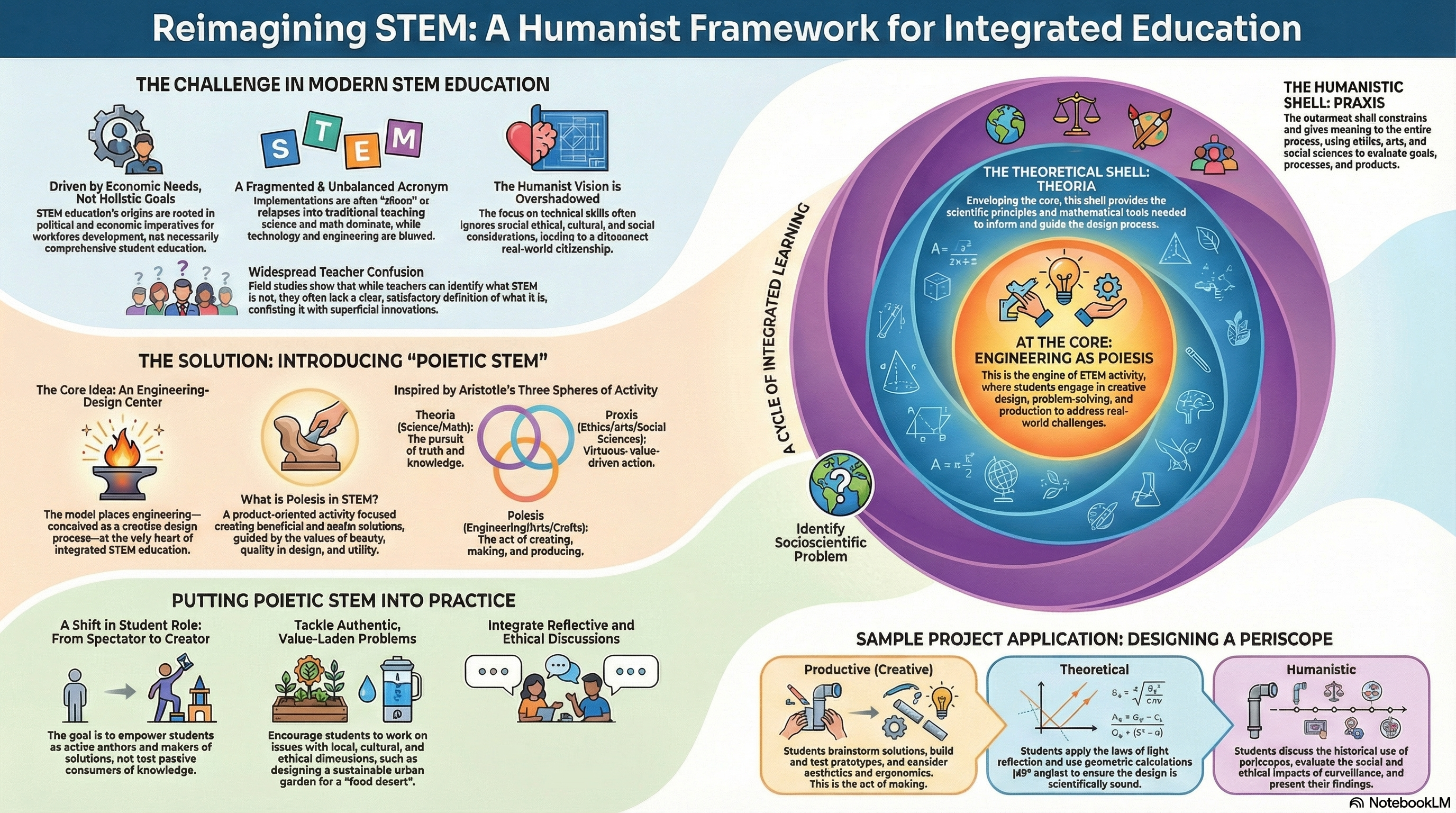




Over the past two decades, STEM education has risen from a policy buzzword to a global educational movement. Its promise is compelling: to prepare new generations capable of navigating complex sociotechnical landscapes through interdisciplinary knowledge, problem-solving, and innovation. Yet as my co-authors and I progressed through our research, we increasingly felt that a deeper issue was being overshadowed: when STEM is framed solely as an engine for workforce development and economic competitiveness, something essentially human is lost. The very practices intended to empower learners risk becoming mechanistic, instrumental, and estranged from the ethical, aesthetic, and cultural dimensions of human life.
Our recently published article, “Theoretical Suggestions for the Nature of Integrated STEM Education: Notes on a ‘Poietic’ STEM”, emerged from years of grappling with this tension. We wanted to understand—in a rigorous philosophical sense—what kind of educational activity STEM actually is, what kind of human being it presupposes, and what kind of society it ultimately serves. This required going beyond the acronym and its common policy narratives and instead revisiting the intellectual traditions that have shaped scientific and technical knowledge.
Where the Study Came From: A Common Unease Among Researchers
The article grew organically from conversations among the four of us, each coming from different intellectual traditions—science education, chemistry education, philosophy of science, and the epistemology of design. We shared a concern: despite the widespread enthusiasm for integrated STEM education, the field still lacked a coherent theoretical foundation. Teachers often articulated what STEM “is not”, but struggled to articulate what STEM is. Implementation problems—fragmented curricula, superficial integrations, neglect of ethics and culture—seemed to stem from this conceptual vagueness.
We also shared a stronger intuition: engineering, especially in its design-based form, was quietly becoming the gravitational center of STEM, yet this shift had not been theorized adequately. Could an engineering-based perspective offer a genuine integrative framework? And if so, what kind of engineering are we talking about?
The Turning Point: Revisiting Aristotle and the Concept of Poiesis
Our conceptual breakthrough came when we revisited Aristotle’s classification of human intellectual activity—theoria (seeking truth), praxis (virtuous action), and poiesis (creative production). Many of the challenges in STEM, we realized, revolved around a neglected question: What does it mean to design? And more importantly, what kind of knowing is involved in designing something for human use?
Modern engineering, in its essence, is a poietic activity:
- it combines theoretical knowledge (science and mathematics),
- practical wisdom (ethics, cultural context, human needs), and
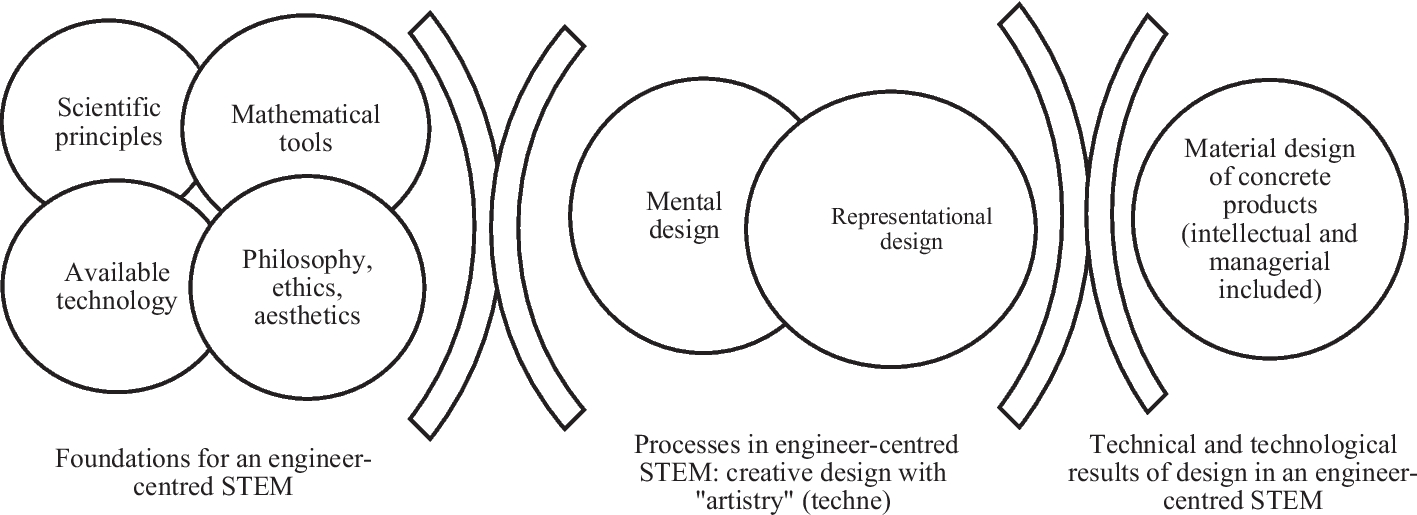
- creative-technological skill (techne).
This framed STEM not merely as a collection of disciplines, but as a unified human activity: producing meaningful, useful, and ethically situated products—material or conceptual. This opened an entirely new way to think about STEM education.
Behind the Scenes: Constructing the Philosophical Model
The writing process involved a continuous back-and-forth between conceptual analysis and practical classroom realities. We spent a great deal of time reviewing the nature-of-science literature, characterizations of engineering practice, and debates around integrated curricula. But the heart of the framework emerged when we realized that the Aristotelian triad could map cleanly onto contemporary educational constructs:
- Theoria → Scientific and mathematical literacy
- Praxis → Ethical reasoning, socioscientific decision-making, reflective action
- Poiesis → Engineering design, creation, innovation
The conceptual leap was to reorganize these not as separate categories, but as layers surrounding a design-oriented STEM core. In this system, engineering is not merely an applied outcome of science and math; it becomes the organizing principle that meaningfully integrates them. Yet engineering itself must be framed not narrowly as technical problem-solving, but as a humanistic, value-informed activity.
What We Mean by “Poietic STEM”
In the paper, we propose poietic STEM education as an approach characterized by:
- Design as the central integrative engine, rather than science or mathematics alone.
- Products understood broadly: not only devices, but symbolic, conceptual, organizational, artistic, or ethical outcomes.
- A strong humanistic orientation, integrating ethics, aesthetics, cultural knowledge, and social awareness.
- Learning cycles in which students design, test, critique, and iterate solutions to real sociotechnical problems.
- A classroom culture modeled on responsible creativity, where making and reasoning are inseparable.
In practical terms, this means that a STEM activity should not merely ask students to “build a bridge” or “design a periscope”, but rather to situate their designs ethically, socially, and aesthetically:
Who benefits from this solution? What are the unintended consequences? How does it fit into human experience?
Methodological Notes: How We Approached the Study
Although the paper is theoretical, it is grounded in:
- systematic reviews of literature on the nature of science, technology, engineering, and mathematics;
- the conceptual history of engineering design;
- philosophical analysis (Aristotelian, post-positivist, and post-humanist perspectives);
- existing STEM frameworks and national curriculum standards;
- and practical examples from classroom-based STEM implementations.
This triangulation helped us build a model that is philosophical in foundation yet pedagogically actionable.
Why This Matters Now
The current global landscape places enormous pressure on schools to produce “technically skilled” individuals. However, major societal challenges—AI ethics, climate engineering, energy transitions, biotechnology—are not merely technical; they are profoundly ethical, cultural, and political. The students we teach today will face decisions that cannot be solved through algorithmic thinking or technical optimization alone.
A STEM education that neglects this complexity risks producing competent technicians rather than responsible creators. A poietic STEM, by contrast, aims to cultivate students who can think with precision, act with ethical awareness, and design with imagination.
Invitation for Discussion
This proposal is not presented as a definitive framework but as an invitation. We believe that integrating classical philosophical categories with contemporary engineering-design practice offers a promising path for reconceptualizing STEM education.
We would be delighted to hear how colleagues across disciplines—scientists, engineers, educators, philosophers, designers—interpret, challenge, and expand upon this poietic approach. How might such a perspective reshape curriculum design, teacher education, assessment, or policy?
Your reflections and critiques will be invaluable as we continue developing this line of inquiry.

Follow the Topic
-
Science & Education
This is the official journal of the IHPST group, which focuses on enhancing teaching, learning, and curricula in science and mathematics through historical, philosophical, and sociological approaches.