Beyond the Taste: A Multifunctional Gustatory Interface for Tongue Cancer Patients
Published in Bioengineering & Biotechnology and Cancer


The Inspiration: From Taste to Electrophysiology
Taste is more than just a delightful experience; it is a crucial sense that influences our dietary choices, safety, and overall well-being. It acts as our first line of defense against potentially harmful substances, allowing us to enjoy a variety of flavors while avoiding those that may be detrimental to our health. However, in speaking with clinical oral surgeons we have learned that for patients undergoing surgical resection of the tongue - often necessary for cancer treatment - the effects can be devastating. The removal of tissue not only alters the physical structure of the tongue, but also disrupts the intricate mechanisms that enable the sense of taste. This can lead to a profound sense of loss and isolation, as patients struggle to cope with changes in their ability to enjoy food and engage socially.
Our team has been working on flexible brain-computer interface technology and developing other flexible electronics for nearly a decade, and we have also been focusing on the applications of bioelectronic devices on neuroprostheses for the reconstruction of sensory, motor and speech functions. We were surprised to find that the sense of taste is a relatively little-touched research direction in this field. Therefore, discussions with clinicians prompted us to explore the extension of electrophysiology to the realm of taste, aiming to offer practical assistance in the clinical management of patients with tongue cancer.
A New Dawn for Gustatory Assessment and Decoding
With that inspiration in mind, we sought to develop a high-density and conformal gustatory interface to connect with the human gustatory system and new perspectives to decode and interpret taste information. Although we are not the first to test the approach, but our goal was to provide a proof-of-concept solution for operative assessment and taste decoding for tongue cancer patients rather than pure electrophysiology recording and analysis.
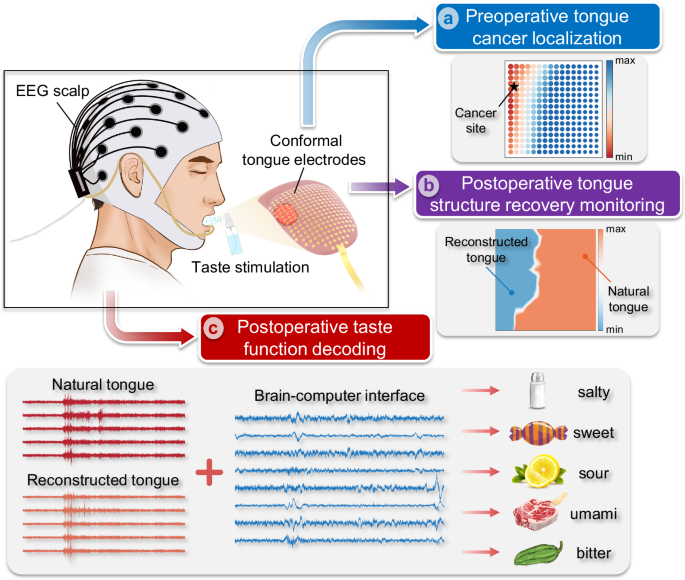
For different clinical scenarios, our device can serve different purposes. Imagine a tool that can accurately map the electrical signals across the surface of tongue, providing invaluable insights into its functionality and health. This is one of the key capabilities of our gustatory interface. On one hand, the interface delineates safe margins for surgical management, allowing surgeons to make informed decisions during procedures. Knowing where to operate and where to preserve tissue can significantly impact patient outcomes. On the other hand, it assesses flap viability, providing essential information about the recovery status of the reconstructed tongue. Monitoring the condition of this tissue is critical in the postoperative phase, as timely interventions can prevent complications.
What sets our interface apart is its ability to decode gustatory information with an accuracy of 97.8%. This level of precision is not merely a technical achievement; it has profound implications for the quality of life for those affected by tongue cancer. By providing the capability of helping patients differentiate flavors from unfamiliar and unknown foods, our gustatory interface empowers patients to reconnect with their food, enjoy meals, and ultimately improve their overall well-being.
Clinical Implications and Future Directions
The clinical implications of our research extend beyond individual patient experiences. The gustatory interface has the potential to improve and transform how we approach preoperative surgical procedures and postoperative care for tongue cancer patients. More personalized and effective care can lead to better surgical outcomes, improved recovery times, and ultimately, a higher quality of life for patients. Furthermore, our research opens the door to exploring the transduction mechanisms underlying taste perception more deeply, which provides the possibility of developing targeted interventions for those experiencing taste disorders due to various health issues.
Looking ahead, we see opportunities to expand the application of our gustatory interface beyond tongue cancer. The principles underlying our technology could be adapted to address other medical conditions that impact taste and oral health. For instance, individuals with neurological disorders that affect taste perception may benefit from similar decoding and reconstruction techniques.
Meanwhile, interdisciplinary collaboration with clinicians can effectively combine clinical insights with technical knowledge to ultimately improve patient care and outcomes by designing tools that are not only scientifically sound, but also practically feasible in clinical settings. Requirements for applications in clinical scenarios also suggest our future research directions, including the development of wireless bioelectronic interfaces.
In conclusion, our research represents a meaningful advancement at the intersection of technology and healthcare. By harnessing the power of electrical mapping and noninvasive monitoring, we aim to enhance the lives of individuals recovering from tongue cancer surgery. Taste is an essential part of the human experience, and with our gustatory interface, we hope to help patients improve the quality of life.
For more information:
Wang, Xiner, et al. "Gustatory interface for operative assessment and taste decoding in patients with tongue cancer." Nature Communications 15.1 (2024): 8967. https://doi.org/10.1038/s41467-024-53379-y

Follow the Topic
-
Nature Communications
An open access, multidisciplinary journal dedicated to publishing high-quality research in all areas of the biological, health, physical, chemical and Earth sciences.

Related Collections
With Collections, you can get published faster and increase your visibility.
Women's Health
Publishing Model: Hybrid
Deadline: Ongoing
Tumor Microenvironment Crosstalk and Therapeutic Implications
Publishing Model: Hybrid
Deadline: Nov 02, 2026