Bioinspired Electrolyte‑Gated Organic Synaptic Transistors: From Fundamental Requirements to Applications
Published in Bioengineering & Biotechnology, Chemistry, and Materials
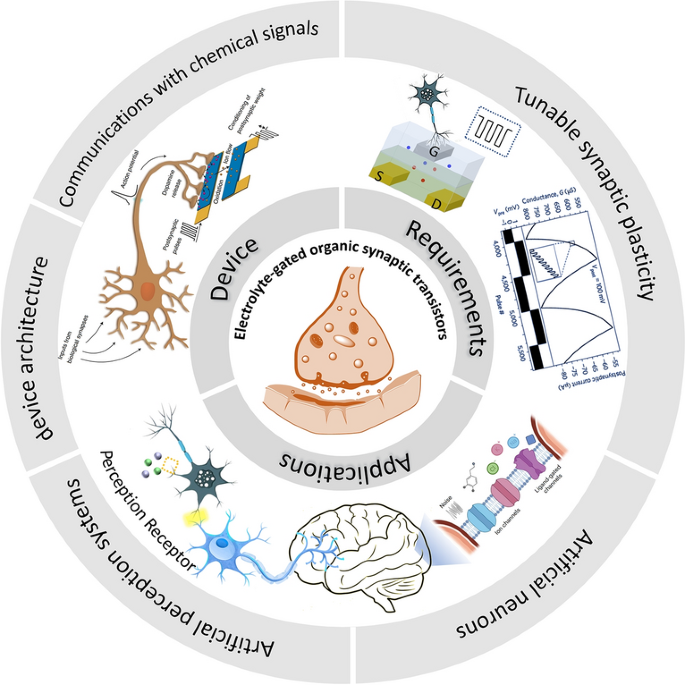

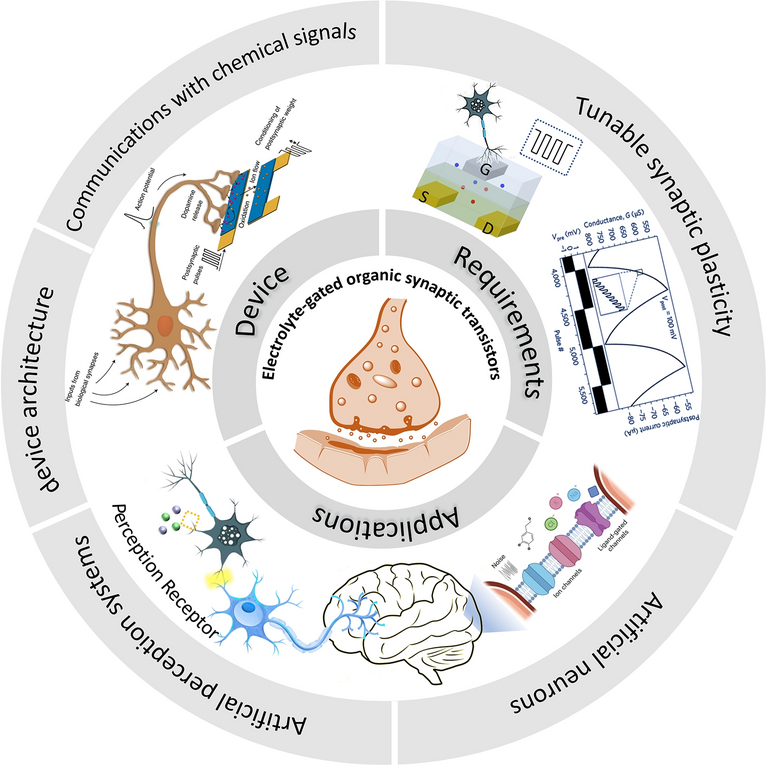

As artificial-intelligence workloads explode, the von Neumann bottleneck—physically separated memory and logic—becomes ever more painful. Now, researchers from Pazhou Lab–Guangzhou, Forschungszentrum Jülich, and Guangzhou National Laboratory, led by Dr. Yuanying Liang and Dr. Dirk Mayer, have delivered a comprehensive roadmap on electrolyte-gated organic synaptic transistors (EGOSTs) that operate like real brain synapses: in water, at body temperature, and with biological-level energy budgets. Their review offers a turnkey guide for building truly biocompatible neuromorphic hardware.
Why EGOSTs Matter
• Brain-Matched Environment: Because ions, not electrons, do the “weight tuning,” EGOSTs work happily in saline, blood, or cell-culture media—something solid-state memristors simply cannot do.
• Femtojoule Switching: Sub-1 V operation and nanoamp-level currents already push energy per spike below 10 fJ—rivaling a biological synapse.
• Multimodal Plasticity: Short-term filtering, long-term retention, paired-pulse facilitation, spike-timing-dependent plasticity (STDP), and even neurotransmitter-mediated learning are all programmable through material chemistry alone.
Innovative Design Levers
• Two Device Flavors: Ion-impermeable channels (P3HT, DPP-DTT) yield fast, volatile EDL transistors—perfect for sensory preprocessing. Ion-permeable polymers (PEDOT:PSS, PBFDO, BBL) enable bulk electrochemical doping for non-volatile weight storage.
• Vertical Nanogaps: Downscaling channel length to 30 nm and area to 10-8 mm2 slashes switching energy to 0.06 fJ while keeping on/off ratios > 105.
• Chemical Gating: Protons, Na+/K+, dopamine, glutamate, or even odorant molecules can act as the presynaptic “spike,” letting the device sense and compute in the same physical layer.
Applications & Future Outlook
• Artificial Perception: EGOST arrays now emulate every human sense—olfaction with odorant-specific receptors, vision with PCBM-photo-doped channels, hearing with ionic-liquid-coupled azimuth detectors, taste with acid/ion-selective membranes, and touch with stretchable e-skin synapses that drive real insect muscle.
• Biohybrid Neurons: Printed p- and n-type OECTs form organic electrochemical neurons (OECNs) that spike at 100 Hz, modulate frequency with ion concentrations, and have already slowed a living mouse heart via vagus-nerve stimulation.
• Challenges & Opportunities: The review closes by mapping the road to clinical impact—air-stable n-type polymers, orthogonal lithography for sub-µm patterning, long-term encapsulation for implants, and multimodal fusion algorithms that merge chemical, optical, and mechanical inputs into a unified neuromorphic layer.
This comprehensive review provides a materials-to-systems blueprint for electrolyte-gated organic synaptic transistors, positioning them as the missing link between soft biological intelligence and silicon-free neuromorphic computing. Stay tuned for more wetware breakthroughs from Dr. Yuanying Liang and Dr. Dirk Mayer!

Editor of Nano-Micro Letters, which is an Open-Access, peer-reviewed journal reported papers that have at least one dimension ranging from a few sub-nanometers to a few hundreds of micrometers. The journal is published by Springer Nature and indexed by SCI, EI, SCOPUS, Pubmed, etc. The 2025 JCR Impact Factor is 38.5. The 2025 CiteScore is 58.9.
Follow the Topic
-
Nano-Micro Letters
Nano-Micro Letters is a peer-reviewed, international, interdisciplinary and open-access journal that focus on science, experiments, engineering, technologies and applications of nano- or microscale structure and system in physics, chemistry, biology, material science, and pharmacy.