Bridging the Data Gap in Orthopedic AI: The Story of the PlaTiF Dataset
Published in Bioengineering & Biotechnology, Computational Sciences, and General & Internal Medicine
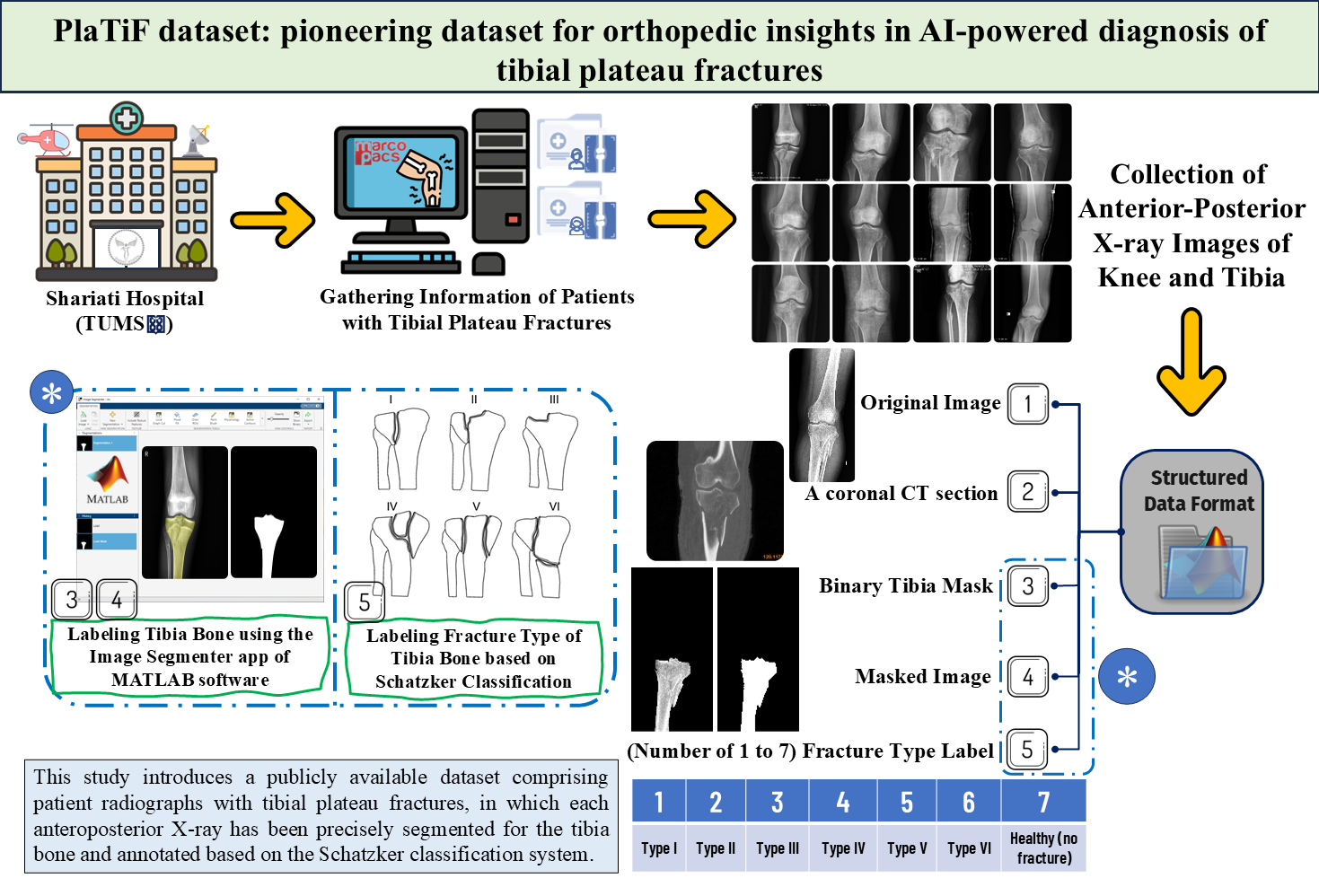



Every year, thousands of patients suffer from tibial plateau fractures (TPFs)—complex injuries that account for about 1% of all skeletal fractures. In the high-pressure environment of an emergency department, diagnosing these fractures correctly is critical. However, we noticed a recurring challenge: the diagnostic process is often labor-intensive and highly variable among observers.
While Artificial Intelligence (AI) has shown immense potential in medical imaging, we found a significant roadblock in orthopedics: the lack of high-quality, expert-labeled, and open-access datasets specifically for TPF. Without a solid foundation of data, even the most advanced deep learning models cannot reach their full potential. This realization drove our team to bridge the gap between clinical expertise and computational power by creating PlaTiF.
The Journey: From Radiographs to Gold-Standard Data
Developing PlaTiF was a collaborative effort involving engineers, radiologists, and orthopedic surgeons. We curated a heterogeneous collection of anterior-posterior radiographs from 186 patients, ensuring our dataset captured the real-world diversity of these injuries.
The process wasn't just about collecting images; it was about precision. Expert surgeons and radiologists meticulously classified each fracture using the Schatzker system, providing a "gold standard" for AI training. Beyond classification, we also generated detailed tibial bone masks for every image. These masks are a vital feature of PlaTiF, as they allow AI models to perform automated fracture assessment and morphological analysis with much higher accuracy.
Why it Matters and What’s Next?
By making this dataset open-access, we aim to democratize the development of AI tools in orthopedics. PlaTiF is not just for building models; it is a resource for:
-
AI-driven detection and classification: Helping junior clinicians identify complex fractures faster.
-
Preoperative planning: Improving surgical outcomes through better visualization.
-
Educational training: Providing a validated library of cases for medical students and residents.
We believe that open science is the key to improving patient care. We invite the global research community to explore the PlaTiF dataset on Zenodo and use it to push the boundaries of what AI can do in orthopedic medicine.

Follow the Topic
-
Scientific Data
A peer-reviewed, open-access journal for descriptions of datasets, and research that advances the sharing and reuse of scientific data.

Related Collections
With Collections, you can get published faster and increase your visibility.
10 years of the FAIR principles
Publishing Model: Open Access
Deadline: Nov 14, 2026
Data to support cancer treatment, diagnosis, and disease understanding
Publishing Model: Open Access
Deadline: Jan 02, 2027