Catalysis‑Induced Highly‑Stable Interface on Porous Silicon for High‑Rate Lithium‑Ion Batteries
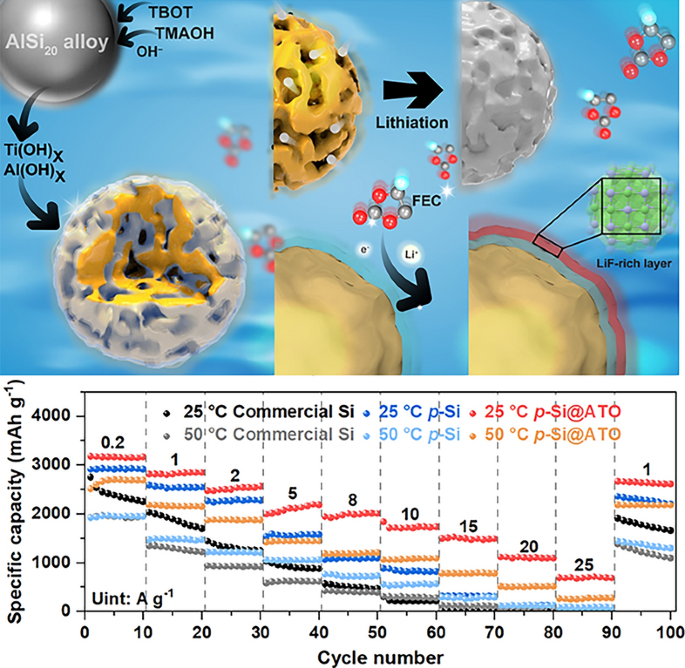



Silicon anodes promise 3,579 mAh g-1—ten times the capacity of graphite—but swell 300 % on each charge, ripping the solid-electrolyte interphase (SEI) and killing batteries within a few hundred cycles. Now, researchers from Shanghai University, Fudan University and partners, led by Dr. Yingying Lv and Prof. Yongyao Xia, have added a 3-nm “catalytic skin” that forces the electrolyte itself to build a rock-solid, LiF-rich SEI exactly where it is needed. The result: a porous-Si particle that survives 1,000 cycles at 20 A g-1 and still delivers 692 mAh g-1 at 25 A g-1—rates that fry conventional Si powders.
Why the Catalytic Interface Matters
• Molecular Concentration → In-situ Conversion: Defect-rich Al–Ti oxide Lewis-acid sites selectively adsorb fluoroethylene-carbonate (FEC) inside 4.9 nm mesopores, pre-concentrating it before catalytic cleavage into LiF.
• Self-Healing SEI: LiF content rises from 90.6 → 93.1 at% during cycling, locking out fresh electrolyte attack and suppressing parasitic reactions.
• High-Temperature Resilience: At 50 °C the same particle retains 80 % capacity after 500 cycles—double the life of commercial Si—while Coulombic efficiency stays > 98.9 %.
Innovative Design & Features
• One-Pot Synthesis: AlSi20 alloy microspheres are mildly etched in alkaline TMAOH while TBOT hydrolyses; Al dissolves, Si porifies, and an amorphous Al–Ti–O layer co-grows in situ—no extra vacuum steps.
• 3–5 nm Oxide Skin: EPR and XAS confirm Ti3+/oxygen-vacancy pairs that lower the d-band centre, accelerating C–F bond scission and LiF precipitation.
• Bimodal Pore Architecture: 4.9 nm mesopores buffer volume expansion; 50–80 nm macropores shorten Li+ diffusion paths, raising the effective diffusion coefficient by 100× versus dense Si.
Applications & Future Outlook
• Extreme Fast-Charge: Half-cells deliver 1,730 mAh g-1 at 10 A g-1 and 692 mAh g-1 at 25 A g-1—enabling 5-min charge without pre-lithiation.
• Practical Pouch Cells: A 3.2 mAh cm-2 p-Si@ATO || LiFePO4 pouch retains 77.4 % capacity over 50 cycles with 97.5 % average CE, validating scale-up.
• Beyond Silicon: The “adsorb-then-catalyse” concept is substrate-agnostic; the same surface chemistry is being rolled out to micro-Sn and micro-Sb anodes for sodium-ion packs.
Challenges & Opportunities: The team is now optimizing Ti/Al ratio for 1,500 °C cycle abuse tests and pilot-line slot-die coating to meet automotive 10-min fast-charge targets.
This work rewrites the silicon-anode playbook—instead of fighting SEI fracture, let the electrode build its own armour. Stay tuned for more gigafactory-ready breakthroughs from Dr. Yingying Lv and Prof. Yongyao Xia!

Editor of Nano-Micro Letters, which is an Open-Access, peer-reviewed journal reported papers that have at least one dimension ranging from a few sub-nanometers to a few hundreds of micrometers. The journal is published by Springer Nature and indexed by SCI, EI, SCOPUS, Pubmed, etc. The 2025 JCR Impact Factor is 38.5. The 2025 CiteScore is 58.9.
Follow the Topic
-
Nano-Micro Letters
Nano-Micro Letters is a peer-reviewed, international, interdisciplinary and open-access journal that focus on science, experiments, engineering, technologies and applications of nano- or microscale structure and system in physics, chemistry, biology, material science, and pharmacy.