Change in global tropical cyclone precipitation footprint from 1980 to 2020
Published in Earth & Environment and Mathematics


Tropical cyclones (TCs) threaten life and property with high winds, coastal storm surges, and heavy precipitation. TC precipitation can cause massive damage from inland flooding and will become more intense under warming climate. Recent study showed that the TC rain rate has systematically decreased in the inner core but increased in the outer bands in the last~ 20 years. However, there are still gaps in our knowledge regarding changes in the spatial structure of heavy TC precipitation.
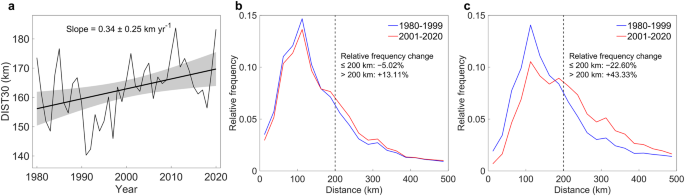
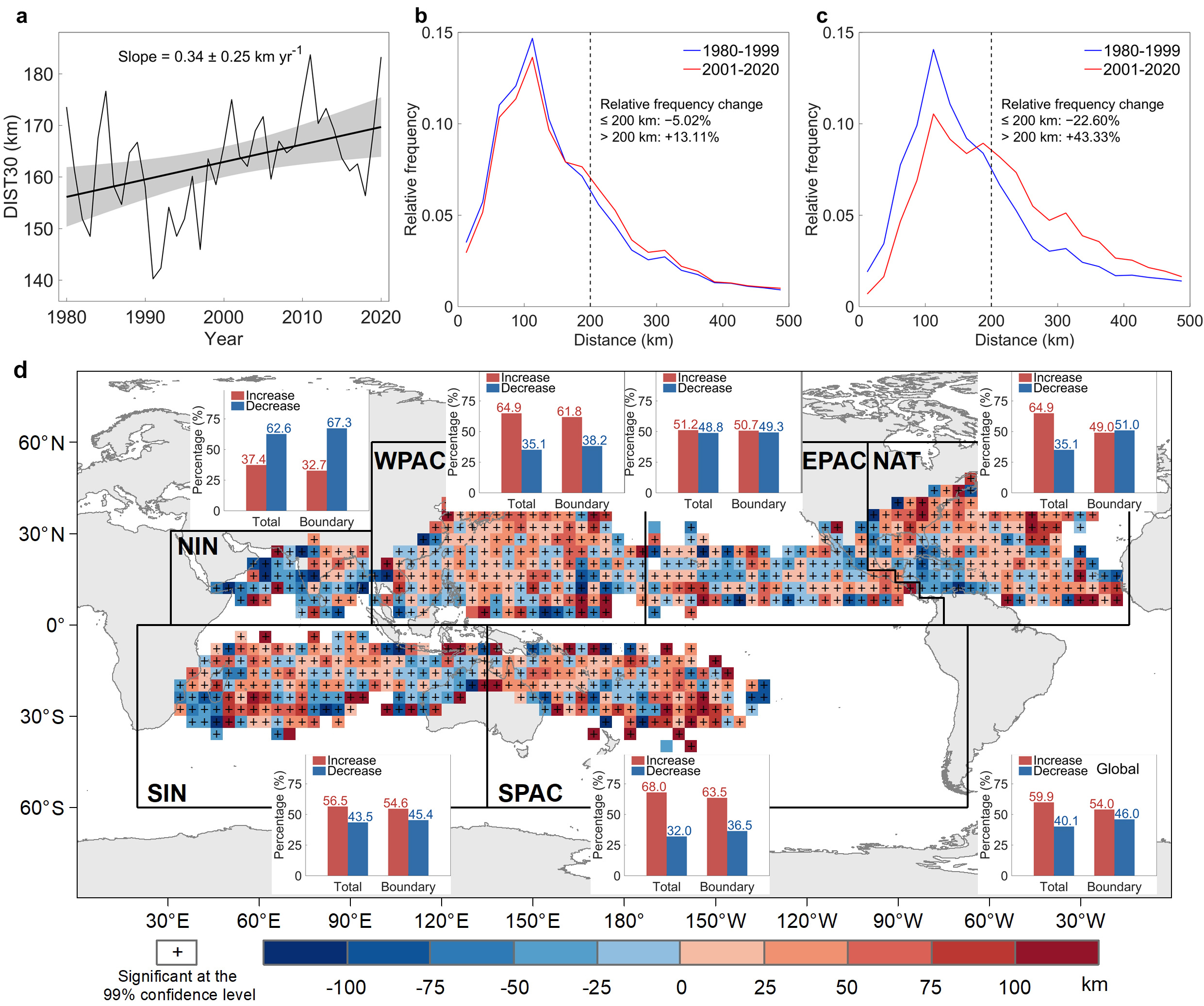
In this recently published work in Nature Communications, we define a TC rainfall metric DIST30 as the mean radial distance from centers of clustered heavy rainfall cells (> 30 mm/3 hours) weighted by their rainfall rate to the TC center. This metric provides a direct approach to understand the major inland flooding risk caused by heavy TC rainfall.
Our results show that DIST30 has increased globally at an average rate of 0.34 km/yr, with stronger increases observed at the ocean-land boundary and in the mid-latitudes of the Northern Hemisphere. The relative frequency of > 30 mm/3 hours TC precipitation beyond 200 km from the TC center increases by 13.11% at low latitudes and by 43.33% at mid-latitudes, while the frequency of > 30 mm/3 hours TC precipitation within 200 km of the TC center decreases by 5.02% at low latitudes and 22.60% at mid-latitudes. Spatially, we find the DIST30 increases in 59.87% (8.79×10⁷ km2) of the global total TC affected area (1.47×10⁸ km2). In addition, 54.02% (2.56×10⁷ km2) of the global land and sea boundary area (4.73×10⁷ km2) affected by TCs observed growth in DIST30. Larger percentage of areas with DIST30 increases are shown in the Western Pacific (61.84% from a total of 1.19×10⁷ km2 affected area) and the Southern Pacific (63.55% from a total of 7.76×10⁶ km2 affected area).
Based on our interpretable machine learning algorithm (XGBoost), we find that maximum wind speed (central pressure), latitude, vertical wind shear, tropical relative air and sea surface temperature, and total column water vapor are the most important variables for DIST30. Our models show that vertical wind shear is the environmental forcing variable with the most significant influence on DIST30. TC poleward migration to regions with higher vertical wind shear in the Northern Hemisphere contributes substantially to the DIST30 upward trend globally.
In recent years, some extreme mid-latitude rainfall events caused by TCs have occurred far from the TC center, including the 2021 Henan flooding event caused by Typhoon In-fa (No. 2106) and the 2023 Hebei flooding event caused by Typhoon Doksuri (No. 2305). Both the scientific community and risk managers need to pay more attention to this spatial migration of TCs and the increased flood risk associated with heavy rainfall from TCs, particularly for densely populated communities in the mid- and high-latitude regions of the Northern Hemisphere. These vulnerable communities have historically been less exposed to the hazards of TCs and are therefore physically and psychologically less prepared for TCs, where exposure to TC hazards has increased substantially in recent years, posing a major threat to local society. Further work is needed to understand the details of the regional mechanisms controlling the changing patterns of TC rainfall in different basins, and how their spatial footprints are likely to change in the future warming world.
Follow the Topic
-
Nature Communications
An open access, multidisciplinary journal dedicated to publishing high-quality research in all areas of the biological, health, physical, chemical and Earth sciences.

Related Collections
With Collections, you can get published faster and increase your visibility.
Women's Health
Publishing Model: Hybrid
Deadline: Ongoing
Tumor Microenvironment Crosstalk and Therapeutic Implications
Publishing Model: Hybrid
Deadline: Nov 02, 2026