Chemical and non-chemical stressors in population health: characterizing joint effects of air quality and social stressors on birth weight in a major city

This study examines the interaction between traffic-related air pollution and social stressors on birth weight, highlighting the complex relationships observed among specific stressors - particuarly violence -within New York City.
Like

Share this post

Choose a social network to share with, or copy the URL to share elsewhere

This is a representation of how your post may appear on social media. The actual post will vary between social networks

Explore the Research

SpringerLink
SpringerLink SpringerLink

Exposure to violence and socioeconomic deprivation in susceptibility to nitrogen dioxide on term infant birthweight in New York City - Environmental Health

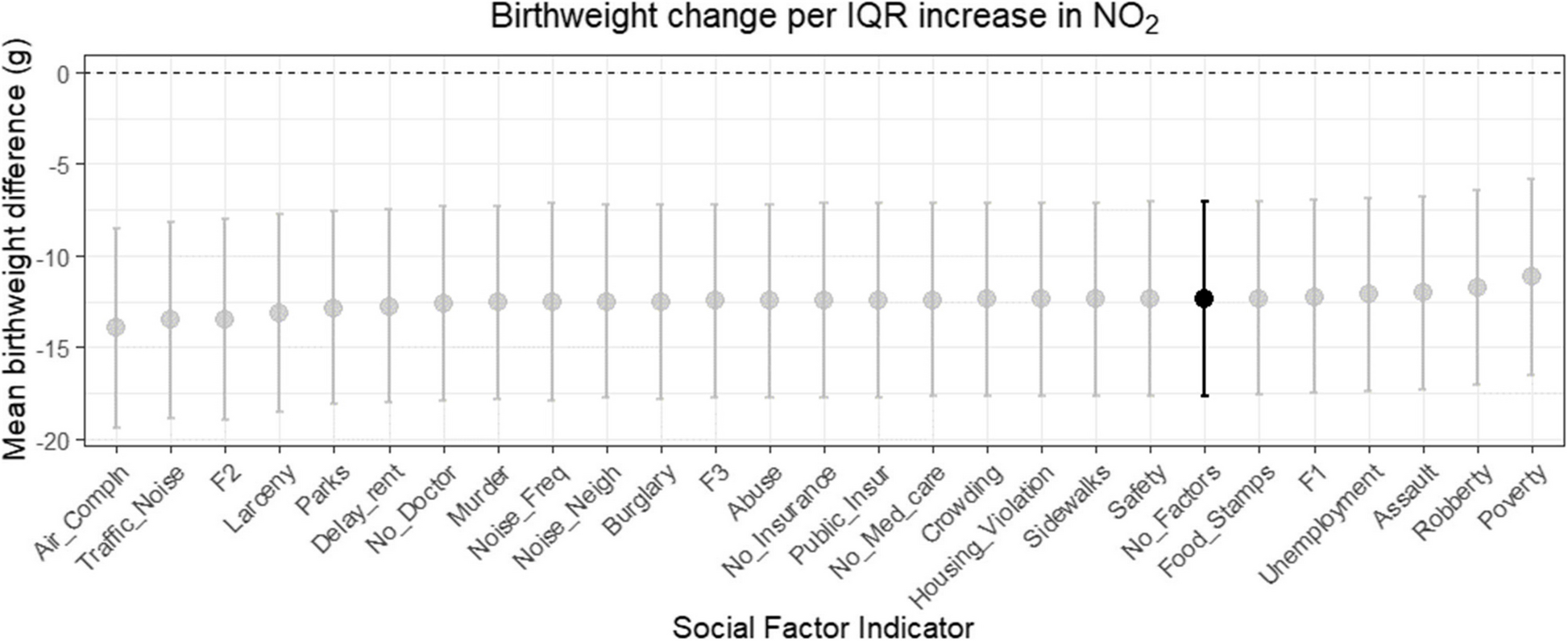
Introduction Air pollution has been associated with adverse birth outcomes, with variation by socioeconomic position (SEP). However, it remains unknown which aspects of lower SEP – comprised of myriad physical and psychosocial stressors – may best explain observed pollution susceptibilities. Building upon previous studies that estimated joint associations of air pollution and socioeconomic deprivation on term birth weight in New York City (NYC), this study seeks to identify specific social stressors underlying that relationship. Methods We examined records for 243,853 term births in NYC from 2007–2010. Residence-specific pregnancy-average NO2 was estimated using NYC Community Air Survey (NYCCAS) and EPA regulatory data. Twenty-six community social stressor indicators were tested as modifiers of NO2-birthweight associations in linear mixed-effects models, adjusting for particulate matter (PM2.5), individual-level maternal characteristics, and other covariates. In sensitivity analyses, we also examined non-linear interactions between continuous NO2 and census-tract level violence and deprivation terms. Results Consistent with previous work, a 1-IQR (6.2 ppb) increase in average prenatal NO2 exposure was associated with a 12.6 (SE = 2.7)-gram decrease in term birthweight.We observed similar values in independent models for most stressors related to violent crime or SEP and significantly lower birthweights with higher stressor exposures. In models of effect modification, however, we found that – despite lower average birthweights in high-stressor communities – NO2-birthweight associations were weaker in higher-stressor communities, particularly for violence-related stressors. For example, in the highest-quartile communities for assault, a 1-IQR increase in NO2 exhibited a decrement of only 7.3 g, on average, compared to 16.9 g in the lowest-assault quartile (p = .01 trend across quartiles). Exposures to non-violent stressors were not significantly associated with lower birthweights, nor modified observed NO2-birthweight associations. Conclusions We found significantly lower term-infant birthweights with higher NO2 or community stressors. Counter to hypotheses, however, in communities with very high stressor exposures (esp. violent crimes), despite lower overall birthweights, associations for NO2 were weaker than in low-stressor communities. Our results suggest a possible saturation effect in stress-pollution interactions, wherein very high stressor exposures appear to overwhelm any effects of pollution. In addition, we observed stronger effects for violent crimes, in relation to other social stressors.

Place matters. The air you breathe. The noises and sounds that surround you. The amount and quality of concrete under your feet. The neighborhood where you live, work, and play can have a strong influence on your health—in and out of the womb. Your social and physical environment can greatly impact your health, even before birth. The combination of these environmental and social characteristics can have an even more pronounced effect.


In a recently published study focusing on term singleton births across New York City, we revisited the role of prenatal ambient nitrogen dioxide (NO2) air pollution and 23 individual community-level stressors on birth weight for infants born full term. These stressors included indicators of crime and violence, physical disorder, noise disruption, socioeconomic position, and access to healthcare. As expected, we found that higher residential NO2 was associated with lower birth weights.

We then tested whether the effects of air pollution differed in those locations with higher stressor exposures. We tested a range of social stressors to identify potential stressors that most affected susceptibility.  We found that violent crime measurements consistently modified the relationship between air pollution and birth weight. This didn’t surprise us –prior qualitative studies have shown us that violence is a paramount urban stressor, which bears a unique toll on the population.

What did surprise us was that, at very high levels of violent crime, we didn’t see much effect of air pollution. While infants born in communities with high violence exposures had lower birth weights, on average, air pollution seemed to have a more reduced effect when compared to infants born in communities with low violence exposures. We suspect that this may be a type of saturation effect - the social stressors in those communities had already taken such a toll on the birth weights that there was little left to be explained by pollution.


So what does this mean?

Maternal stress arising from environmental and non-chemical (e.g., social) exposures can adversely affect birth outcomes and, likely, long-term health. However, at very high stressor exposures, these factors may be a highly influential determinant of health, making the benefits of improved air quality hard to detect. Our conclusion does not negate the critical implications of environmental effects on health —lower air quality can have profound consequences for population health. Rather, this study highlights the need to incorporate measures of neighborhood quality, social deprivation, and safety when studying the built environment and to consider their interactions.


A convergence and linkage of high-quality environmental, social, and health data sources 

This work would not have been possible without the use of high-quality data products collected, curated, and maintained by federal, state, local, and academic partners. We included highly resolved air pollution data based on data collected by the New York City (NYC) Department of Health and Mental Health (DOHMH) and the US Environmental Protection Agency, and processed by researchers.

Maternal and neonatal characteristics were gathered using birth records from NYC’s Bureau of Vital Records. Data sources for community-level social stressors include the New York Police Department, the NYC Administration for Children’s Services, the NYC Parks Department, Housing Preservation and Development, and more!  The utility of data linkages through multiple sources is a valuable asset towards answering complex population health questions within the built environment.

If interested in learning more about the topic or the comprehensive, high-quality data sources we used, you can read the full paper here: https://rdcu.be/epCcM

Please sign in or register for FREE

If you are a registered user on Research Communities by Springer Nature, please sign in

Follow the Topic

Air Pollution and Air Quality
Physical Sciences > Earth and Environmental Sciences > Environmental Sciences > Pollution > Air Pollution and Air Quality
Urban Geography and Urbanism
Physical Sciences > Earth and Environmental Sciences > Geography > Regional Geography > Urban Geography and Urbanism
Maternal and Child Health
Life Sciences > Health Sciences > Clinical Medicine > Gynecology > Maternal and Child Health
Public Health
Life Sciences > Health Sciences > Public Health
SDG 3: Good Health & Wellbeing
Research Communities > Community > Sustainability > UN Sustainable Development Goals (SDG) > SDG 3: Good Health & Wellbeing

Related Collections

With Collections, you can get published faster and increase your visibility.

Impact of climate change on non-communicable diseases

Building upon our collection on the contribution of climate change to the spread of infectious diseases, we are now also calling for articles examining the impact of climate change on non-communicable diseases.

Climate change alters the risks of chronic diseases through affecting dietary, environmental and lifestyle factors. For instance, higher environmental exposures to air pollution, ultraviolet radiation, agricultural chemicals, and infectious agents are linked to long term diseases such as asthma and cancer. Disruptions caused by extreme weather events have healthcare implications for patients with long-term treatment needs.

This collection brings together in one place articles outlining those chronic diseases that are likely to increase due to the effects of climate change.

Publishing Model: Hybrid

Deadline: Ongoing