Coexisting shapes in a unique quantum system
Published in Physics
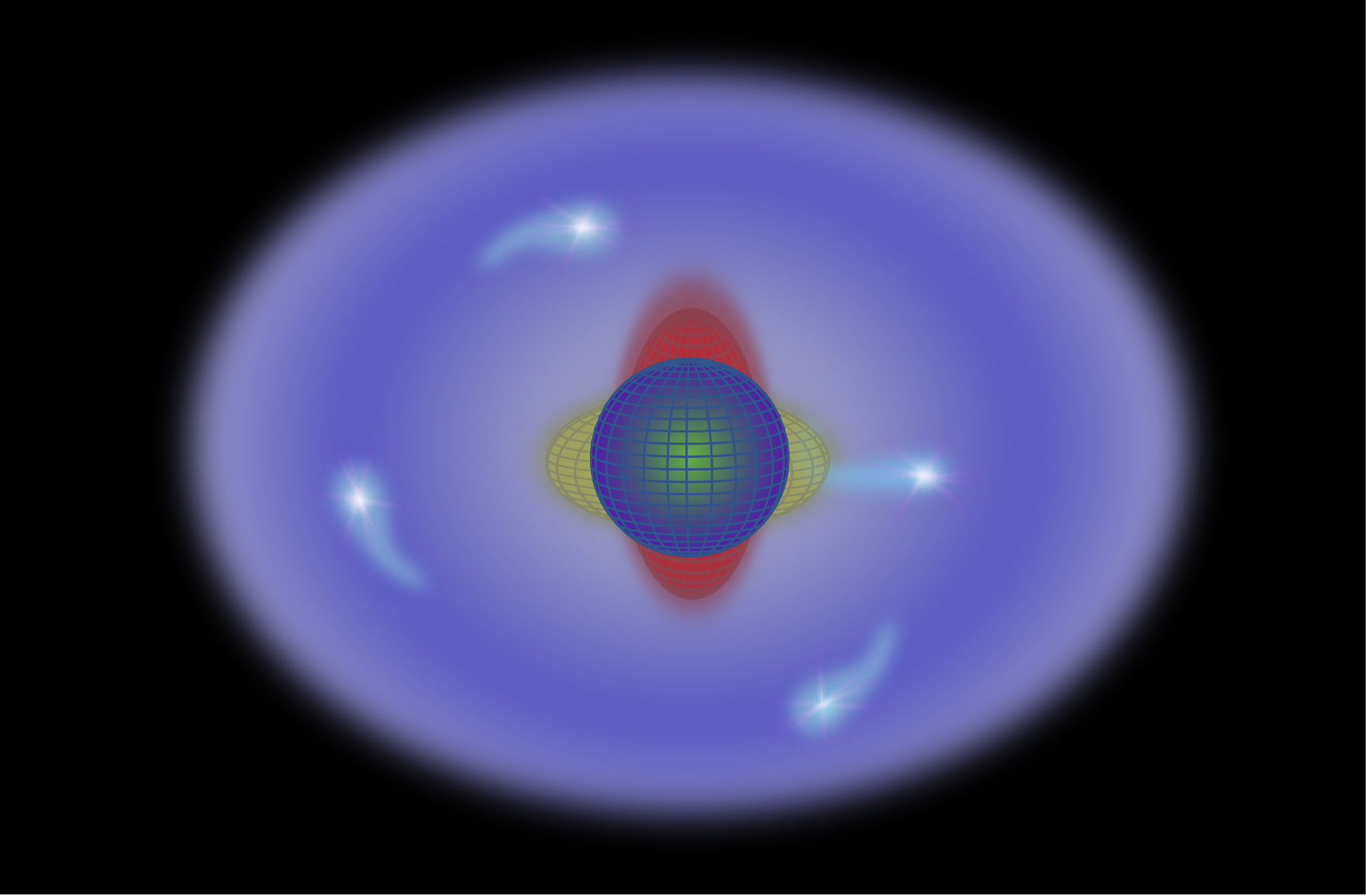



Atomic nuclei provide a unique ground for investigating complex quantum phenomena. They are governed by interactions involving single-particle motion, the collective behaviour of nucleons and nucleon pairing. A combination of these can give rise to the coexistence of different nuclear shapes. As stated by Heyde and Wood: “Shape coexistence in nuclei appears to be unique in the realm of finite many-body quantum systems” [1]. Coexistence in this context could be publicised using the famous analogy of Schrödinger’s cat, where a nucleus simultaneously possesses different shapes due to configuration mixing, corresponding to the cat being dead and alive at the same time.
The 186Pb nucleus is arguably the most famous nucleus exhibiting shape coexistence. It is the only known system where three different shapes appear as the three lowest states in energy, stimulating broad interest across different physics domains. These three states are also mixed, analogous to Schrödinger’s cat being, for instance, dead, lazy and animated at the same time. Ever since it was presented by Andreyev et al. in a paper published in Nature in 2000 [2], the figure that associates different shapes with different potential energy minima has become immediately recognisable at conference presentations, with the audience associating it with (triple) shape coexistence.
Over the years, 186Pb has been the focus of extensive experimental and theoretical efforts. Our work aimed to shed more light on the characteristics of the low-lying 0+ states. It not only redraws the picture of the low-lying states in 186Pb, but also provides new insight into the quantum laboratory at the heart of triple shape coexistence. The experiment was performed in the Accelerator Laboratory of the University of Jyväskylä, Finland, employing the SAGE spectrometer [3] in conjunction with the RITU separator [4]. It was conducted in 2013, which highlights that sometimes one has to dig deep to get the result out.
We demonstrated that simultaneous in-beam γ-ray and electron spectroscopy provides unrivalled sensitivity to probe the electric monopole (E0) transitions in nuclei. This is likely to have a big impact in future experimental efforts where complementary techniques are deployed in a quest for new knowledge on the subject.
[1] K. Heyde and J. L. Wood, Rev. Mod. Phys. 83 (2011), 1467.

[2] A. N. Andreyev et al., Nature 405 (2000), 430.

[3] J. Pakarinen et al., Eur. Phys. J. A 50 (2014), 53.

[4] M. Leino et al., Nucl. Instrum. Methods B 99 (1995), 653.

Most of the known atomic nuclei are spherical or slightly quadrupole deformed. My research employs complementary spectroscopic methods to study shapes and shape coexistence in exotic atomic nuclei. I perform these experiments mainly at the Accelerator Laboratory of University of Jyväskylä, or at the ISOLDE radioactive ion-beam facility, CERN.
Follow the Topic
-
Communications Physics
An open access journal from Nature Portfolio publishing high-quality research, reviews and commentary in all areas of the physical sciences.

Related Collections
With Collections, you can get published faster and increase your visibility.
Nonlinear dynamics of living systems
Publishing Model: Open Access
Deadline: Nov 09, 2026
Active, Entangled or Confined: Polymer Physics Across Synthetic and Living Matter
Publishing Model: Open Access
Deadline: Dec 31, 2026