Comparative analysis of smart city scientific research trends in the USA and China
Published in Social Sciences, Earth & Environment, and Sustainability





Scientific knowledge, reflected in research papers, books, patents, and other scholarly outputs, relies on the systematic organization of concepts and relationships within and across disciplines. Computational tools provide powerful ways to process and synthesize these diverse materials, helping to identify collective research interests and emerging scientific frontiers. The concept of 'smart cities'—integrating technology, human factors, and institutional frameworks—has become a major focus of contemporary research. Existing studies have explored smart cities through various methods—such as literature reviews, case studies, and policy analyses—focusing on technology, engineering, social innovation, government initiatives, and commercial services. Yet, scientific knowledge in this area often remains fragmented, with a clear divide between technology-driven and human-centered approaches.
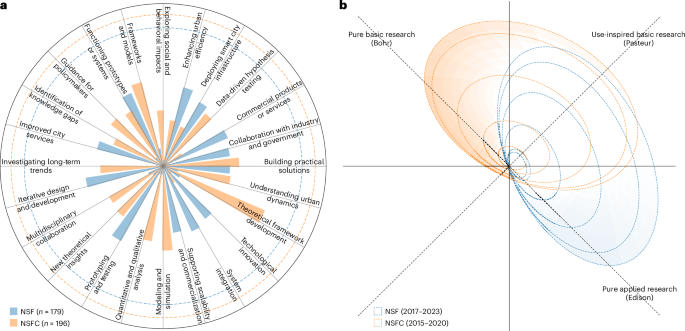
In our latest study "Comparative analysis of smart city scientific research trends in the USA and China" published in Nature Cities, we use open data and large language models (LLMs) to analyze smart city-related scientific research proposals funded by the NSF in the U.S. and the NSFC in China. Funded proposals reflect researchers' ambitions and challenges, while also offering early clues into future policy impacts, collaboration trends, and the strategic priorities of funding agencies. They reveal key focus areas, potential advances, and existing gaps in smart city scientific research.
Our results show both common scientific questions and divergent research pathways influenced by national contexts, highlighting a persistent tension between techno-centric and human-oriented priorities. By tracing links between scientific inquiry, real-world challenges, and technological solutions, we uncover core themes in smart city proposals—such as sustainability, resilience, equity, and well-being. This study offers a fresh perspective on smart city research in two of the world's leading technological and economic powers. The comparative analysis uncovers new insights into how the field is evolving, pointing to shared challenges but also distinct national priorities and funding mechanisms that may further divide the field.
Methodologically speaking, comparing research proposals demands both domain expertise and computational skills to handle large, complex datasets. Our early attempts at manual analysis quickly exceeded human capacity, leading us to adopt generative AI methods for support. Using LLMs, we developed a unified set of criteria to efficiently annotate all proposals, enabling meaningful comparison between the two countries' research trends. Through extensive interaction with LLMs, we continuously refined our prompts and instructions to improve response quality. This iterative process helped us develop scalable evaluation criteria and efficiently annotate all proposals. In addition, well-trained volunteers manually labeled a subset for validation, showing strong consistency with AI-generated results—confirming their reliability.
Conventional manual labeling is not only time-consuming and labor-intensive but also prone to subjective bias and disagreement among annotators. In contrast, LLMs provide consistent, efficient, and scalable alternatives. Their natural language interfaces also offer greater flexibility and user-friendliness compared to traditional computational tools, making advanced analysis accessible even to researchers without a programming background. Our work demonstrates the promise of human–AI collaboration in extracting meaningful insights from unstructured data. Success depends on careful prompt design, which helps channel the general intelligence of LLMs into task-specific analytical capabilities. Our study advances methodologies for large-scale text analysis and offers guidance for future research using AI-aided synthesis.
In conclusion, the ongoing tension between techno-centric and human-oriented views risks splitting smart city research into two separate paths. While some convergence exists, differing national emphases may deepen divides in research questions and value systems. These findings highlight the need for more international collaboration to effectively tackle global urban challenges.
Read more about this study: Lai, Y., Zhao, H. Comparative analysis of smart city scientific research trends in the USA and China. Nat Cities (2025). https://doi.org/10.1038/s44284-025-00305-y
Follow the Topic
-
Nature Cities
This journal aims to deepen and integrate basic and applied understanding of the character and dynamics of cities, including their roles, impacts and influences — past, present and future.