Contact electrification of solutions: beyond neutrality
Published in Physics

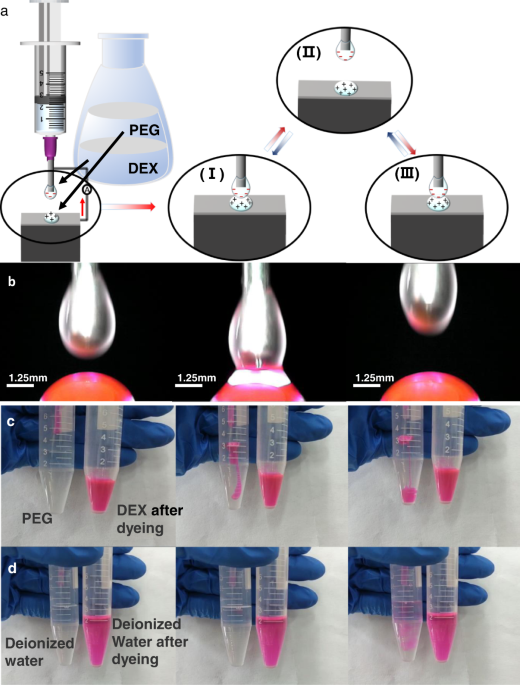

In conventional understanding, water is typically the representative of electric neutrality. Due to the free movement of ions in water, a slight difference in potential distribution can quickly induce a redistribution of charged ions, so static electricity often has nowhere to hide in humid or underwater environments. Here, Qingming Ma, Xiaoxiong Wang and others from Qingdao University found that there is contact charge transfer in the two-phase aqueous system, and the transferred charge density is significantly large. This non-electrically neutral phenomenon in water inspires a new perspective to treat the underwater phase separation behavior, in other words, not only does the phase change, but the charge redistribution is also an indispensable factor.
This charge transfer effect has been proven to be applied for developing a nanogenerator. Considering the potential of nanogenerators as distributed energy sources, the charge transfer effect by phase separation in water may work as a driving source of electrical energy in earlier life phenomena. Therefore, even without ATP and ion channels, potential redistribution can still be achieved to facilitate some primitive reactions, inspiring additional ideas to explain the origin of living matter additional ideas to explain the origin of living matter.
In addition, the high charge density-low voltage behavior relationship in water is also noteworthy. Due to the existence of the electric double layer, even a large amount of non-neutral charges will be shielded by the Helmholtz layer, so a high charge density-low voltage non-electrically neutral design can be achieved, which performs as a standpoint for other non-electrically neutral phenomenon such as electrowetting.
Report can be referred to: Lu, Y., Jiang, L., Yu, Y. et al. Liquid-liquid triboelectric nanogenerator based on the immiscible interface of an aqueous two-phase system. Nat Commun 13, 5316 (2022). https://doi.org/10.1038/s41467-022-33086-2

Follow the Topic
-
Nature Communications
An open access, multidisciplinary journal dedicated to publishing high-quality research in all areas of the biological, health, physical, chemical and Earth sciences.

Related Collections
With Collections, you can get published faster and increase your visibility.
Women's Health
Publishing Model: Hybrid
Deadline: Ongoing
Tumor Microenvironment Crosstalk and Therapeutic Implications
Publishing Model: Hybrid
Deadline: Nov 02, 2026