CYP1A1: the problem is not sensing the signal. It is stopping it.
Published in Cell & Molecular Biology, Biomedical Research, and Immunology


Review article
CYP1A1 as a conserved metabolic circuit linking environmental sensing to immune regulation
Where this started
Looking across studies on AhR signaling, the same inconsistency appeared.
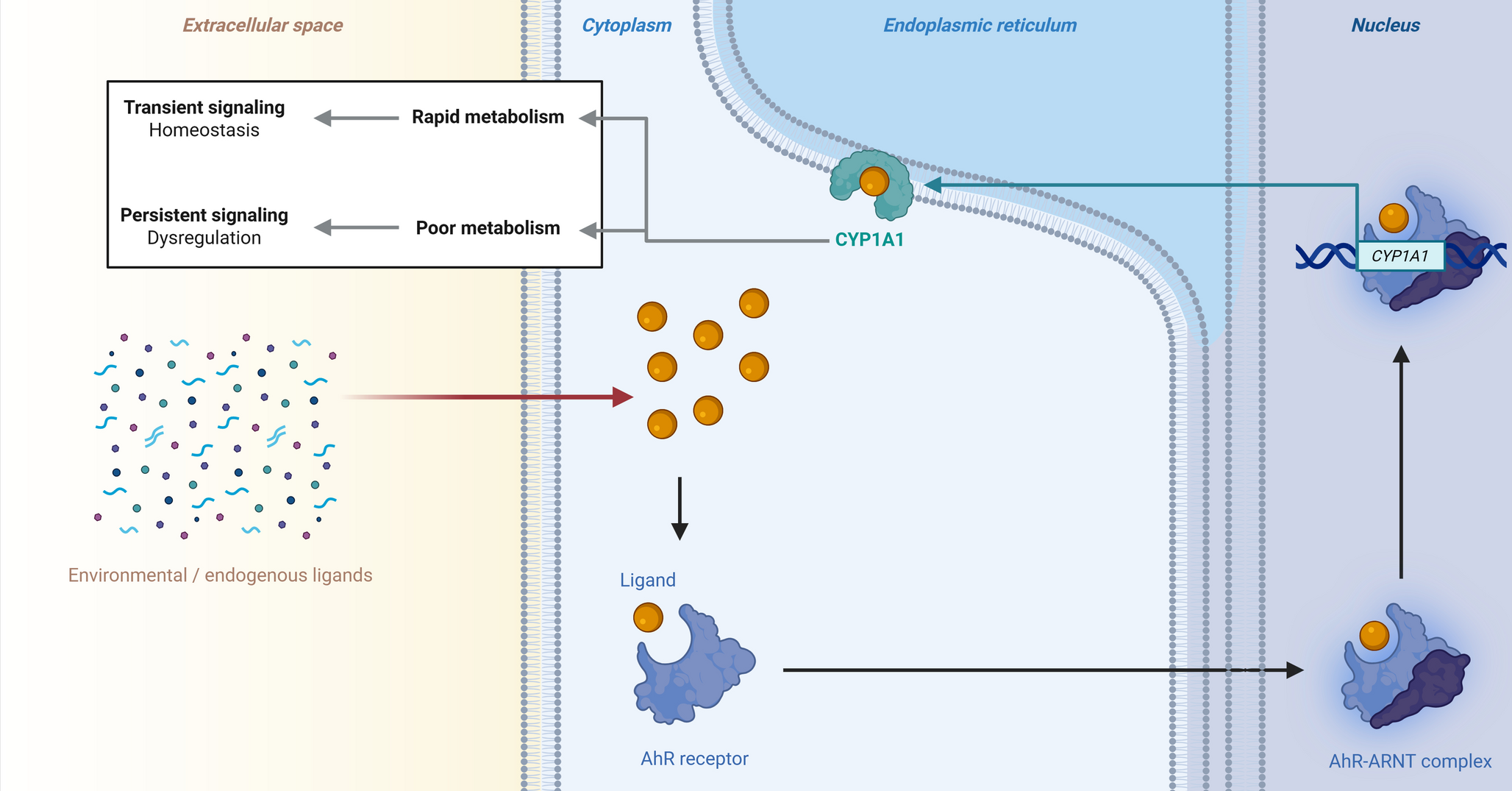
Very different ligands, from diet, pollutants, and endogenous metabolism, could activate the same receptor. Yet the outcomes were not consistent. Some responses were transient and controlled. Others lingered and shifted into something more disruptive.
The usual explanation focused on ligand potency. It did not fully explain the divergence.
A different way to look at it
Instead of focusing on how signals start, this work focused on how they end.
AhR activates rapidly when it detects a ligand. That part is straightforward.
What is less emphasized is that the system builds its own termination mechanism. CYP1A1 is induced after activation and begins metabolizing the same ligands that triggered the signal. This creates a built-in delay between activation and shutdown, and that delay is what defines the outcome.
What changes when timing is considered
When viewed this way, the pathway is no longer just about activation. It becomes a question of signal duration.
Some ligands are cleared efficiently once CYP1A1 is expressed. Their signals rise, then fall, and the system resets. Others are not easily metabolized. Even when feedback is engaged, they remain present. The signal does not resolve as expected.
So two exposures can look similar at the start, but diverge over time.
Why this matters for biology
Immune systems are sensitive to timing.
Short-lived signals can support normal regulation and adaptation. Prolonged signals, even if modest, can shift cell behavior and alter tissue balance. This means that persistence, not just presence, becomes the key variable. It also explains why some compounds with relatively low apparent potency still produce significant biological effects.
What complicates the system
In reality, exposures do not occur one at a time.
Multiple ligands enter the system together. Some are rapidly metabolized, others are resistant. They compete for receptors and for metabolic pathways. At the same time, other enzyme systems are co-activated. The result is not a simple on–off response, but a continuously adjusted signal shaped by competing inputs and feedback efficiency. Under these conditions, small differences in metabolism can have outsized effects on signaling behavior.
What stood out most
CYP1A1 is highly conserved across species.
That is unusual for enzymes typically framed as detox tools, which often vary depending on environmental pressures. Conservation suggests a role that is more fundamental than simple chemical clearance. It points toward regulation, not redundancy.
What remains unclear
Current approaches rarely capture the dynamics of this system.
Most measurements are taken at a single time point, which flattens a time-dependent process into a static readout. It becomes difficult to distinguish between a signal that is properly resolving and one that is failing to shut down. There is also limited understanding of how real-world mixtures reshape these dynamics over longer periods.
Where this leads
This work shifts the emphasis.
From: How strongly does a chemical activate a pathway?
To: How effectively can the system turn that signal off?
If CYP1A1 functions as part of a feedback mechanism, then disruption does not require overwhelming exposure. It may only require interference with signal resolution. That reframes how environmental effects are interpreted.
Not as isolated activation events, but as failures in a system that is designed to resolve itself.
Reference
Sailis AB. CYP1A1 as a conserved metabolic circuit linking environmental sensing to immune regulation. Archives of Toxicology. 2026. https://doi.org/10.1007/s00204-026-04384-1
Full text available here: link

Ardie Barry Sailis is a PhD candidate in Pharmaceutical Sciences at Universiti Malaya, specializing in toxicology, pharmacology, and molecular systems biology.
His research focuses on the toxicological effects of e-cigarette exposure, particularly on reproductive health.
He is also developing a conceptual program, Cellular Signaling as Dynamic Regulatory Circuits, which frames biological pathways as control systems.
Follow the Topic
-
Archives of Toxicology
This is a cutting-edge journal providing latest advancements in the field of toxicology.