
Gene regulatory networks
Whether the cell is dividing, differentiating, or responding to external stimuli, genes stand as the architects of these processes. Yet genes do not work in isolation but are integral components in a dynamic interplay between transcription factors and cis-regulatory elements. Together, they form a web of regulatory crosstalk, known as gene regulatory networks. A long-standing goal in systems biology has been to elucidate and understand the structure of these regulatory networks and how they contribute to cell identity, diseases, and cellular processes. But given their sheer complexity, advanced sequencing technologies and computational methods are required to complete the job, which is the subject of our recent review paper.
Why are gene regulatory networks important?
Whether you are interested in cell identity, cellular processes, or disease and treatment responses, uncovering the regulatory networks that drive these them can generate hypotheses and reveal important insights. For example, identifying genes that are differentially regulated between healthy and diseased cell states can assist in selecting targets for therapeutics. Alternatively, understanding the regulatory networks that drive a cell’s identity may help efforts to grow more accurate organoids for study as disease models.
The power of single-cell multi-omic data
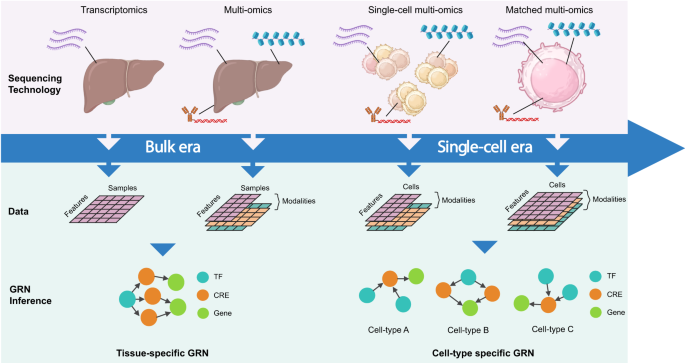
Within each cell is an ecosystem of millions of interacting molecules that play important roles in many processes. One of the most well-known molecules, besides DNA, is its cousin RNA, which can be measured as a proxy for gene expression. The earliest sequencing technologies were developed to capture RNA and other molecules within separate samples of cells. This provides distinct perspectives into the molecular activities within a cell. However, we can now measure different molecules within the same cell which can provide a better resolution into the interactions between different molecular players in each cell. This new approach opens up many new possibilities to better model gene regulatory networks as we can now more accurately model the interactions between molecules. However, the potential of this new data type cannot be realized without the appropriate computational tools to decode them.
Gene regulatory network inference
Since the advent of microarray data, various statistical and computational methods have been developed and used to better capture the regulatory relationships between genes, transcription factors, and cis-regulatory elements. With the arrival of matched single-cell multi-omic data, cutting-edge inference methods have emerged to transform this data into a comprehensive view of gene regulatory networks at the cell-type resolution. Recent methods leverage a range of techniques including stochastic differential equations to model regulatory interactions by including environmental interactions, while others harness the power of deep neural networks, paving the way for innovative approaches in the field. In fact, many use a combination of approaches, underscoring the intricacies of their algorithms.
We’re here to help
The concurrent advances in sequencing technologies and computational methods have provided an exciting opportunity to characterize the regulatory networks of cellular processes and responses. However, the complexity of gene regulatory networks is almost matched by the sheer number of inference methods and their unique statistical foundations, making it challenging to make sense of their underlying approaches. To facilitate readers in gaining a deeper understanding of the current landscape, we have written a comprehensive review exploring the advancements in gene regulatory network inference methods in the new era of single-cell multi-omics data.

Follow the Topic
-
npj Systems Biology and Applications
An online Open Access journal dedicated to publishing the premier research that takes a systems-oriented approach and encourages studies that integrate, or aid the integration of, data, analyses and insight from molecules to organisms and broader systems.

Related Collections
With Collections, you can get published faster and increase your visibility.
Systems immunology: multi-omics approaches, dynamical modeling and novel agentic AI approaches
Publishing Model: Open Access
Deadline: Dec 12, 2026
Mechanistic and data-driven modeling in mathematical oncology
Publishing Model: Open Access
Deadline: Dec 02, 2026