Decoding sex-specific metabolomic biomarkers in the loggerhead sea turtle (Caretta caretta)
Published in Ecology & Evolution, Protocols & Methods, and Zoology & Veterinary Science

The loggerhead sea turtle (Caretta caretta) is found in oceans worldwide and is classified under nine distinct population segments by the U.S. Endangered Species Act. It is also listed as vulnerable by the Convention on International Trade in Endangered Species (CITES) Appendix I. Factors such as climate change, along with other human-induced impacts, may be depleting their populations.
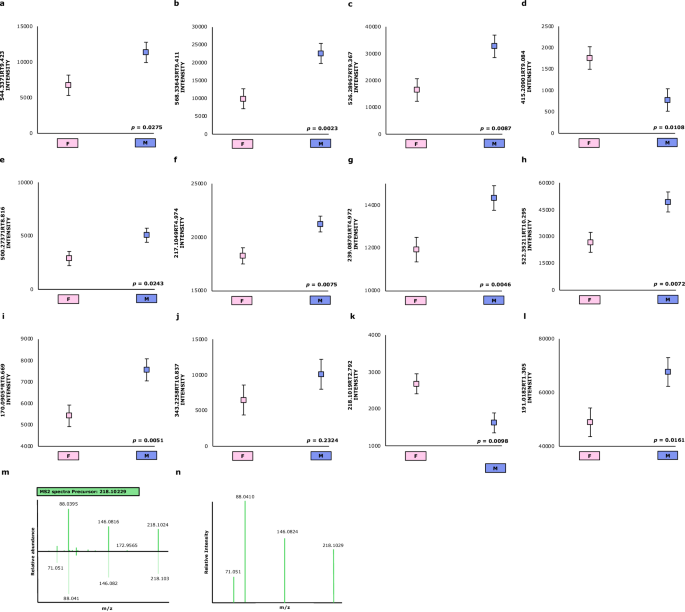
This study aimed to assess the sex-specific effects on plasma chemistry and the metabolome of loggerhead sea turtles, and to identify potential biomarkers for early sex determination during different life stages.
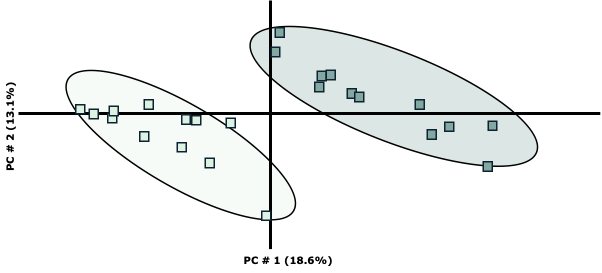
Figure 1: The Principal component analyzed (PC) plot derived from multivariate analysis demonstrates a clear separation between sexes in post-hatchling animals.
Therefore, we can affirmatively answer the first question: there is an effect of sex on the metabolome in both physiological stages. However, to provide a more comprehensive analysis, we identified the metabolites responsible for these differences, which were significantly present in greater or lesser amounts in a specific sex.
However, as mentioned, this is the first of the proposed objectives/questions. Now we can ask the next one: Are there useful biomarkers for sex classification in turtles?
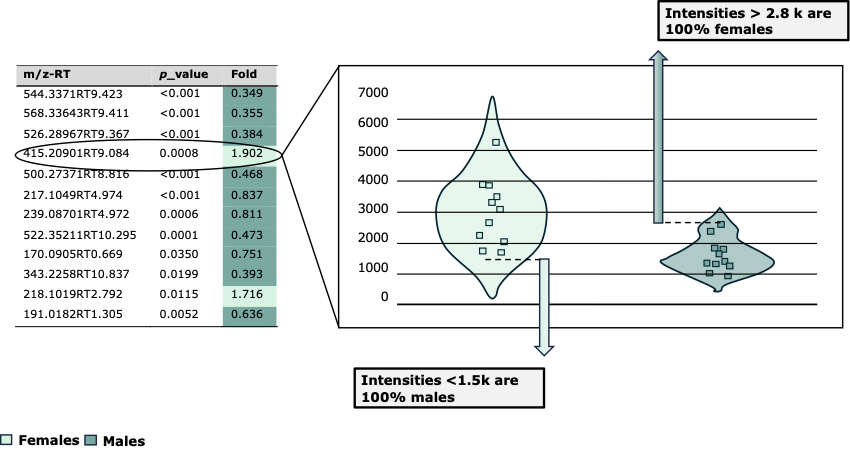 Figure 2: Example of Biomarkers.
To achieve this, we analyzed the individual values and their intensities in both groups, creating several graphs, such as the one shown in Figure 2. In this case, for the metabolite 415.20901RT9.084, we found that the values were significantly higher in females than in males (p=0.0008). Specifically, values below 1.5 allowed for the classification of 100% of males, while levels greater than 2.8 indicated 100% females. After conducting several studies of this nature and maintaining a stringent approach, this work concludes with some candidates identified as biomarkers for sex classification in the early life stages of this species.
These results can be found in the publication in Communications Biology doi:10.1038/s42003-024-07033-4.

Follow the Topic
-
Communications Biology
An open access journal from Nature Portfolio publishing high-quality research, reviews and commentary in all areas of the biological sciences, representing significant advances and bringing new biological insight to a specialized area of research.

Related Collections
With Collections, you can get published faster and increase your visibility.
Healthy Aging
Publishing Model: Open Access
Deadline: Dec 31, 2026
DNA repair and human disease
Publishing Model: Hybrid
Deadline: Oct 31, 2026