Designing Metal Phosphide Solid‑Electrolyte Interphase for Stable Lithium Metal Batteries Through Electrified Interface Optimization and Synergistic Conversion
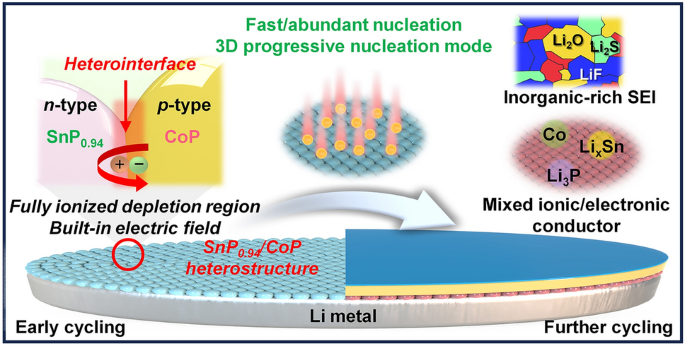

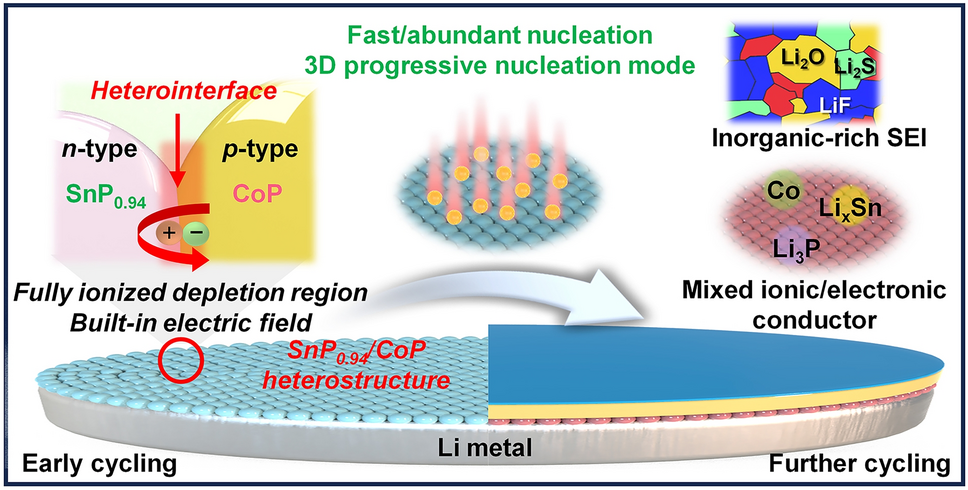

As the demand for high-energy-density batteries continues to grow, lithium metal batteries (LMBs) have emerged as a promising next-generation technology. However, challenges such as lithium dendrite growth, unstable interfaces, and poor cyclability have limited their practical use. Now, researchers from Korea University, KIST, and SungShin Women’s University, in a study published in Nano-Micro Letters, have developed a novel strategy to stabilize lithium metal anodes using a heterostructured metal phosphide modulation layer, offering new hope for safe and long-lasting energy storage.
Why This Matters
- Dendrite-Free Deposition: The smart modulation layer promotes uniform lithium nucleation and planar growth, effectively suppressing dendrite formation.
- High-Rate Capability: Enables stable lithium plating/stripping even at high current densities up to 5 mA cm-2.
- Long Cycle Life: Demonstrates over 750 stable cycles in symmetric cells and excellent performance in full-cell configurations.
Innovative Design and Features
- SnP₀.₉₄/CoP Heterostructure: A porous, nanobubble-rich structure formed via the Kirkendall effect, creating a p–n heterojunction with built-in electric field and ionized depletion region.
- In-Situ Conversion: Reacts with lithium during cycling to form a mixed ionic/electronic conductor (MEIC) composed of metallic Co, Li–Sn alloy, and Li3P.
- Enhanced Interfacial Stability: Provides abundant lithiophilic sites, reduces nucleation overpotential (~2.2 mV), and guides dense, dendrite-free lithium deposition.
Applications and Future Outlook
- Symmetric Cells: SCP@Li exhibits ultra-low overpotential and stable cycling for over 1200 hours at 1 mA cm-2, and up to 750 cycles at 5 mA cm-2.
- Full Cells: When paired with LiFePO4 or NCM811 cathodes, SCP@Li delivers superior capacity retention and rate performance, with LFP//SCP@Li retaining 75.8% capacity after 800 cycles.
- Scalable Strategy: The solid-state synthesis method is simple, efficient, and compatible with existing battery manufacturing processes.
This work highlights the power of interface engineering and heterostructure design in tackling the fundamental challenges of lithium metal anodes. It opens a new pathway toward practical, high-energy, and safe lithium metal batteries for electric vehicles, portable electronics, and grid-scale energy storage.
Stay tuned for more exciting developments from this research team as they continue to push the boundaries of next-generation battery technologies!

Editor of Nano-Micro Letters, which is an Open-Access, peer-reviewed journal reported papers that have at least one dimension ranging from a few sub-nanometers to a few hundreds of micrometers. The journal is published by Springer Nature and indexed by SCI, EI, SCOPUS, Pubmed, etc. The 2025 JCR Impact Factor is 38.5. The 2025 CiteScore is 58.9.
Follow the Topic
-
Nano-Micro Letters
Nano-Micro Letters is a peer-reviewed, international, interdisciplinary and open-access journal that focus on science, experiments, engineering, technologies and applications of nano- or microscale structure and system in physics, chemistry, biology, material science, and pharmacy.