Development and Design of Pattern Cards for Platform Revenue Models
Published in Business & Management






In our paper, we studied how platform revenue models – the strategies platforms use to generate revenue – can be structured and designed systematically, focusing on those operating in Germany. To do so, we developed a classification-based design approach, which we translated into a practical tool: pattern cards for platform revenue models.
These cards aim to help both researchers and practitioners better understand the mechanisms behind digital business models and provide inspiration for developing new monetization strategies.
Platforms – more than just technology
Digital platforms are not merely pieces of software. They form the core of broader digital ecosystems – networks of companies, individuals, and technologies that create value together. Within these ecosystems, multiple actors collaborate and exchange resources, products, or data.
However, technical infrastructure alone does not guarantee success. A sustainable business model is crucial. Platform operators must decide which market side to monetize, what kind of pricing structure to use, and how to ensure long-term economic stability.
While existing research has discussed the general principles of digital entrepreneurship, the concrete design of platform revenue models has remained underexplored. This gap motivated our work.
Building a taxonomy for platform revenue models
Platforms generate revenue in very different ways. Some charge access fees (like Tyre24 in the automotive parts trade), others rely on transaction-based commissions (like empto in waste management), offer premium services (like Vinted), or operate through sponsorships (like nebenan.de).
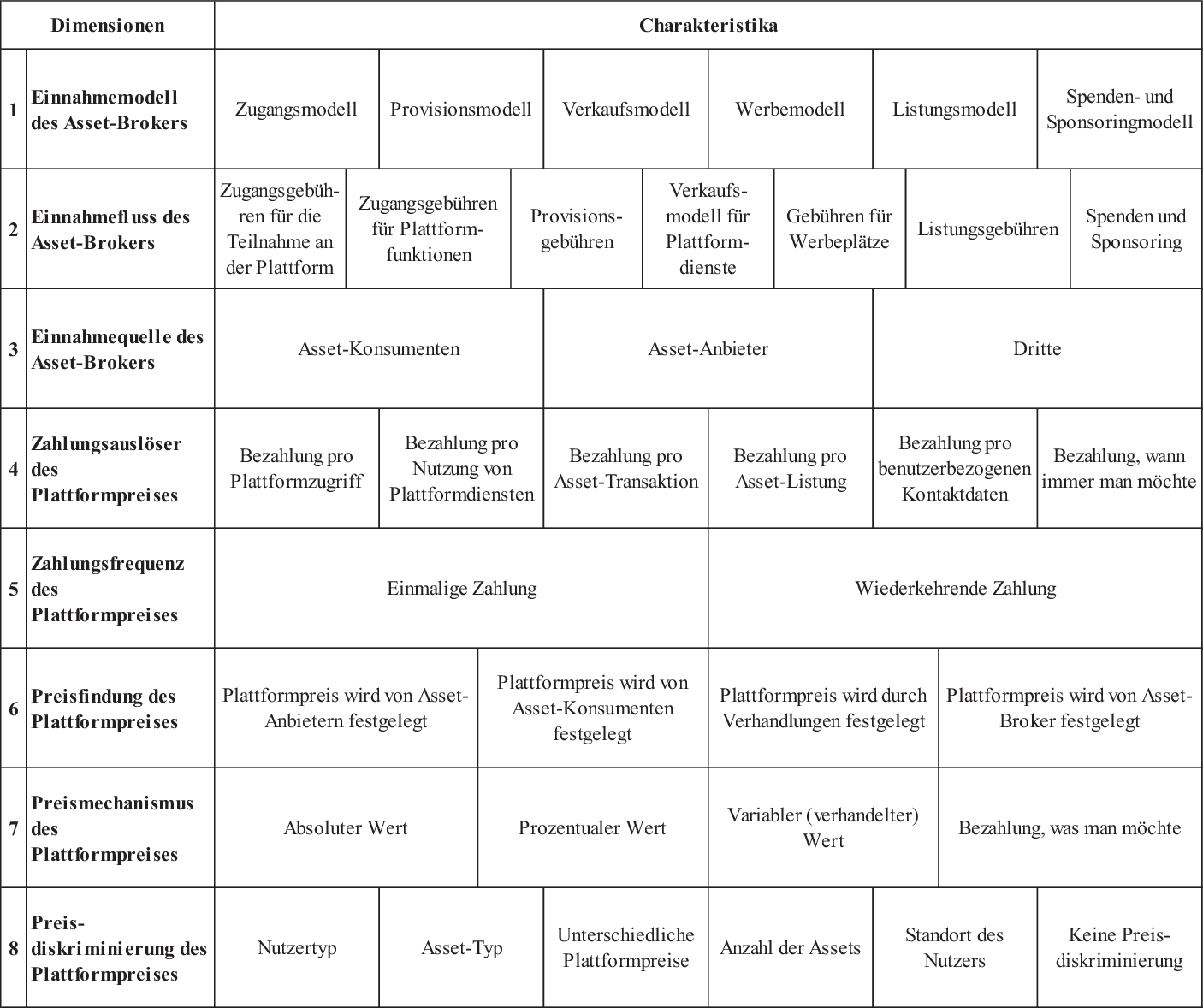
Because of this diversity, comparisons are difficult. To bring structure into this variety, we developed a taxonomy of platform revenue models – a classification framework that identifies and organizes the key dimensions of platform monetization.
Our taxonomy includes different dimensions with characteristics, such as:
- Revenue source: Who pays – the supplier, the consumer, or a third party?
- Revenue flow: How is the revenue generated – through access, use, transaction, or advertising?
- Pricing mechanism: Is the price fixed, variable, or negotiable?
This framework enables systematic analysis and comparison of revenue models and provides a structured foundation for both academic research and business design.
From theoretical model to practical tool
A taxonomy is valuable for classification, but we wanted to make it usable in practice. That’s why we translated it into pattern cards – concise, visually structured tools that summarize recurring types of platform revenue models.
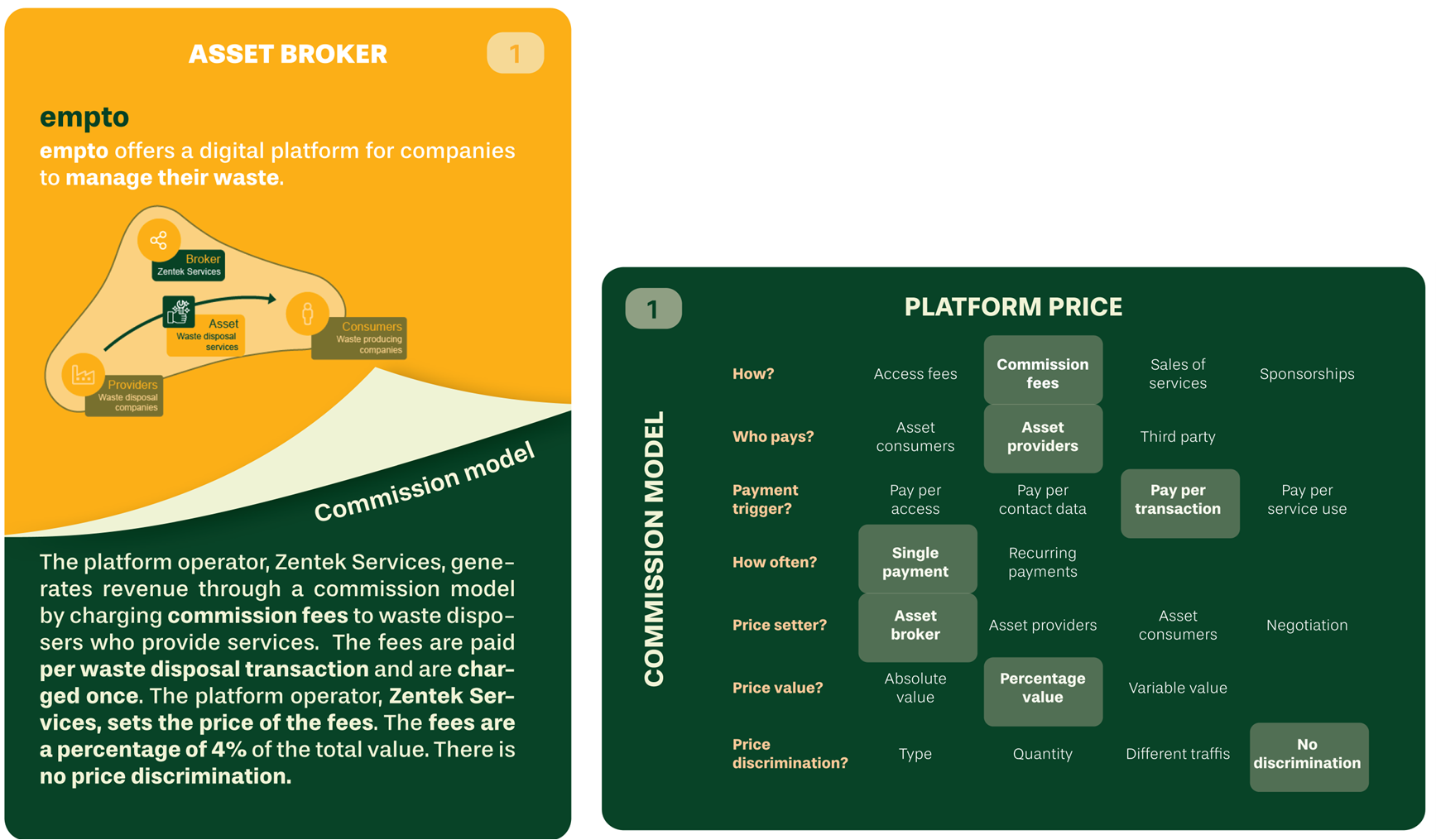
Each pattern card describes one specific model. It includes:
- a short explanation of the platform and its business logic,
- a visual representation of the actors involved (the platform operator, providers, and consumers),
- and a concise description of the relevant taxonomy dimensions.
The goal is to give decision makers in digital business a hands-on tool for exploring monetization options:
Which revenue model suits my platform idea? How should payments be structured? And which side of the market should I charge?
The concept builds on the “Business Model Navigator” by Gassmann and Frankenberger (2014) but tailors it specifically to the logic of platform revenue models.
Five real-world examples
To illustrate our cards, we analyzed five established platforms, each representing a different type of revenue model (see Figure 1 for an example card). Based on these analyses, we created a set of five pattern cards:
-
empto – Commission-based model
Waste management companies pay a 4% transaction fee per disposal order. -
Tyre24 – Access-based model
Workshops pay a monthly or annual access fee (between €29 and €69) to buy parts through the platform. -
MyHammer – Contact-fee model
Craftspeople pay for each customer contact they receive. -
Vinted – Add-on service model
Users can pay €25 per item for an optional verification service to boost buyer trust. -
nebenan.de – Sponsorship model
Municipalities or organizations financially support the platform to foster local communities.
These five patterns reveal the diversity of ways in which platforms capture value – from transaction-based logic to community-driven sponsorship.
Why this matters for practitioners
The pattern cards are not just theoretical artifacts. They are designed to be used actively in strategy workshops, innovation projects, and platform design processes.
For example, a start-up founder can use the cards to evaluate questions such as:
- Which user group should be monetized first?
- Would a recurring subscription model or a one-time fee be more effective?
- How do different pricing mechanisms affect user acceptance?
By making these dimensions explicit, the cards support structured and comparable decision-making in areas that are often guided by intuition alone.
This can be particularly valuable for early-stage digital ventures that need to define a viable revenue model before scaling their platform operations.
Limitations and future directions
Our approach is a starting point, not a final answer. The five pattern cards cover only a subset of all possible platform revenue types. In practice, most platforms operate with far more complex and hybrid models. For example, Tyre24 not only charges access fees but also applies transaction-based commissions, and other platforms combine multiple monetization strategies that evolve over time.
Therefore, the pattern cards should be understood as illustrative examples rather than comprehensive representations of entire revenue architectures. They capture the dominant or most visible monetization logic at a given point in time, but not the full financial interplay behind a platform business model.
Moreover, platform revenue models are dynamic. They adapt to market conditions, user behavior, and regulatory environments. What works today may not work tomorrow.
Therefore, future research could focus on:
- Expanding the set of pattern cards across industries and geographies.
- Longitudinal studies to observe how revenue models evolve over time.
- Empirical validation through real-world applications in start-ups and established companies.
Why now?
As digital platforms continue to transform markets, the question of monetization becomes increasingly critical. Many platforms fail not because of technical issues but because their revenue logic is unsustainable.
Our research aims to address this challenge by offering a structured, and practically applicable approach to platform monetization. By linking a rigorous taxonomy with intuitive design tools, we hope to bridge the gap between academic theory and entrepreneurial practice, and to provide a small contribution for those building the next generation of digital platforms.
Conclusion
With our pattern cards, we provide a structured and visually supported framework for analyzing and designing platform revenue models. It connects conceptual clarity with hands-on usability and helps innovators explore how digital platforms can both create and capture value sustainably. Digital platforms will remain a cornerstone of modern economies. Understanding how they earn money – and how they can do so responsibly and effectively – is essential for shaping the future of digital entrepreneurship.
Follow the Topic
-
HMD Praxis der Wirtschaftsinformatik
This is a double-blind peer-reviewed journal. It provides solution-oriented ideas from both academia and practice for current challenges of digital transformation, presents concrete implementation approaches, and shares the latest developments in the field of business informatics.