


It is now well established that breastfeeding is the strongest modifiable factor shaping infant microbiome development. Decades of dairy milk research have shown that milk contains a diverse collection of microbes, and while these were initially viewed as unwanted contaminants, it is now becoming clear that microbes are naturally present in milk from healthy mothers of all mammalian species. In fact, it has been estimated that breastfed infants ingest 104 to 106 bacteria per day (based on an average daily consumption of 800 mL of milk). However, until now, the vast majority of milk microbiology research (including our own research in the CHILD Cohort Study) has focused exclusively on bacteria. Inspired by new evidence from our lab mates studying fungi in dairy milk, and motivated by the growing interest in fungi as important members of the human microbiome, we decided to re-analyse the CHILD breast milk samples - this time looking for fungi.
Using the rich metadata available through the CHILD Cohort Study, we comprehensively assessed the association of breast milk fungi with maternal, infant, early life, and milk factors. We also collaborated with CHILD researchers who specialise in environmental science. This allowed us to study many factors that are not commonly available in human studies, such as the population density and green space surrounding each home, and interior home environment characteristics including dust, moisture, and mould. These environmental features greatly expanded the scope of our analysis, building on our theoretical framework of the origins of milk microbes. Since we had previously analysed bacteria in the same samples, we were able to examine the inter-kingdom associations between fungi and bacteria.
In contrast to the universal presence of bacteria in all milk analysed, we detected fungi in only 20% of samples, which raises the question: are fungi universally present in milk? If not, could this help explain the non-universal presence of fungi in the infant gut over the first year of life? And is this a reflection of the variability of environmental fungal in different regions and across different seasons? Indeed, some of the strongest predictors of the presence of milk fungi in our study were the city of residence and season of sample collection.
Interestingly, when it came to inter-kingdom interactions, bacterial composition was a strong determinant of fungal presence in milk, independent of the home environment. Also, in samples containing fungi, there were negative correlations between the relative abundances of specific bacteria and fungi. We speculate three potential scenarios to explain this observation (Figure): 1) some milk bacterial communities are more permissive to fungal presence and proliferation, 2) milk bacterial dynamics are influenced by fungi when they are present, and/or 3) milk bacterial composition is influenced by the milk environment, which also independently facilitates fungal inoculation or colonisation. Conceivably, these interactions might actually occur in the infant mouth before retrograde transfer to the milk during breastfeeding.
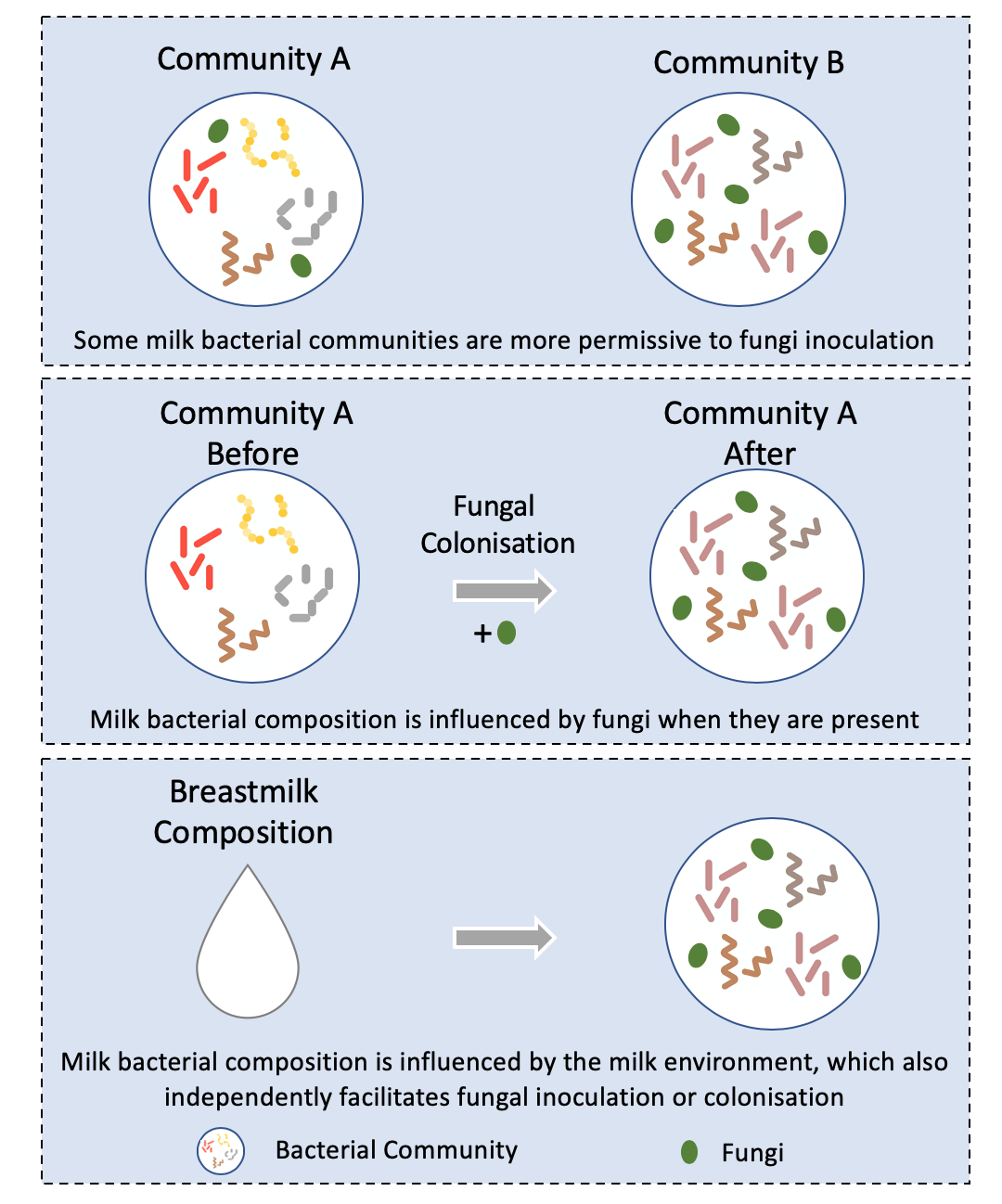
Plausible mechanisms underlying the association of milk bacterial composition with milk fungi presence.
The milk microbiome is controversial in the sense that scientists are divided on whether it represents an evolutionarily-conserved mechanism of microbial selection and vertical transfer from mothers to infants, or a natural consequence of exposure to the infant mouth and/or pumping apparatus. Our study cannot answer this question – but regardless, we believe that any microbial species found in milk are important as they are ingested by the infant. These milk microbes may contribute to the well-documented health effects of breastfeeding, including a lower risk of non-communicable diseases such as asthma - an association which is partly mediated by infant gut microbiota. If breastfeeding is modulating infant microbiota development by enriching, protecting, and delivering bacteria and potentially fungi to the infant respiratory and gastrointestinal tract, it is plausible that alterations in milk bacteria and fungi could influence trajectories of respiratory and gut health. We are currently exploring these questions in the CHILD Cohort as the ‘infants’ (now 8-10 years of age) continue to be followed and evaluated for childhood asthma - stay tuned!
The full paper was published in BMC Microbiology and can be found here.
Bacterial icon were obtained from vecteezy under free licence.

Follow the Topic
-
BMC Microbiology
This is an open access, peer-reviewed journal that considers articles on all microorganisms - bacteria, archaea, algae and fungi, viruses, unicellular parasites and helminths.

Related Collections
With Collections, you can get published faster and increase your visibility.
Current challenges and future directions in virology
The field of virology has gained significant momentum over the past few decades, driven by the global rise in emerging and re-emerging viral infectious diseases. Recent developments in molecular biology, multi-omics technologies, next generation sequencing and bioinformatics have significantly enhanced our understanding of the mechanisms of viral replication, pathogenesis, and the intricacies of virus–host interactions. These advances continue to open new avenues for antiviral development and vaccine design. By promoting interdisciplinary approaches and collaborations, virology research is well-positioned to uncover the fundamental principles and determinants underlying viral success and evolution, and to identify novel therapeutic targets.
Persistent and latent viral infections, such as those caused by HIV and herpesviruses, present a continuing challenge due to their ability to evade immune responses and establish long-term reservoirs. Additionally, the rapid genetic evolution of viruses and the emergence of resistance to existing antivirals highlight the need for sustained innovation in treatment strategies and vigilant molecular surveillance.
In support of United Nations’ Sustainable Development Goal 3 (SDG 3, Good Health and Well-Being), BMC Microbiology launches the Collection ‘Current challenges and future directions in virology’. This Collection aims to bring together research on virology, seeking to highlight current and future challenges of the field, with the goal of advancing our ability to study viruses and control viral infectious diseases. We welcome submissions addressing all aspects of virology, including virus–host cell interactions, viral transmission, antiviral interventions, and the role of environmental factors in viral ecology. Manuscripts without a clear focus on viruses or virus-cell host interactions will not be considered. We invite researchers and experts in the field to submit research articles covering a broad range of topics including, but not limited to:
Molecular mechanisms of viral infection and virus-host cell interactions
Virus-host cell metabolism interactions during infection
Innate immune response mechanisms to viral pathogens
Mechanisms of immune evasion by viruses
Direct-acting antivirals and host-directed antiviral therapeutic approaches
Viral proteins in pathogenesis and their potential as therapeutic targets
Pathways of viral replication and infection relevant to drug discovery
Immunotherapeutic approaches aimed at enhancing innate and trained immunity
Innovations in molecular diagnostics for virus detection
Environmental virology and virus ecology, including the influence of environmental factors on viral transmission and emerging viral diseases
Development of pan-viral or broadly protective vaccines targeting multiple virus families
Applications of artificial intelligence and machine learning in viral detection, antivirals and vaccine development, and surveillance
Personalized virology and precision medicine approaches based on host genetics and immune profiling
Drug repurposing for emerging viruses: role of computational pharmacology
All manuscripts submitted to this journal, including those submitted to collections and special issues, are assessed in line with our editorial policies and the journal’s peer review process. Reviewers and editors are required to declare competing interests and can be excluded from the peer review process if a competing interest exists.
Publishing Model: Open Access
Deadline: Nov 05, 2026
Microbes in built environments
The microbial communities (e.g. bacteria, fungi, viruses) that inhabit human-built environments are diverse, dynamic and complex, and they play a significant role in human health and wellbeing. From indoor air quality to the surfaces and building materials we touch daily, we interact with a range of microbes that come from a variety of sources such as other humans, pets, plants, pests, and other outdoor sources. Investigating and understanding these interactions require interdisciplinary approaches that integrate microbiology, ecology, and engineering principles, among other disciplines. As our understanding of microbial dynamics within built environments advances, it becomes increasingly clear that built-environment microbes and microbiomes can strongly affect human health, either positively or negatively.
Recent research has highlighted the potential importance of indoor microbial diversity in influencing human health (e.g. respiratory health, allergies, and the spread of multidrug-resistant organisms, particularly in healthcare settings). Innovations in monitoring and modelling microbial communities are opening new avenues for designing healthier indoor environments and mitigating risks from unwanted microbial exposures. Ongoing research in the field has the potential to yield novel insights into how these microbes respond metabolically to certain stressors and how we can leverage that knowledge. Additionally, a better understanding of microbe-host interactions could aid in developing novel approaches in building design and public health initiatives. Adaptive antimicrobial methods based on real-world conditions (such as occupancy, ventilation, and microbial indicators) offer a promising pathway to control microbial risks while minimizing unintended impacts.
In support of the United Nations’ Sustainable Development Goal 3 (SDG 3, Good Health and Well-Being), BMC Microbiology launches the Collection Microbes in built environments. This Collection invites research articles that contribute to the understanding of microbes and microbiomes in human-built environments, encompassing microbial ecology, diversity, metabolism, and their implications for human health. Submissions are welcome on topics ranging from indoor microbial communities to the impact of design on microbe-host interactions in the built environment. Research without a clear focus on microorganisms, microbial communities, or microbiomes in built environments will not be considered. We invite researchers and experts in the field to submit research articles covering a broad range of topics, including, but not limited to:
- Interactions between microorganisms/viruses and hosts in built environments
- Microbial physiology, metabolism, adaptation and diversity of the built environment
- Impact of microbes in the built environment on human health and diseases
- Antimicrobial resistance of the built environment
- Holistic pathogen defence in the built environment
- Microbial ecology of the built environment
- Microbial adaptation and evolution in response to anthropogenic disturbances in built environments
- Viruses in the built environment
- Food surfaces and disinfection in the built environment
- Role of indoor air quality, ventilation and HVAC systems in microbial community dynamics
- Impact of surface and building materials on microbial colonisation
- Bioremediation and microbial management in built environments
- Interventions to promote/discourage microbial exposures in built environments
- Environmental monitoring methods of microbes in built environments
- Adaptive antimicrobial strategies in built environments
All manuscripts submitted to this journal, including those submitted to collections and special issues, are assessed in line with our editorial policies and the journal’s peer-review process. Reviewers and editors are required to declare competing interests and can be excluded from the peer review process if a competing interest exists.
Publishing Model: Open Access
Deadline: Oct 22, 2026