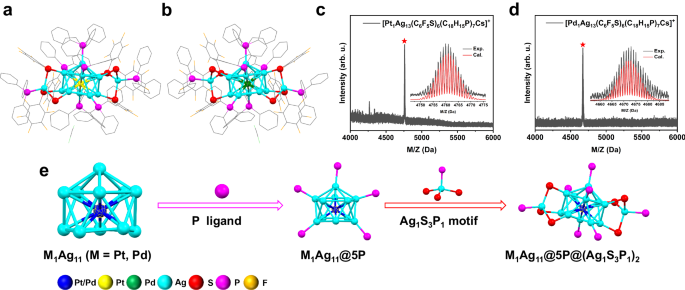

Atomically precise nanoclusters (NCs) with exact atomic configurations are ideal platforms for investigating photoluminescence (PL) mechanisms, which enables customizing the PL properties of these NCs and promoting their application in the field of optoelectronics. In particular, the NCs with dual-emission may emerge as novel materials for ratiometric sensing, bioimaging, and novel optoelectronic devices. Although several studies have been conducted to reveal the PL mechanism of dual-emissive NCs, they are primarily limited to NCs with closed-shell structures which are preferred in NCs according to superatom theory and electron-counting rules. The instability of open-shell NCs with one unpaired electron may restrict its research on PL. Meanwhile, the open-shell molecules emit differently from the closed-shell molecules. Generally, they exhibit doublet fluorescence emission from the first excited doublet state (D1) to the ground state (D0). Quartet phosphorescent emission from the first excited quartet state (Q1) to the D0 state has rarely been reported because of the higher energy level of the Q1 state. Thus, identifying open-shell NCs with unpaired electrons in the excited state may provide an alternative strategy for further understanding the PL mechanism of dual-emissive NCs. In this work, we synthesized two open-shell nanoclusters, Pt1Ag13 and Pd1Ag13, and elucidated their dual emission mechanism. This study provides a fresh perspective on understanding the dual emission mechanism and opens up new possibilities for the application of nanoclusters in magnetoluminescence and novel optoelectronic devices.
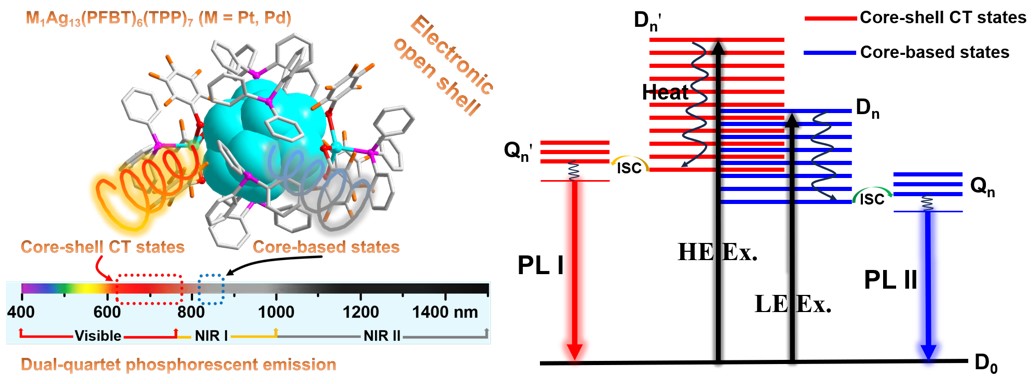
Proposed schematic dual-emission mechanism of M1Ag13 nanoclusters.
The article begins by detailing the synthesis and characterization of Pt1Ag13 and Pd1Ag13 nanoclusters. Through techniques such as electrospray ionization mass spectrometry (ESI-MS), electron paramagnetic resonance (EPR), thermogravimetric analysis (TGA), and X-ray photoelectron spectroscopy (XPS), the chemical composition and structure of the nanoclusters are confirmed. Luminescence spectroscopy prove that both nanoclusters exhibit dual-quartet phosphorescent emission, with emissions in the visible and near-infrared regions.
Subsequently, we delve into the dual-emission mechanism of Pt1Ag13 and Pd1Ag13 nanoclusters. Through a combination of experimental and theoretical studies, the high-energy visible emission and low-energy near-infrared emission are attributed to distinct quartet excited states: the core-shell charge transfer and core-based states, respectively. The role of PFBT ligands in facilitating energetically feasible core-shell transitions is highlighted, providing a blueprint for designing materials with dual-emission properties.
Furthermore, we extend the significance and potential applications of dual-quartet phosphorescent emission in open-shell nanoclusters. This unique dual-emission property not only enriches our understanding of emission mechanisms but also paves the way for the application of nanoclusters in magnetoluminescence and novel optoelectronic devices.
For more details, check out our paper “link: https://doi.org/10.1038/s41467-024-50289-x” on Nature Communications.
This post is contributed by Cao Fang, Daqiao Hu and Manzhou Zhu.
Follow the Topic
-
Nature Communications
An open access, multidisciplinary journal dedicated to publishing high-quality research in all areas of the biological, health, physical, chemical and Earth sciences.

Related Collections
With Collections, you can get published faster and increase your visibility.
Women's Health
Publishing Model: Hybrid
Deadline: Ongoing
Tumor Microenvironment Crosstalk and Therapeutic Implications
Publishing Model: Hybrid
Deadline: Nov 02, 2026