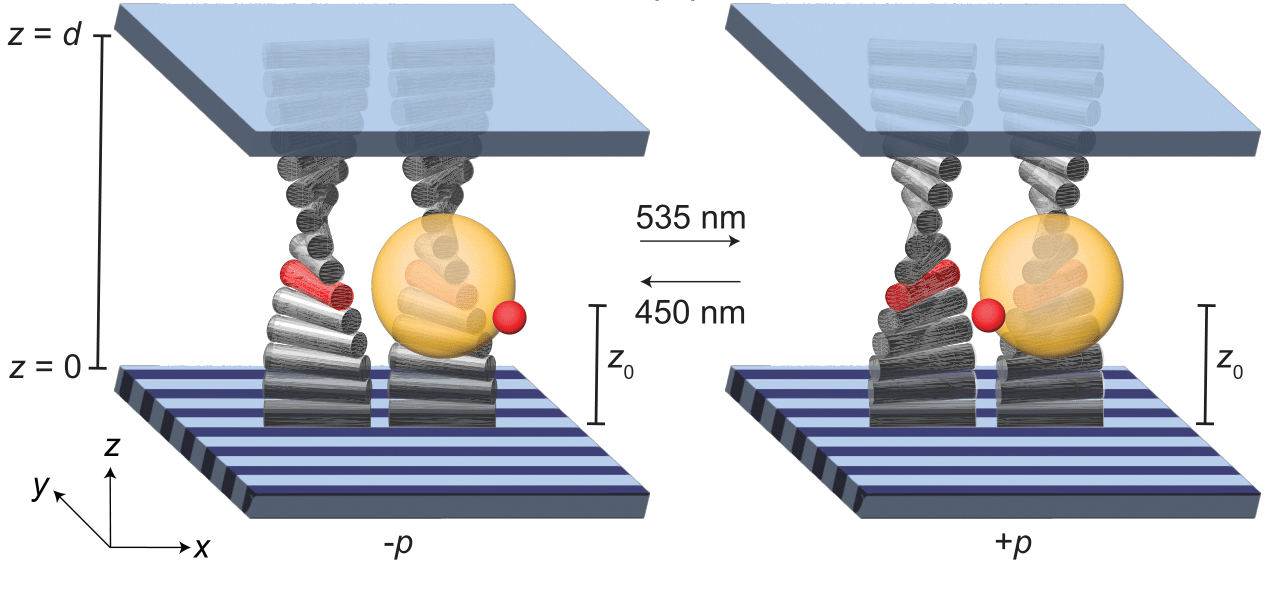
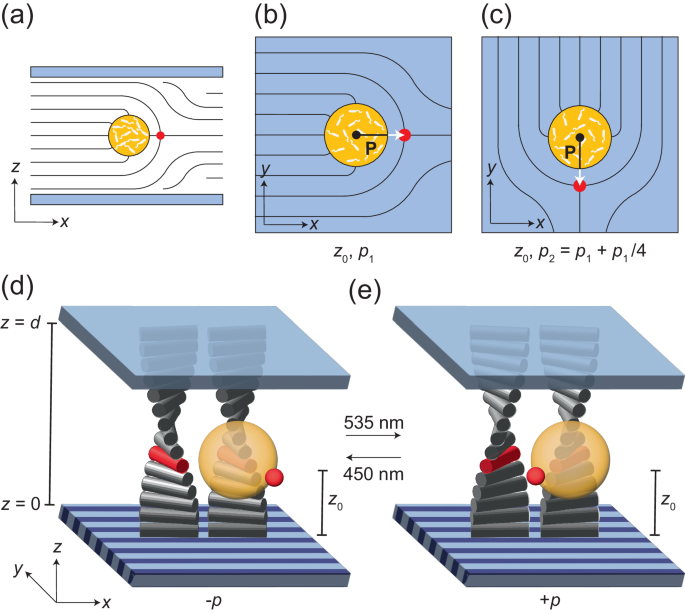

Microscopic active droplets are of interest since they can be used to transport matter from one point to another. In our research, active droplets represent droplets of water with thousands of swimming bacteria Bacillus subtilis inside them. These droplets can be stabilized by surfactants in oil-like environment. When the environment is isotropic, the droplets show random displacements, similar to classic Brownian motion, and produce no directional transport. However, when placed in an anisotropic oil environment, namely, a nematic liquid crystal with molecules that tend to align parallel to each other, active droplets show a remarkable ability to propel themselves over long distances. The trajectories run parallel to the surrounding molecular orientation of the liquid crystal. The propulsion is unidirectional, because the liquid crystal creates a polar “cloud” of molecular orientation that breaks the fore-aft symmetry, see Figure below. The flows created by the randomly swimming bacteria inside the droplet transfer through the interface into the nematic surrounding. The fore-aft asymmetry of molecular orientations around the droplet rectifies these chaotic flows into a directional flow of the nematic outside the droplet. As a result, the droplet propels unidirectionally. The grand challenge is how one can dynamically steer the droplet into a desired direction. In the past, static control of propulsion was achieved through surface patterning of the orientation of the liquid crystal. In our work, we proposed a dynamic non-contact method to control the propulsion direction of active droplets by placing them in a photoresponsive cholesteric liquid crystal environment. A cholesteric is a chiral version of the nematic liquid crystal. The molecules are arranged in nematic-like layers that stack on top of each other; the direction of molecular orientation twists from one pseudolayer to the next. This helical supramolecular structure is characterized by a pitch p, which is the distance over which the molecular orientation twists by 360°. The pitch of the cholesteric can be tuned by light if the material is doped by photosensitive molecules that change their conformations upon irradiation; the helicoid can even be completely unwound. For example, the cholesteric material developed in our laboratory changes the sense of rotation from left-handed to right-handed when exposed to blue light and in opposite direction when exposed to green light, as shown in the Movie below. When the pitch changes, the axis of the fore-aft asymmetry rotates. As a result, an active droplet suspended in a cholesteric bulk realigns its trajectory since the latter is always parallel to the fore-aft asymmetry axis.
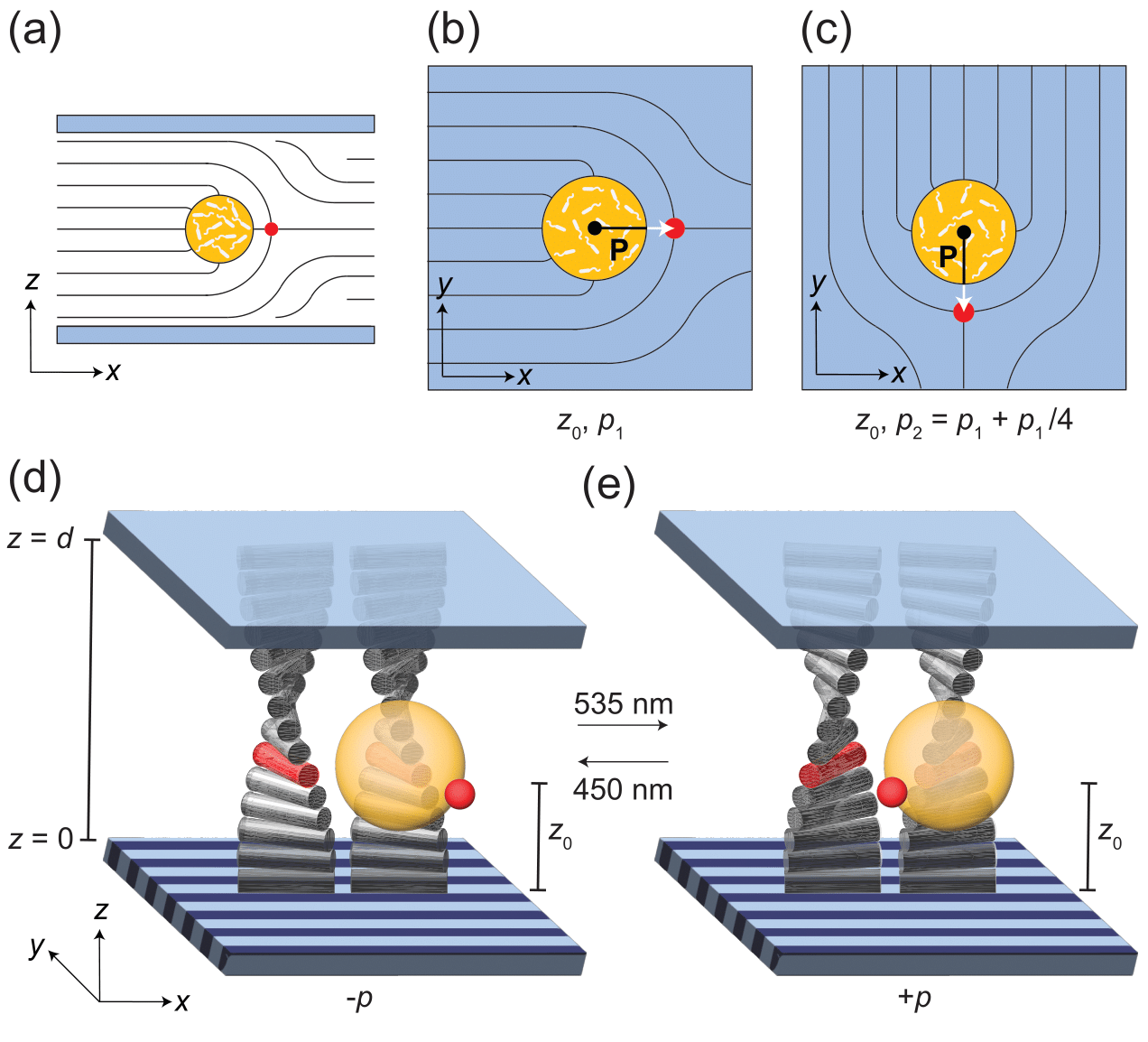
An important parameter controlling the dynamics of trajectory adjustments is the pitch-to diameter ratio, |p|/2R. A relatively small |p|/2R ≈ 1.5 in a strongly twisted cholesteric allows for a wider range of trajectory realignment, up to approximately 180°, albeit with slower propulsion speeds and transient regimes of structural reorganization. Conversely, a weakly twisted cholesteric with a higher |p|/2R ≈ 3.7-3.8 provides propulsion speeds comparable to those in nematic environments and reduce director reorganization times during irradiation to approximately 2 minutes, owing to a heightened degree of polar asymmetry.
The presented approach allows one to dynamically control the trajectories of active droplets using light as a non-contact stimulus, with a simple experimental design. An important condition of the dynamic control is that the surrounding medium is a photosensitive cholesteric liquid crystal. Without orientational order of the liquid crystal, the propulsion of active droplets is random and hard to control. In our work, the driving force of the droplets' propulsion is the activity of bacterial microswimmers inside them. However, the driving force is not necessarily limited by bacteria. For example, the needed energy influx can be provided by artificial engineered microswimmers; any interior or surface active flows within droplets would produce similar propulsion and re-direction by the cholesteric environment if the director field outside the droplet is asymmetric.
You can read the complete article here.

Follow the Topic
-
Communications Physics
An open access journal from Nature Portfolio publishing high-quality research, reviews and commentary in all areas of the physical sciences.

Related Collections
With Collections, you can get published faster and increase your visibility.
Nonlinear dynamics of living systems
Publishing Model: Open Access
Deadline: Nov 09, 2026
Active, Entangled or Confined: Polymer Physics Across Synthetic and Living Matter
Publishing Model: Open Access
Deadline: Dec 31, 2026