EDUCATION FOR SUSTAINABLE DEVELOPMENT AND THE 2030 AGENDA
Published in Social Sciences, Earth & Environment, and Ecology & Evolution


📚🌱 EDUCAÇÃO PARA O DESENVOLVIMENTO SUSTENTÁVEL E A AGENDA 2030
Tenho o prazer de compartilhar novamente nosso artigo publicado na Discover Sustainability, uma revista da Springer Nature :
📖 Educação para o desenvolvimento sustentável no contexto universitário brasileiro e a Agenda 2030
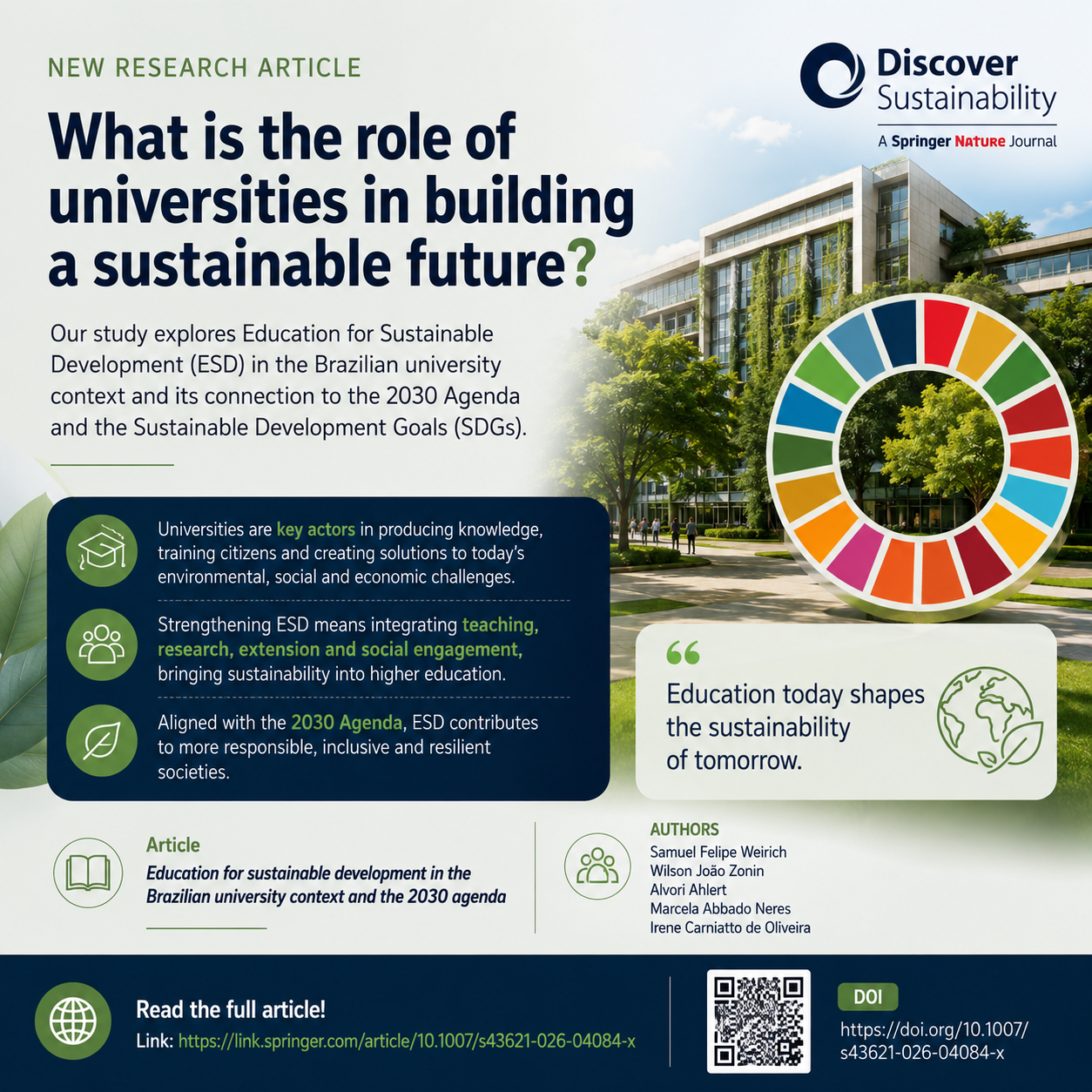
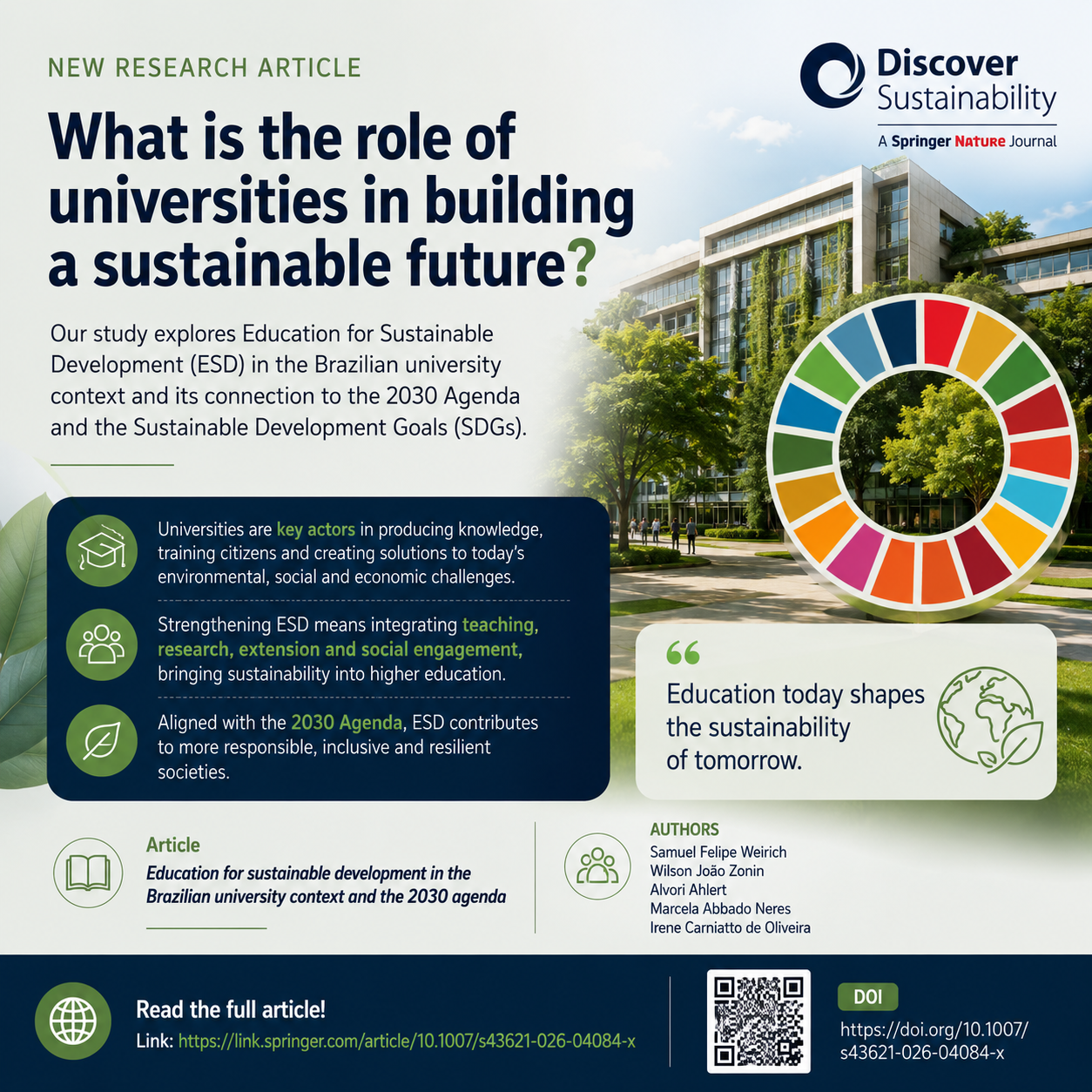
O estudo aborda uma questão cada vez mais importante: qual é o papel das universidades na construção de um futuro mais sustentável?
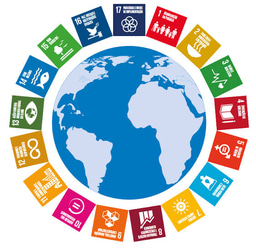
Nossa pesquisa analisa a Educação para o Desenvolvimento Sustentável (EDS) no contexto das universidades brasileiras e sua conexão com a Agenda 2030 e os Objetivos de Desenvolvimento Sustentável (ODS) .
🌎 Mais do que espaços para formação profissional, as universidades desempenham um papel estratégico na produção de conhecimento, na educação de cidadãos e no desenvolvimento de respostas aos desafios ambientais, sociais e econômicos contemporâneos .
Nesse contexto, fortalecer a Educação para o Desenvolvimento Sustentável significa reunir ensino, pesquisa, extensão e engajamento social , ajudando a integrar efetivamente os princípios da sustentabilidade no ensino superior.
👥 Autores:
Samuel Felipe Weirich
Wilson João Zonin
Alvori Ahlert
Marcela Abbado Neres
Irene Carniatto de Oliveira See More
📘 Descubra a Sustentabilidade | Springer Nature
🔗 Leia o artigo completo:
https://link.springer.com/article/10.1007/s43621-026-04084-x
🔎 DOI:
https://doi.org/10.1007/s43621-026-04084-x
#DesenvolvimentoSustentável #Agenda2030 #ODS #EducaçãoParaOSuficiência #EducaçãoAmbiental #EnsinoSuperior #Universidades #Sustentabilidade #PesquisaCientífica #DescubraASustentabilidade #SpringerNature #UNIOESTE
Follow the Topic
-
Discover Sustainability
A multi-disciplinary, open access, community-focussed journal publishing results from across all fields relevant to sustainability research whilst supporting policy developments that address all 17 of the United Nations Sustainable Development Goals (SDGs).

Related Collections
With Collections, you can get published faster and increase your visibility.
Climate Resilient, Smart and Sustainable Futures: Integrated Solutions for a Just and Inclusive Planet
Given the growing concern over the impact of climate change-induced extreme weather events, transformative responses to the climate crisis are required to integrate resilience building, Sustainable Development Goals (SDGs), digital and smart technologies, equitable governance, and sectoral pathways (including heritage conservation, tourism, and aviation). This collection invites transdisciplinary research that advances knowledge on integrated solutions for climate-resilient, smart, and sustainable futures, especially in the contexts of the developing world. This collection is seeking research that bridges theoretical advances, empirical studies, and policy/practice implications with a strong preference for studies that speak to real-world transitions, justice, inclusivity, and cross-sectoral collaboration. Topics of interest for this collection include:
• Climate Impact, Resilience and Mitigation
• Sustainable Development Goals Integration
• Smart change and digital transformations
• Policy, law, and governance
• Heritage, tourism, aviation, and services under climate change
Keywords: Climate Change, SDGs, Smart Change, Climate Resilience, Policy and Governance, Tourism, Nature-Based Solutions
Publishing Model: Open Access
Deadline: Mar 30, 2027
Environmental Management and the SDGs: Innovations, Challenges, and Future Directions
Achieving the Sustainable Development Goals (SDGs) requires innovative and effective approaches to environmental management. This Collection welcomes research that addresses practical solutions, emerging challenges, and new directions in managing environmental resources in support of SDGs such as clean water (SDG 6), clean energy (SDG 7), sustainable cities (SDG 11), responsible production (SDG 12), climate action (SDG 13), and protection of terrestrial and aquatic ecosystems (SDG 14 & 15). We invite articles presenting scientific advancements, applied case studies, policy insights, and assessment tools that help governments, communities, and industries strengthen sustainability and environmental resilience in both developing and developed regions.
Keywords: Sustainable development, Environmental management, Climate resilience, Environmental assessment (EIA/SEA/SIA), Renewable energy, Circular economy, Biodiversity, Municipal solid waste management, Environmental policy and governance
Publishing Model: Open Access
Deadline: Dec 01, 2026