Evidence of chronic sinusitis alleviation after open sinus allogeneic bone augmentation with simultaneous implant placement: A long-term retrospective observational study

Like

Share this post

Choose a social network to share with, or copy the URL to share elsewhere

This is a representation of how your post may appear on social media. The actual post will vary between social networks

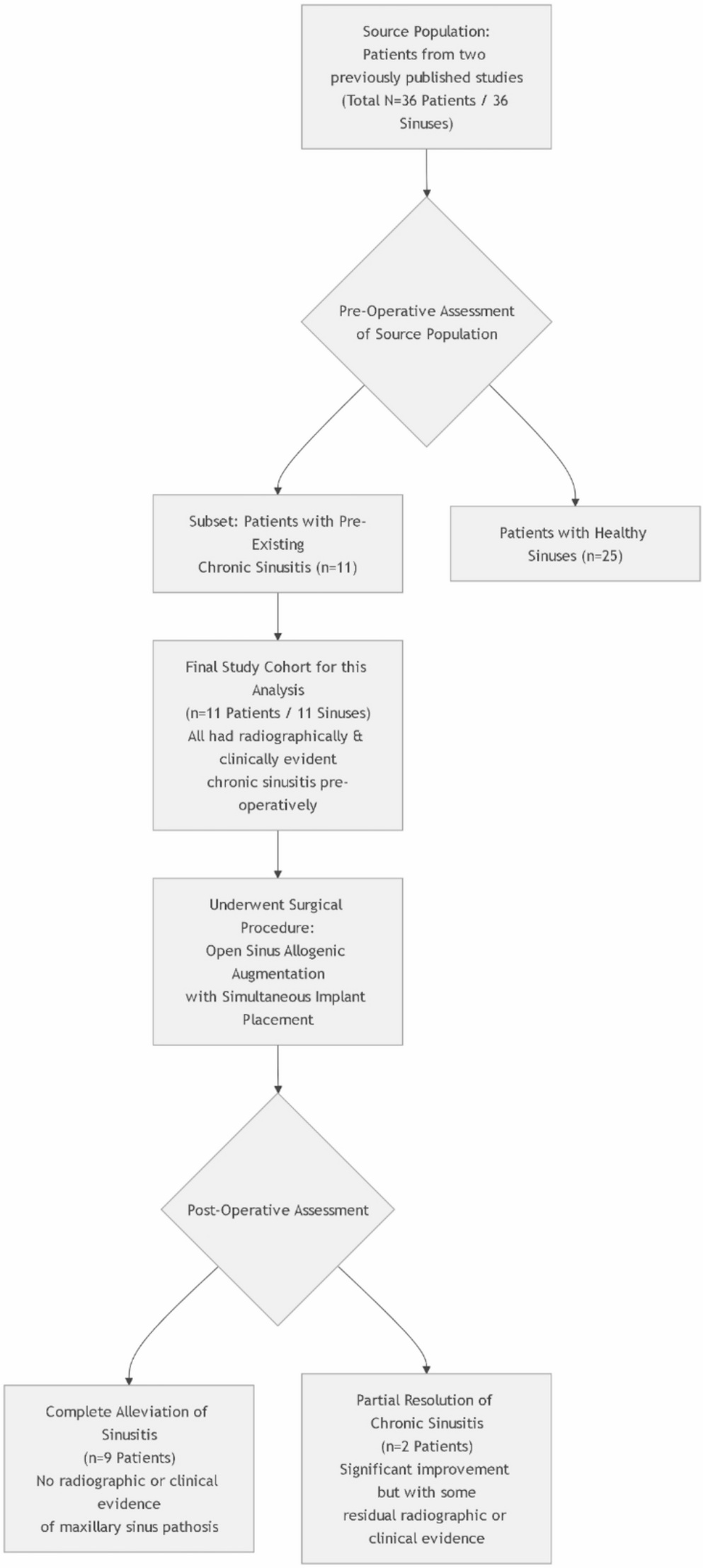
Severe maxillary atrophy poses challenges for dental implant placement, particularly in the posterior maxilla. The study found that using the open sinus elevation technique with simultaneous implant placement can lead to the resolution of chronic sinusitis symptoms. This retrospective analysis focused on patients with pre-existing chronic sinusitis, revealing complete resolution in nine out of eleven cases and partial resolution in two. Radiographic evaluations showed significant reductions in fluid levels, and clinical assessments indicated a notable decrease in SNOT-22 scores, highlighting symptom improvement. However, more work is still needed to confirm these findings and explore their broader implications for dental and sinus health. Read the full article here. 


Evidence of chronic sinusitis alleviation after open sinus allogeneic bone augmentation with simultaneous implant placement: A long-term retrospective observational study | Oral and Maxillofacial Surgery

https://doi.org/10.1007/s10006-025-01482-9

Please sign in or register for FREE

If you are a registered user on Research Communities by Springer Nature, please sign in

Follow the Topic

Clinical Medicine
Life Sciences > Health Sciences > Clinical Medicine
Dental Implant
Life Sciences > Health Sciences > Clinical Medicine > Dentistry > Dental Treatments > Dental Implant

Your space to connect: The Primary immunodeficiency disorders Hub

A new Communities’ space to connect, collaborate, and explore research on Clinical Medicine, Immunology, and Diseases!

Continue reading announcement

Related Collections

With Collections, you can get published faster and increase your visibility.

Current State and Future Opportunities for 3D Printing/Additive Manufacturing in Oral and Maxillofacial Surgery: from Basic Science to Clinical Applications

Three-dimensional (3D) printing, also known as additive manufacturing, has emerged as a transformative technology in oral and maxillofacial surgery. It offers unprecedented precision and customization in the fabrication of patient-specific anatomical models, surgical guides, and implants. This not only enhances preoperative planning and intraoperative accuracy but also significantly reduces surgical time and improves postoperative outcomes, as surgeons can now visualize complex craniofacial structures in tangible form, simulate procedures, and tailor interventions to the unique anatomical and functional needs of each patient. It minimizes risks and optimizes aesthetic and functional results, especially in cases involving congenital deformities, trauma reconstruction, oncologic resections, and orthognathic surgery, where traditional methods often fall short in achieving ideal fit and alignment. The integration of biocompatible materials and advances in digital imaging and computer-aided design (CAD) further expand the scope of 3D printing applications, enabling the production of implants that conform precisely to bone contours and support tissue regeneration. As this technology continues to evolve, with ongoing research into bio-printing and the use of stem cells and growth factors, the potential for creating living tissue constructs and fully functional bone grafts becomes increasingly feasible, promising a future where personalized, regenerative solutions become standard practice in maxillofacial care. Although challenges remain in terms of regulatory approval, cost-effectiveness, and widespread clinical adoption, the growing body of evidence supporting its efficacy and safety underscores the importance of continually educating practitioners on the latest developments in the subject to enable informed decision-making and ultimately, improved patient outcomes.

Publishing Model: Hybrid

Deadline: Ongoing