Expected effects of a global transformation of agricultural pest management
Published in Ecology & Evolution, Sustainability, and Agricultural & Food Science





Authors: Niklas Möhring and Robert Finger
The protection of crops from pests, diseases and weeds is central for the production of safe and diverse food in sufficient quantities worldwide (Savary et al., 2019). Current pest management is strongly relying on pesticide use with a global consumption of 3.7 million tons in 2023 (FAO, 2025). Pesticides are often the cheapest, most effective and most easy to apply approach to pest management. But concerns about their environmental impacts, human health risks, and the long-term sustainability of chemically intensive crop protection have increased steadily over recent decades (Frank, 2024, Perrot et al., 2025). Policy goals to reduce pesticide risk have therefore been set on global, national, and regional levels (Möhring et al., 2020, 2023). However, the consequences of a massive reduction of the reliance of pesticides by a large-scale transformation to sustainable pest management at the global scale are unknown. While there is evidence for specific crops and regions, we so far lack the data and methods to assess such a transformation coherently at the global scale for a wide range of crops, farming systems and regions.
In a study published in Nature Communications (Möhring et al., 2025) we provide an assessment of the expected effects of a global transformation of agricultural pest management. A challenge in this research field, additional to data scarcity, is that potential effects cover a wide range of domains and disciplines. To answer this question, we have therefore assembled an interdisciplinary team of co-authors from Agricultural Economics, Ecology, Pest Management Sciences, and Toxicology from all over the world.
To assess the potential effects of a transformation of pest management, we created the first holistic assessment framework, covering 24 indicators in the domains of Economics, Food Security, the Environment, Human Health and Social Equality. The indicators cover areas where we previously had a comparably good knowledge of potential effects (e.g., pollution of waterbodies) but also those for which effects have previously been completely unknown, such as the fair distribution of costs and benefits of pest management. Our analysis aims to assess implications of a global transformation to sustainable pest management and how potential effects would differ between global regions. Based on the framework, we then conducted a global expert assessment with 517 senior experts on sustainable pest management. The experts covered all important global agricultural regions, as all well as all scientific disciplines working in the field and also comprised non-academic experts. We excluded respondents from domains where they have no expertise and conducted robustness checks for domain-specific expertise.
Fig. 1: Differences in expected effects of a global transformation of agricultural pest management across indicators.
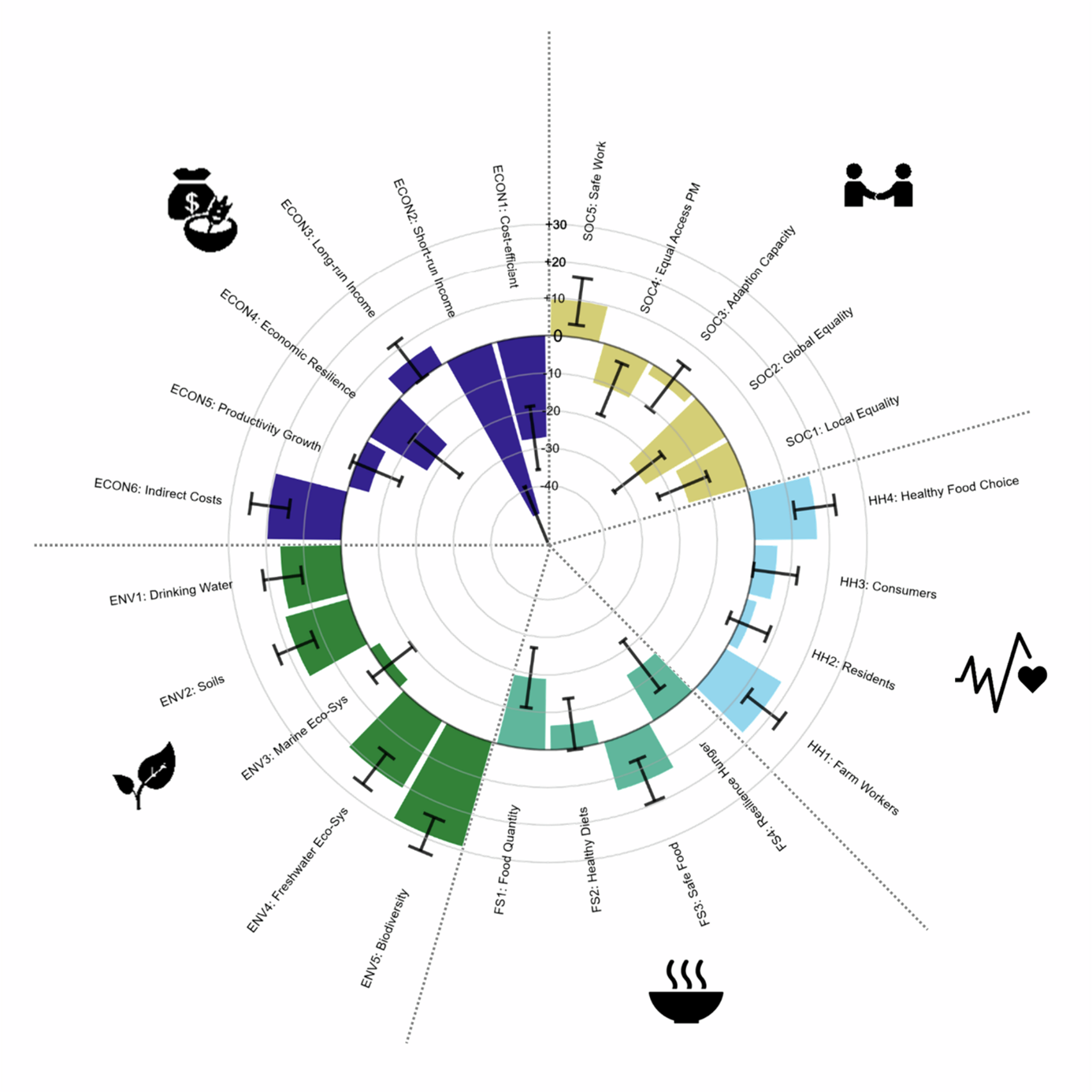
Data comes from a global survey of experts (N = 517), who assessed potential effects of a transformation of global pest management across 24 inidcators from -10 to +10. Coloured bars show deviations from global means (in percentage points) and the black error bars show 95% confidence intervals. For details see Möhring et al., (2025).
We find that a transformation to sustainable pest management would overall have positive effects across indicators and could be an important nexus for simultaneously tackling several sustainability challenges – at least in the long term. Experts expected particularly strong improvements at an environmental level, for example, for water pollution or biodiversity. This was true irrespective of the region and discipline. It similarly applied to expected effects on human health.
However, there were big differences in the expected economic impacts and emerging tradeoffs across regions. In North America, Europe and Australia, approximately the same number of experts expected positive impacts as negative impacts on the income of farmers - at least in the short term. However, higher short- to mid-term costs could pay off in the long term. In contrast, the experts for Asia, Africa and South America tended to believe that this transformation would also offer an economic opportunity. The respondents for these continents also believed that the transformation would have a more positive impact on local access to safe food than the experts for North America, Europe and Australia.
We then assessed drivers of expected effects. First, consistent with economic theory, we find decreasing marginal benefits of sustainable pest management. This means that in regions where there is already a high level of sustainable pest management, experts expect smaller additional benefits from further increasing it than in regions with currently low levels. Second, we also find indications for legacy effects. This means that experts expect that the longer we wait with a transformation, the smaller benefits of sustainable pest management will be. Reductions in biodiversity might, for example, be irreversible to some degree. Third, we also find that expected effects vary over disciplines of the surveyed experts. Ecologists consistently expect the highest and Economists the lowest benefits of a transformation. This may indicate that discourses on the same topic, but in different disciplines actually differ, and that an interdisciplinary exchange can help to align knowledge and expectations.
Despite these differences, the experts were surprisingly optimistic overall. This does not mean, however, that the switch to sustainable crop protection would be free of costs and trade-offs. Generally, it will therefore be key to support farmers during this transformation. We find that this will require a mix of instruments, for instance, tailored and effective alternatives for crop protection and appropriate educational, economic and legal support mechanisms.
Finally, while we conducted a range of robustness checks and the study was based on a large sample of diverse experts, inherent limitations of expert assessments remain. In order to verify study results and identify appropriate local solutions we will need to carry out more local studies across various regions in which we can try out sustainable pest management strategies and systematically research their effects. Our study provides a foundation for future studies, helping to prioritize research.
Niklas Möhring is at the University of Bonn, Robert Finger at ETH Zürich, Contact: mohring@uni-bonn.de and rofinger@ethz.ch
Article (open access): Möhring, N., Ba, M.N., Braga, A.R.C. et al. Expected effects of a global transformation of agricultural pest management. Nat Commun 16, 10901 (2025). https://doi.org/10.1038/s41467-025-66982-4
References
FAOSTAT (2025). FAO Data on Agricultural Production (last accessed 5 August 2025, 2025).
Frank, E. G. (2024). The economic impacts of ecosystem disruptions: Costs from substituting biological pest control. Science, 385(6713), eadg0344.
Möhring, N., Ingold, K., Kudsk, P., Martin-Laurent, F., Niggli, U., Siegrist, M., ... & Finger, R. (2020). Pathways for advancing pesticide policies. Nature food, 1(9), 535-540.
Möhring, N., Kanter, D., Aziz, T., Castro, I. B., Maggi, F., Schulte-Uebbing, L., ... & Leadley, P. (2023). Successful implementation of global targets to reduce nutrient and pesticide pollution requires suitable indicators. Nature Ecology & Evolution, 7(10), 1556-1559.
Perrot, T., Möhring, N., Rusch, A., Gaba, S., & Bretagnolle, V. (2025). Crop yield loss under high insecticide regime driven by reduction in natural pest control. Proceedings of the Royal Society B: Biological Sciences, 292(2051).
Savary, S., Willocquet, L., Pethybridge, S. J., Esker, P., McRoberts, N., & Nelson, A. (2019). The global burden of pathogens and pests on major food crops. Nature ecology & evolution, 3(3), 430-439.

Follow the Topic
-
Nature Communications

An open access, multidisciplinary journal dedicated to publishing high-quality research in all areas of the biological, health, physical, chemical and Earth sciences.
What are SDG Topics?
An introduction to Sustainable Development Goals (SDGs) Topics and their role in highlighting sustainable development research.
Continue reading announcementRelated Collections
With Collections, you can get published faster and increase your visibility.
Women's Health
Publishing Model: Hybrid
Deadline: Ongoing
Advances in neurodegenerative diseases
Publishing Model: Hybrid
Deadline: Mar 24, 2026
Please sign in or register for FREE
If you are a registered user on Research Communities by Springer Nature, please sign in