February Highlights from the Humanities & Social Sciences Communities
Published in Social Sciences, Behavioural Sciences & Psychology, and Education

This February, I came across a range of insightful stories across the Humanities and Social Sciences Communities. From new ways of understanding attention to fresh reflections on psychology and intercultural communication, these posts reminded me how quickly ideas evolve, and how researchers continue to challenge assumptions and deepen our understanding of the world.
If a post resonates with you, leave a like and/or share your thoughts in the comments!
How Does the Brain Ignore Sudden Movement?
@Xiaojin Ma
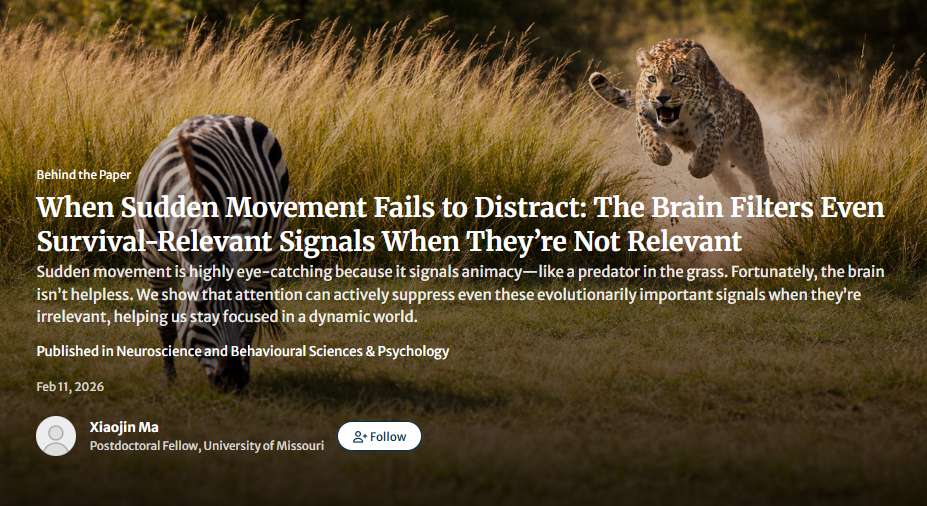
Imagine you’re working at your desk, and something suddenly moves nearby – you would expect it to grab your attention immediately, but sometimes it doesn’t. This Behind the Paper post explores why. Based on research published in Attention, Perception, & Psychophysics showing that sudden motion is usually very good at pulling our attention, the study demonstrates that the brain can also actively suppress these signals when they are irrelevant to what we’re doing. This helps explain how we stay focused in busy, fast‑changing environments.
Read the full post to see how the brain filters out even survival‑relevant distractions to keep attention on track.
Is Psychological Capital Really Personal?
@Ayse Yavuz
This Behind the Paper post shares a study published in Human Arenas, offering a critical look at Psychological Capital (PsyCap) – a concept often described as a set of inner strengths that can boost performance and wellbeing. While PsyCap is usually treated as something any individual can develop, the post suggests looking more closely at the social and cultural contexts that shape these traits. It challenges the assumption that everyone has equal access to such inner resources and shows how expectations around self‑improvement can reflect broader social pressures.
Read the full post to explore why rethinking PsyCap matters and how social context shapes what we often assume is purely personal.
How Is AI Rewiring The Human Brain?
@Hans Westerbeek
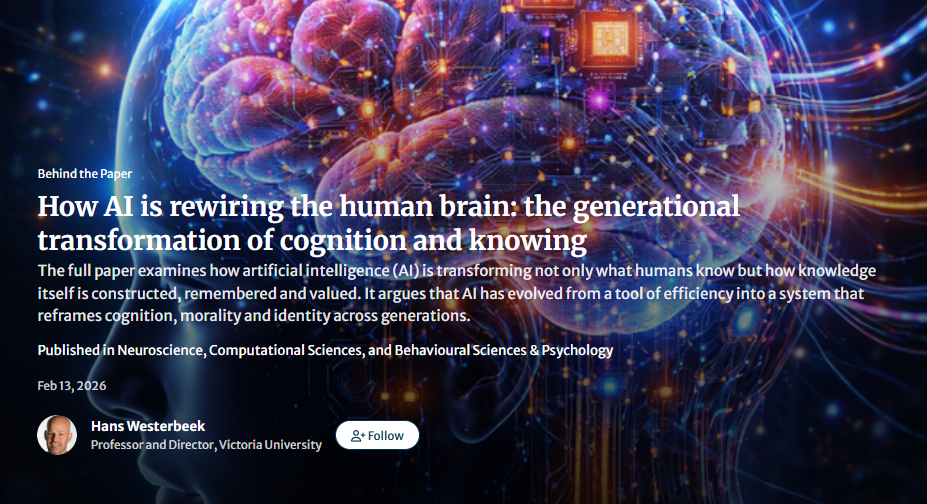
Think about how quickly we now turn to AI for answers – whether it’s asking a chatbot for an explanation or using an app to summarise information. This Behind the Paper post explores what this shift means for the way different generations learn, think, and form knowledge. Based on a study published in AI & Society, the author argues that AI is no longer just a tool but part of the environment in which our thinking takes place. The post highlights how younger generations are growing up with AI in daily learning, which may reduce the need for memory, reflection, and slow, effortful thinking. This raises concerns about whether people will still develop the ability to think for themselves.
Read the full post to explore how AI may be reshaping thinking across generations and what this means for future learning and decision‑making.
The Story Behind a Famous Quote
@Maxim Demin
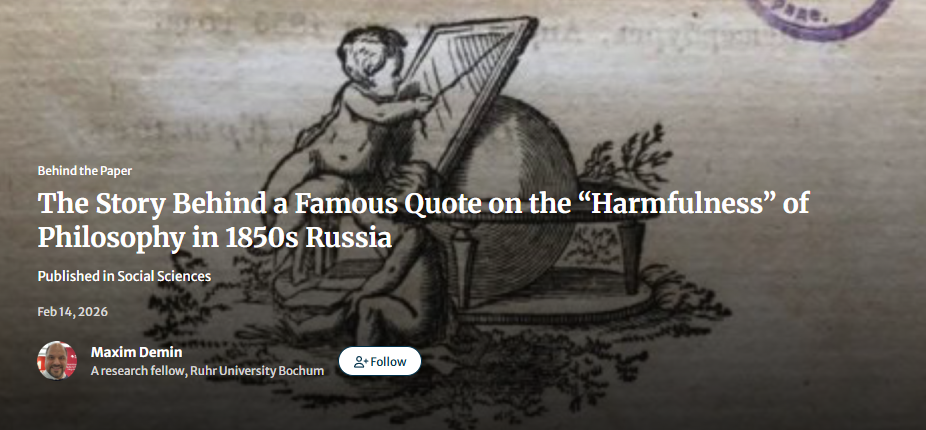
The uselessness of philosophy has not been proven, but the possibility of its being harmful is a fact.”
This quote, attributed to Count Platon Shirinskii-Shikhmatov, Minister of Education in 1850s Russia, became a symbol of governmental hostility toward free rational thought. Yet as time went by and the phrase became commonplace, its origins were forgotten.
Drawing on archival material and historical records, author of this Behind the Paper post unpacks how the quote emerged, who used it, and why it became so influential in debates about censorship, education, and intellectual life in Russia.
Read the full post to discover the real story behind the famous line.
Behind the Scenes of he Intercultural Legacy Project
@Sandra Mumford Fowler
Most academic fields began long before anyone living today could describe their earliest days. This post highlights a rare exception: the field of intercultural communication is young enough that many of its pioneers can still share first‑hand stories. Drawing on contributions collected in the book Creating the Intercultural Field: Legacies from the Pioneers, the project captures how early practitioners – now in their 80s and 90s –built the field without formal training, textbooks, or clear career paths.
Read the full post to learn how the Intercultural Legacy Project and the book preserve the origins of a field that continues to evolve today.
This blog is also part of the Social Science Matters Campaign – click through to explore more posts from this series.

As I wrap up this month’s highlights, I’m reminded of how much insight and curiosity our members continue to bring to these conversations. If you’d like to explore more of the work shared across the Research Communities, feel free to browse the Topic pages and check out the further readings below for more stories that spark new ways of thinking!
Further readings:

Supporting Humanities and Social Sciences research area on the Research Communities platform. I’d love to hear from you and connect!
Follow the Topic
-
Attention, Perception, & Psychophysics
This is a journal that encompasses all areas of research in sensory processes, perception, attention, and psychophysics.
-
Human Arenas
The aim of this journal concerns the interdisciplinary study of higher psychological functions (as topic of a general theory of psyche from the perspective of cultural psychology) in human goal-oriented liminal phenomena in ordinary and extraordinary life conditions.
-
Studies in East European Thought
This is a scholarly platform focusing on the philosophical thought and intellectual history of East and Central Europe, Russia, and post-Soviet states.
-
AI & SOCIETY
This journal focuses on societal issues including the design, use, management, and policy of information, communications and new media technologies, with a particular emphasis on cultural, social, cognitive, economic, ethical, and philosophical implications.
-
Palgrave Macmillan
Palgrave Macmillan is a world-class publisher of books and journals with more than 175 years’ experience in the Humanities and Social Sciences.





Related Collections
With Collections, you can get published faster and increase your visibility.
Arena of Technologies
Publishing Model: Hybrid
Deadline: Ongoing
Arena of Health
Publishing Model: Hybrid
Deadline: Ongoing