July Highlights from the Humanities and Social Sciences Communities
Published in Social Sciences, Behavioural Sciences & Psychology, and Arts & Humanities

July brought a diverse mix of conversations to the Humanities and Social Sciences Communities, from friendship and population change to neuroscience and AI. The posts featured below reflect some of the topics that captured our attention and offer plenty of thought-provoking reading for the summer.
If something here captures your interest, it is well worth exploring the full posts, and I would welcome any thoughts you may wish to share in the comments!
Celebrating Humanities & Social Sciences Festival
 Earlier this year, we held an internal Springer Nature Humanities and Social Sciences (HSS) Festival. Across a series of keynote presentations, town halls, panel discussions, lightning talks, quizzes, and social events, we celebrated our rich HSS research output in book and journal article form, and our heritage, highlighting the impact and value of what we publish.
HSS Festival Series Posts
In June and July, a series of short videos and accompanying blog posts were published based on lightning talks that were delivered by Springer Nature colleagues during the festival. They build on individual experience to tell compelling stories about what we publish and why we value our work with academic communities in the varied disciplines that comprise the Humanities and the Social Sciences.
Explore some of the Festival highlights below!
- How the Humanities Bring Historic Objects Back to Life @Gino D'Oca
- HSS for a Connected World @Satvinder Kaur @Leana Li
- Why Humanities and Social Science are Essential for a Data-Empowered Society @Josie Taylor
- What Ancient Greek Philosophy Taught Me About Social Media: An HSS Festival Lightning Talk @Robin James
- Why Humanities Matter in Scientific Publishing @Valeriana Ramondo
- Promoting and supporting credible, reproducible science @Samantha Antusch
What Makes Us Human?
This short video highlights some impactful Humanities and Social Sciences research published by Springer Nature and explores the enduring value of these disciplines.
Friendship and Belonging
On 30 July, the International Day of Friendship celebrates the power of relationships in building understanding, trust, and community. These posts explore friendship from different perspectives and remind us why meaningful human connections matter.
Why Friendship Matters
@Harry Blatterer
If we ever needed evidence that loneliness is most acutely felt in a crowd, digital sociality clearly shows that numbers of friends, like numbers of likes, cannot indicate depth of connection.
Why do friendships matter so much, yet receive so little attention from social scientists? Drawing on themes from his book Everyday Friendships: Intimacy as Freedom in a Complex World and his forthcoming work Friendship and Sociality, Harry explores friendship through questions many of us recognise: what helps us trust others, why friendships sometimes drift apart, and how digital life may be changing the way we connect.
Read the full blog post for a fresh perspective on one of the most familiar, yet often overlooked, parts of everyday life.
The Power of Women's Friendships
@Molly Beck @Teresa Martinez-Quiles
 What brings women together, and what helps friendships endure across differences in background and experience? In this interview, @Teresa Martinez-Quiles discusses her forthcoming book Women’s Friendships in Contemporary Diasporic Fiction, exploring how friendships between women can offer support for connection. Drawing on contemporary literature, she examines how gender, race, and social class shape relationships, while also highlighting the ways friendship can help bridge those differences.
Read the full post for some perspectives on women’s friendship.
Population and Society
World Population Day on 11 July, encourages reflection on how demographic change shapes societies around the world. These posts explore population trends, reproductive health, and the social challenges and opportunities linked to a growing and changing global population.
Preparing for an Ageing World
@Juliette Ruth Kleemann @Mohamed Ismail
As populations age around the world, how can health and care systems prepare for growing demand? In this Behind the Paper interview, @Mohamed Ismail discusses his research on long-term care needs across the Middle East and North Africa, exploring the challenges of population ageing and care dependency. The conversation highlights why better evidence, forward planning, and equitable care systems are essential for supporting ageing populations in the years ahead. Read the full interview to learn more.
Interested in learning more? Explore other World Population Day posts recently shared by @Juliette Ruth Kleemann.
Young People's Futures in Focus
@Angela Yang
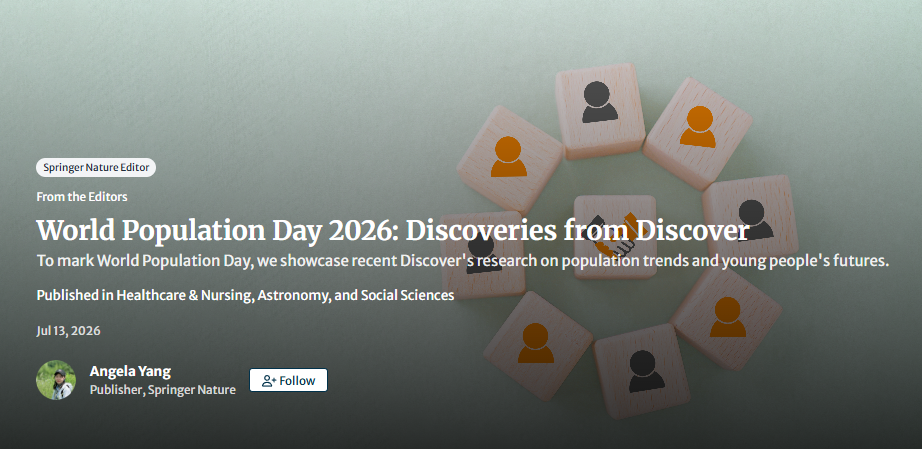 What does the future look like for the next generation? Bringing together research from across the Discover portfolio, this post explores topics ranging from population trends and sustainability to youth wellbeing, employment, mental health, and future aspirations. Together, these studies highlight how demographic change intersects with some of the most important social, economic, and health challenges facing young people today.
Read the full post to explore the research and perspectives featured in Discover journals.
Human and Machine
As digital technologies become increasingly embedded in everyday life, several posts this month explored how humans interact with machines and how technology is reshaping research itself.
What Basketball Can Teach Us About the Brain
@Miguel Angel Contreras Altamirano @Stefanie Dehnen
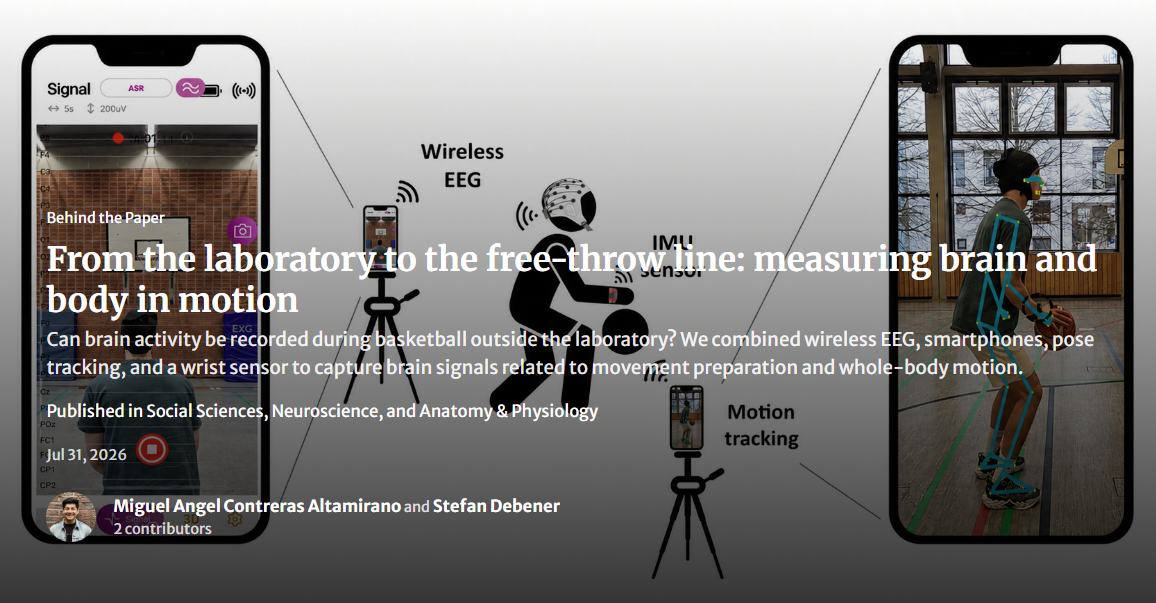 Can we study brain activity while people move naturally, rather than sitting still in a laboratory? In this fascinating Behind the Paper post, the authors share how they used a portable research setup to follow basketball players as they took free throws in real-world conditions. The study offers a glimpse into how the brain and body work together during complex movements.
Read the full post to discover how researchers are taking the study of human behaviour beyond the lab.
When AI Mirrors Us
@Santiago Castiello de Obeso @Daniel Lametti
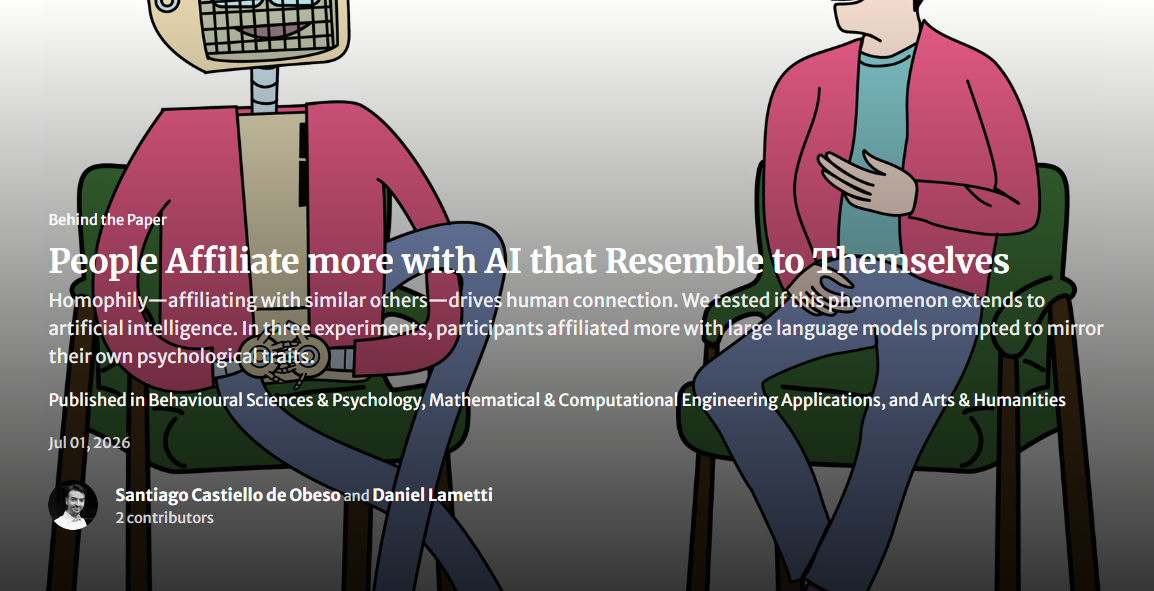 Why do some AI tools feel easier to talk to than others? In this Behind the Paper post, researchers explore whether people feel more connected to AI that seems a little more like themselves. Their findings suggest that similarity matters, raising interesting questions about how we might interact with AI in the future.
Read the full post to find out what makes some AI feel more familiar than others.
This month’s posts explore a wide range of topics, from friendship and society to technology and human behaviour. I hope they inspire you to discover something new and encourage you to explore the full posts. Thanks for reading, and feel free to join the conversation in the comments!
Further reading:
- June Highlights from the Humanities and Social Sciences Communities
- Quarterly Highlights from the Humanities & Social Sciences Communities
- Highlights from the Health & Clinical Research and Life Sciences Communities @Alice Taylor
- Highlights from the Mathematics, Physical & Applied Sciences Communities @Yijia Li

Supporting Humanities and Social Sciences research area on the Research Communities platform. I’d love to hear from you and connect!
Follow the Topic
-
Discover Global Society
This is an interdisciplinary, international journal that welcomes research on the complexities of modern global society, its development and its challenges.
-
Communications Psychology
An open-access journal from Nature Portfolio publishing high-quality research, reviews and commentary. The scope of the journal includes all of the psychological sciences.
-
Discover Psychology
This is an international, open access journal that publishes research in behavioral sciences and related fields, including health, environment, neuroscience, business, economics, ergonomics, linguistics, and education.
-
Population Health Metrics
Population Health Metrics aims to advance the science of population health assessment, and welcomes papers relating to concepts, methods, ethics, applications, and summary measures of population health.
-
Experimental Brain Research
This journal publishes original contributions on many aspects of experimental research of the central and peripheral nervous system.
-
Discover Sustainability
A multi-disciplinary, open access, community-focussed journal publishing results from across all fields relevant to sustainability research whilst supporting policy developments that address all 17 of the United Nations Sustainable Development Goals (SDGs).






Introducing the Palgrave Macmillan Campaign for the Humanities
At Palgrave Macmillan we publish cutting-edge humanities research that has real-world impact. This research community brings together the voices of our authors and editorial team to highlight and publicize the value of the humanities and humanities research in our world today.
Continue reading announcementRelated Collections
With Collections, you can get published faster and increase your visibility.
Advancing the Measurement of Social Connection for Population Health: New Evidence, Metrics, and Global Priorities
Social connection is increasingly recognized as a vital component of population health. It includes the structure of social networks, the support that flows through relationships, and the quality of interactions that contribute to well-being. Research across multiple disciplines has established that limited or poor social connection is linked to higher risks of premature mortality, mental health problems, cardiovascular disease, cognitive decline, lower educational attainment, and reduced economic participation. These findings highlight the need for rigorous and comparable metrics that can illuminate the distribution, determinants, and consequences of social disconnection at scale.
Despite a growing interest in social connection, population level measurement remains uneven. Studies often rely on single items, short scales, or constructs that capture only one aspect of the broader social landscape. Loneliness, social isolation, and social support are frequently treated as interchangeable, even though each reflects a different dimension of social life and may influence health through distinct pathways. In many settings, there is no routine surveillance of social connection. As a result, policymakers and practitioners lack the data needed to design effective interventions or monitor changes over time.
Conceptual clarity is a prerequisite for measurement. Social connection is multidimensional and includes the size and diversity of social networks, the availability of emotional or instrumental support, and the positive or negative qualities of relationships. Social isolation is the objective absence of social roles or interactions. Loneliness is the subjective experience of wanting more or better connection than one currently has. These concepts intersect but are not synonymous. Accurate assessment requires tools that reflect each dimension and that can be adapted or validated across cultures, languages, and life stages.
Research from low and middle income countries is particularly limited even though many of these settings experience social conditions that may heighten vulnerability to social disconnection. Large and rapid demographic transitions, urban migration, changing family structures, economic insecurity, and exposure to conflict or displacement can all shape patterns of social connection. Yet most validated instruments originate in high income countries, and many have not been adapted or tested for linguistic, cultural, and contextual relevance in LMIC populations.
The need for strong metrics extends beyond conceptual work. The use of digital technology, demographic change, shifting household structures, migration, and urbanization all influence how social connections form and function. These forces create new opportunities for measurement, such as digital interaction data or innovative mixed-method approaches, but they also introduce new challenges. Measures grounded in one cultural or linguistic context may not translate easily to another. Children, adolescents, older adults, and marginalized groups may require tailored instruments that reflect their social realities. Community and policy interventions also need evaluation frameworks that capture both intended and unintended effects on connection.
This special issue invites research that advances the science of measuring social connection for population health. Relevant contributions include but are not limited to:
1. New conceptual models and frameworks for assessing social connection at scale
2. Validation or adaptation of measurement instruments across cultures and population groups
3. Methods for distinguishing between loneliness, social isolation, and social support in surveillance systems
4. Epidemiologic analyses that examine levels, patterns, and trends in social connection
5. Studies linking social connection metrics with health, economic, or educational outcomes
6. Approaches to integrating social connection into existing population health surveys
7. Measurement of social connection in digital and hybrid social environments
8. Evaluation metrics for policies, community initiatives, and individual level interventions
9. Proposals for harmonized indicators that support international comparisons
All submissions in this collection undergo the journal’s standard peer review process. Similarly, all manuscripts authored by a Guest Editor(s) will be handled by the Editor-in-Chief. As an open access publication, this journal levies an article processing fee (details here). We recognize that many key stakeholders may not have access to such resources and are committed to supporting participation in this issue wherever resources are a barrier. For more information about what support may be available, please visit OA funding and support, or email OAfundingpolicy@springernature.com or the Editor-in-Chief.
Publishing Model: Open Access
Deadline: Nov 30, 2026
Measuring Population Health in the Era of Climate Change
Measuring Population Health in the Era of Climate Change
Climate change is increasingly recognized as a major challenge for population health worldwide. Rising global temperatures, more frequent and severe extreme weather events, and changing seasonal patterns affect mortality, morbidity, and broader population health dynamics across countries and regions. These impacts are not distributed equally across populations, with older adults, socioeconomically disadvantaged populations, people from culturally and linguistically diverse backgrounds, Indigenous populations, and other vulnerable groups often facing disproportionate risks.
A growing body of research has documented the adverse health impacts of climate-related exposures, including heat and cold, floods, droughts, and wildfires. Over recent decades, substantial progress has been made in improving methodologies for assessing climate-health associations, increasing the availability and granularity of environmental, geospatial, and health data, and developing cross-national initiatives aimed at strengthening the evidence base. Nevertheless, important challenges remain in measuring and comparing climate-related health impacts across population subgroups, geographical contexts, and time periods.
This Special Collection seeks contributions that advance the measurement and understanding of climate-related impacts on population health. We welcome ecological and population-level studies, methodological innovations in estimating the burden associated with non-optimal temperatures and extreme weather events, and improved approaches for measuring excess mortality and mortality displacement. We also encourage contributions examining seasonality and temporal dynamics in population health, climate-related impacts on non-communicable diseases and mental health conditions, and the interplay between climatic, behavioural, and socioeconomic determinants of health outcomes. Contributions focusing on low- and middle-income countries are particularly welcomed.
Relevant contributions include, but are not limited to:
- Methodological innovations in measuring and modelling climate-related impacts on non-communicable, mental, and infectious diseases
- Advances in measuring excess mortality and short-term mortality displacement (harvesting) associated with extreme weather events
- Determinants of seasonal variation in mortality and morbidity across climatic zones and population groups
- Small-area estimation and spatial modelling of local climate impacts on population health
- Measuring climate-related health outcomes in data-constrained settings
- Comparative and cross-national studies of the socioeconomic, behavioural, and demographic determinants of climate-related health outcomes
- Population vulnerability, adaptation, and resilience to climate-related health risks
- Healthy ageing in a changing climate
- Forecasting and scenario-based approaches to climate-related population health burdens
This Collection welcomes original research articles, methodological contributions, interdisciplinary studies, comparative analyses, and systematic reviews that align with the scope of Population Health Metrics.
All submissions in this collection undergo the journal’s standard peer review process. Similarly, all manuscripts authored by a Guest Editor(s) will be handled by the Editor-in-Chief. As an open access publication, this journal levies an article processing fee (details here). We recognize that many key stakeholders may not have access to such resources and are committed to supporting participation in this issue wherever resources are a barrier. For more information about what support may be available, please visit OA funding and support, or email OAfundingpolicy@springernature.com or the Editor-in-Chief.
Publishing Model: Open Access
Deadline: Feb 26, 2027