Quarterly Highlights from the Humanities & Social Sciences Communities
Published in Social Sciences, Education, and Arts & Humanities

Looking back at the second quarter of 2026, I’ve enjoyed seeing the range of posts shared across the Humanities & Social Sciences Communities. They take us from TikTok algorithms and ancient engineering to peer review, teaching, and the value of the humanities disciplines. Here are some of the posts I think are worth revisiting!
What Did TikTok’s Algorithm Show Voters?
@Yasir Zaki @Talal Rahwan @Hazem Ibrahim
This Behind the Paper post, based on a research article published in Nature Human Behaviour, describes how during the 2024 US election the researchers created test TikTok accounts that behaved like Democratic- and Republican-leaning users, running hundreds of experiments across three states and analysing more than 280,000 recommended videos. Their results showed a difference in political content that could not be fully explained by user engagement.
Read the full post to learn more about how this algorithmic audit was carried out.
Could Code Help Explain the Great Pyramid?
@Vicente Luis Rosell Roig
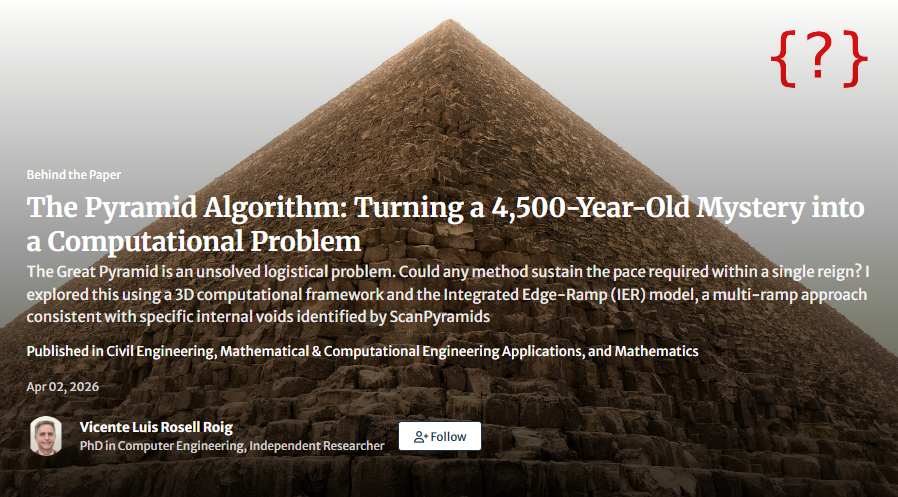
A documentary, a few hand-drawn sketches, and a 4,500-year-old engineering mystery became the starting point for this unusual research journey – this Behind the Paper story reveals how the idea of the paper published in npj Heritage Science first took shape and evolved. Using a three-dimensional computational model, the author explored whether several ramps built into the pyramid’s edges could have allowed builders to move blocks efficiently enough to complete the Great Pyramid within a single reign.
Read the full blog to see the model visuals and explore how the idea develops through simulation. This post is also featured in @Yijia Li’s latest MPAS Communities round-up, which brings together more research stories from across mathematics, physical sciences and applied sciences.
How to Peer Review Efficiently and Responsibly?
@Alessia Ricchiuti @Jo Appleford-Cook
Can templates and AI make peer review more efficient without weakening its quality or integrity? This Researcher Riddle explores the difference between useful guidance and overly general review comments. Templates can help reviewers organise manuscript-specific feedback, and AI may assist with limited tasks, but neither can replace subject expertise, ethical judgement, confidentiality, or responsibility for the final review.
Read the full post to test how you would respond to a common reviewing dilemma and explore practical principles for using these tools responsibly.
A New Space for the Humanities
@Felicity Plester
Why do the humanities matter today, and how can their value reach audiences beyond academia? This post introduces the Palgrave Macmillan Campaign for the Humanities to its new home on the Research Communities. Bringing together research highlights, editorial perspectives, events, and resources, the campaign explores how humanities research contributes to public debate, cultural understanding, policy, and responses to contemporary challenges.
Explore the post and follow the campaign to discover new humanities research, hear from authors and editors, and join the wider discussion about why humanities research still matters today.

Can a Website Improve Teaching?
@Madhukar Pai
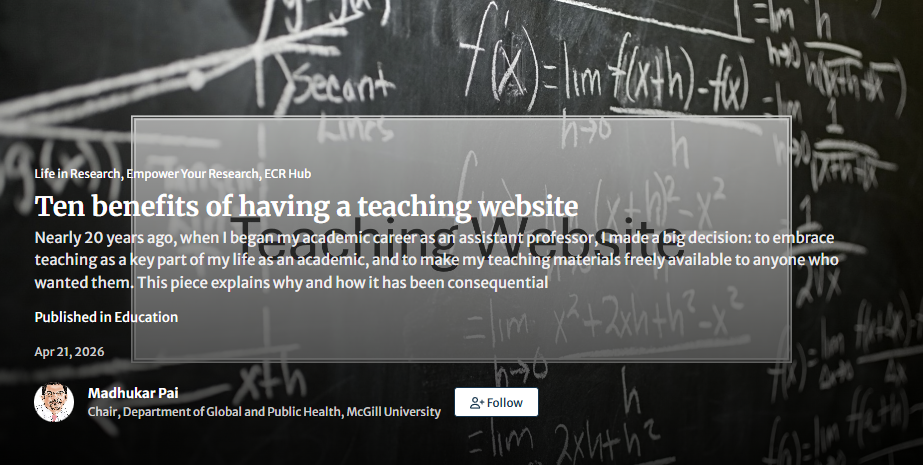
Nearly twenty years ago, @Madhukar Pai decided to make his teaching materials freely available online. In this personal and practical post, he reflects on how that decision helped him organise his resources, connect with students and educators around the world, develop new collaborations, and improve his own understanding of the subjects he teaches. His central idea is simple: knowledge can grow when we share it.
Read the full post for ten reasons to create a teaching website and plenty of inspiration for making educational resources more open and useful.
An Opportunity for Game-Based Learning Researchers
@Faija Miah @Roberto Dillon
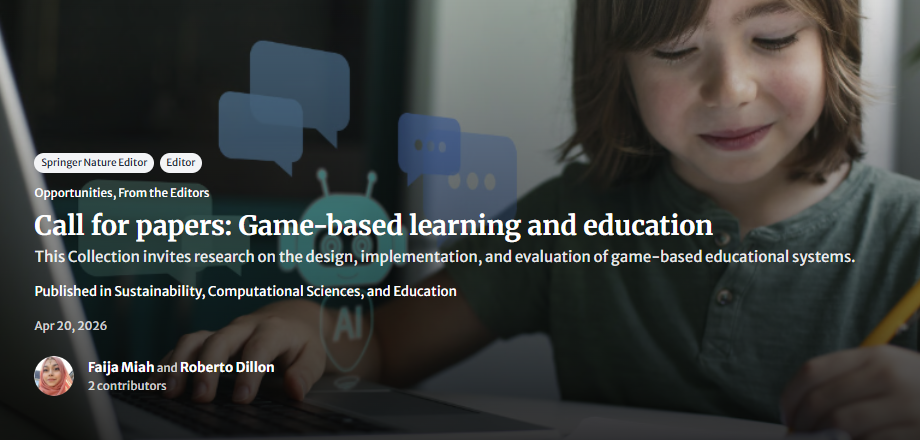
Researchers working on game-based learning and education are invited to submit their work to a Scientific Reports Collection. The Collection welcomes research on the design, use, and evaluation of game-based educational approaches across disciplines and age groups.
Read the full post to explore the Collection and find out how to submit by 31 July 2026.
I found plenty to think about in these posts shared in the second quarter of 2026, and I hope you do too. Take a look at the full stories and share your thoughts with the authors in the comments!
Further readings:
- Quarterly Highlights from the Humanities & Social Sciences Communities
- Highlights from Health & Clinical and Life Sciences Research Communities
- Highlights from the Mathematics, Physical & Applied Sciences Communities

Supporting Humanities and Social Sciences research area on the Research Communities platform. I’d love to hear from you and connect!
Follow the Topic
-
Scientific Reports
An open access journal publishing original research from across all areas of the natural sciences, psychology, medicine and engineering.
-
Nature Human Behaviour
Drawing from a broad spectrum of social, biological, health, and physical science disciplines, this journal publishes research of outstanding significance into any aspect of individual or collective human behaviour.
-
npj Heritage Science
This journal will consider original research papers for the scientific study of heritage, based primarily on physical, chemical and biological measurements and / or computations.
-
A Collection of original research articles on the design, implementation, and evaluation of game-based educational systems, aiming to advance pedagogical innovation and deepen our understanding of how playful experiences can drive meaningful learning outcomes.



Introducing the Palgrave Macmillan Campaign for the Humanities
At Palgrave Macmillan we publish cutting-edge humanities research that has real-world impact. This research community brings together the voices of our authors and editorial team to highlight and publicize the value of the humanities and humanities research in our world today.
Continue reading announcementRelated Collections
With Collections, you can get published faster and increase your visibility.
Cancer Prevention and Control
Publishing Model: Hybrid
Deadline: Feb 19, 2027
Digital Media and Mental Health
Publishing Model: Hybrid
Deadline: Oct 30, 2026