Forecasting Trends in Food Insecurity with Real-Time Data
Published in Earth & Environment and Sustainability


A New Frontier in Humanitarian Early Warning Systems
In the complex world of humanitarian aid, early warning systems are indispensable. They offer a crucial advantage: the ability to pre-empt crises, allowing for timely interventions that save lives, preserve livelihoods, and optimize scarce resources. At the forefront of these efforts is the World Food Programme (WFP), which has long been a central actor in gathering critical data from some of the world’s most fragile environments.
Our latest study, recently published in Nature Communications, enhances this effort by leveraging WFP's Real-Time Monitoring (RTM) system. Developed over the past decade, RTM provides near-instantaneous insights into food security at the household level across nearly 20 countries. Data is collected daily via computer-assisted telephone interviews, offering granular, up-to-date information on indicators like the Food Consumption Score (FCS), a composite measure of dietary diversity and frequency.
The Power of Real-Time Data
While other food security assessments—such as those produced by IPC, CH, and FEWS.NET—issue reports every few months, RTM supplies daily updates. This continuous stream of data is a game changer. It allows for the real-time tracking of deteriorating conditions, enabling faster responses to emerging food insecurity before it spirals into a full-blown crisis. RTM’s reliance on quantitative data, devoid of subjective interpretation, further strengthens its robustness.
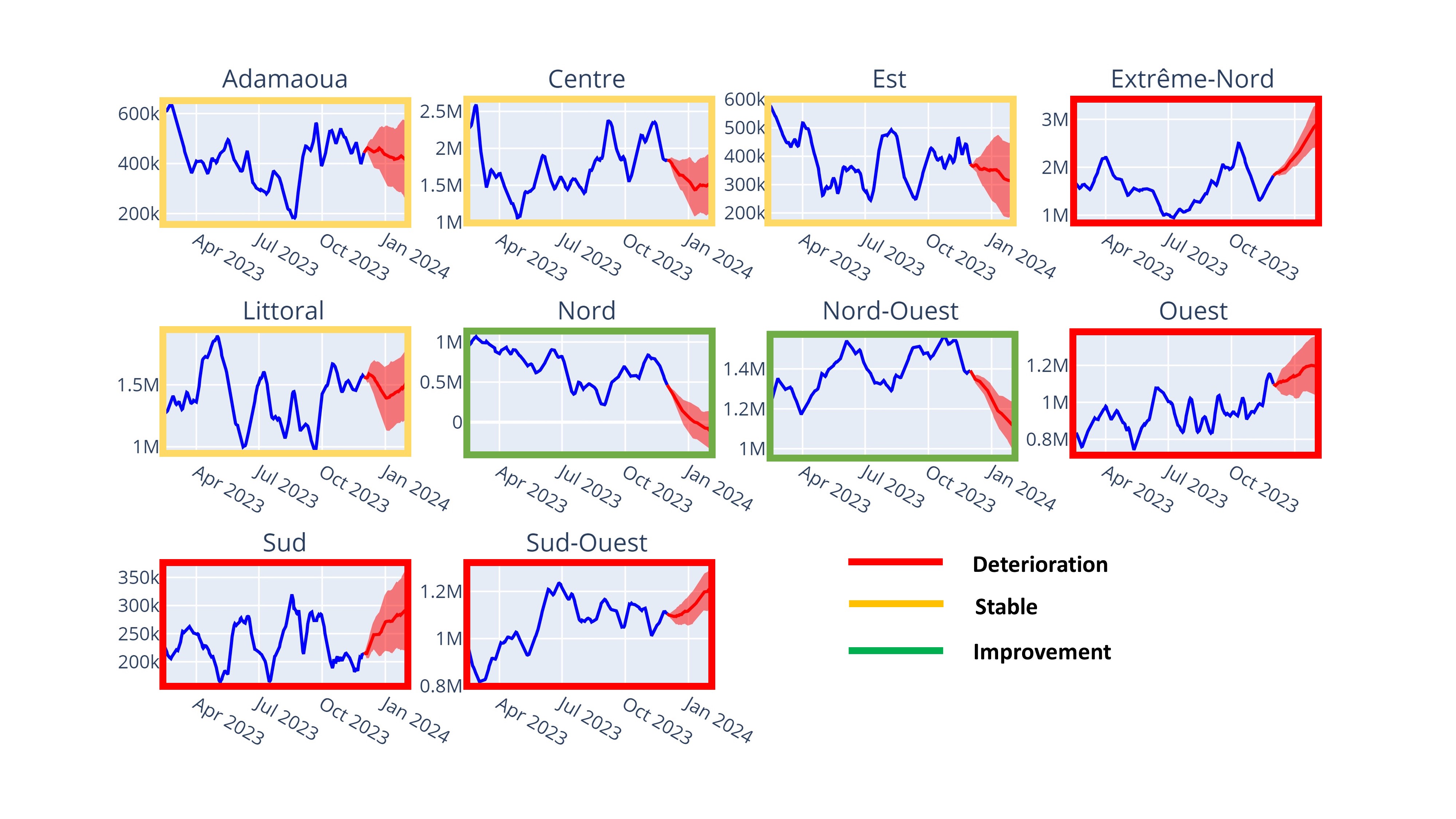
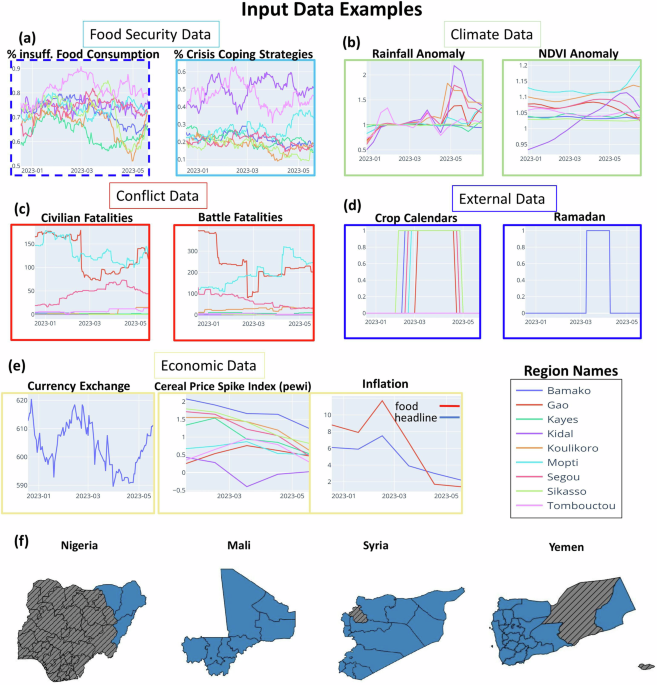
Our research focuses on using this real-time data to forecast food insecurity trends over a 60-day horizon. This forecasting capability, developed through a collaboration between WFP and the German Aerospace Agency (DLR), targets regions within four countries—Mali, Nigeria, Syria, and Yemen—that are particularly vulnerable to food crises. The predictive tool of choice is Reservoir Computing (RC), a type of recurrent neural network that excels in processing sequential data and is well-suited for resource-constrained settings, where data is often limited.
Forecasting the Future of Food Security
RC offers several advantages over conventional forecasting methods. It is computationally efficient, resistant to overfitting, and adept at capturing non-linear relationships in time series data. Crucially, it has proven highly effective in predicting sudden drops in food security—precisely the kind of event that early warning systems are designed to detect.
Our model integrates a wide range of variables, from conflict and climate conditions to economic drivers and seasonal patterns. By forecasting food security at the subnational level, the model provides a critical tool for humanitarian operations, where decisions on resource allocation must often be made weeks in advance. In regions where logistical bottlenecks can delay the delivery of aid, having an accurate 60-day forecast can be the difference between effective intervention and missed opportunity.
Results That Matter
Our simulations, covering the period from June 2022 to May 2023, reveal that the RC model outperforms traditional approaches like ARIMA and even more advanced techniques such as LSTM neural networks and XGBoost. Notably, RC consistently produced more accurate forecasts, particularly in scenarios where food insecurity deteriorated rapidly—precisely the moments when quick action is most needed.
The model’s accuracy, measured by Root Mean Squared Error (RMSE), remained below 5% for 60-day forecasts across all four countries studied, a notable achievement given the inherent challenges of data scarcity and country-specific variations.
However, our work is not without limitations. Like many forecasting tools, the model has a conservative bias, tending to predict stability more often than sudden declines. Future research will aim to refine the model's ability to anticipate these rare but crucial shifts in food security.
The Road Ahead: From Prediction to Practice
The ultimate test of any early warning system lies not just in its predictive accuracy, but in its utility on the ground. We are now piloting this forecasting model with WFP country offices, gathering feedback from field teams to ensure the tool aligns with operational realities. This iterative process is essential. Predictions are only as valuable as their capacity to inform timely and effective humanitarian responses.
By embedding these forecasts into WFP’s decision-making processes, we aim to enhance the organization’s ability to anticipate food crises and deploy resources accordingly. The potential impact is significant: more targeted interventions, faster response times, and, ultimately, better outcomes for those at risk of hunger in some of the world’s most vulnerable regions.

Follow the Topic
-
Communications Earth & Environment
An open access journal from Nature Portfolio that publishes high-quality research, reviews and commentary in the Earth, environmental and planetary sciences.

Related Collections
With Collections, you can get published faster and increase your visibility.
Ecological resistance and resilience under global change
Publishing Model: Open Access
Deadline: Apr 07, 2027
Hazards in Mountain Regions
Publishing Model: Open Access
Deadline: Nov 02, 2026