Fusing AI and Edge Computing: Next-Generation Sensing Networks in Earth Science
Published in Earth & Environment, Electrical & Electronic Engineering, and Mathematics

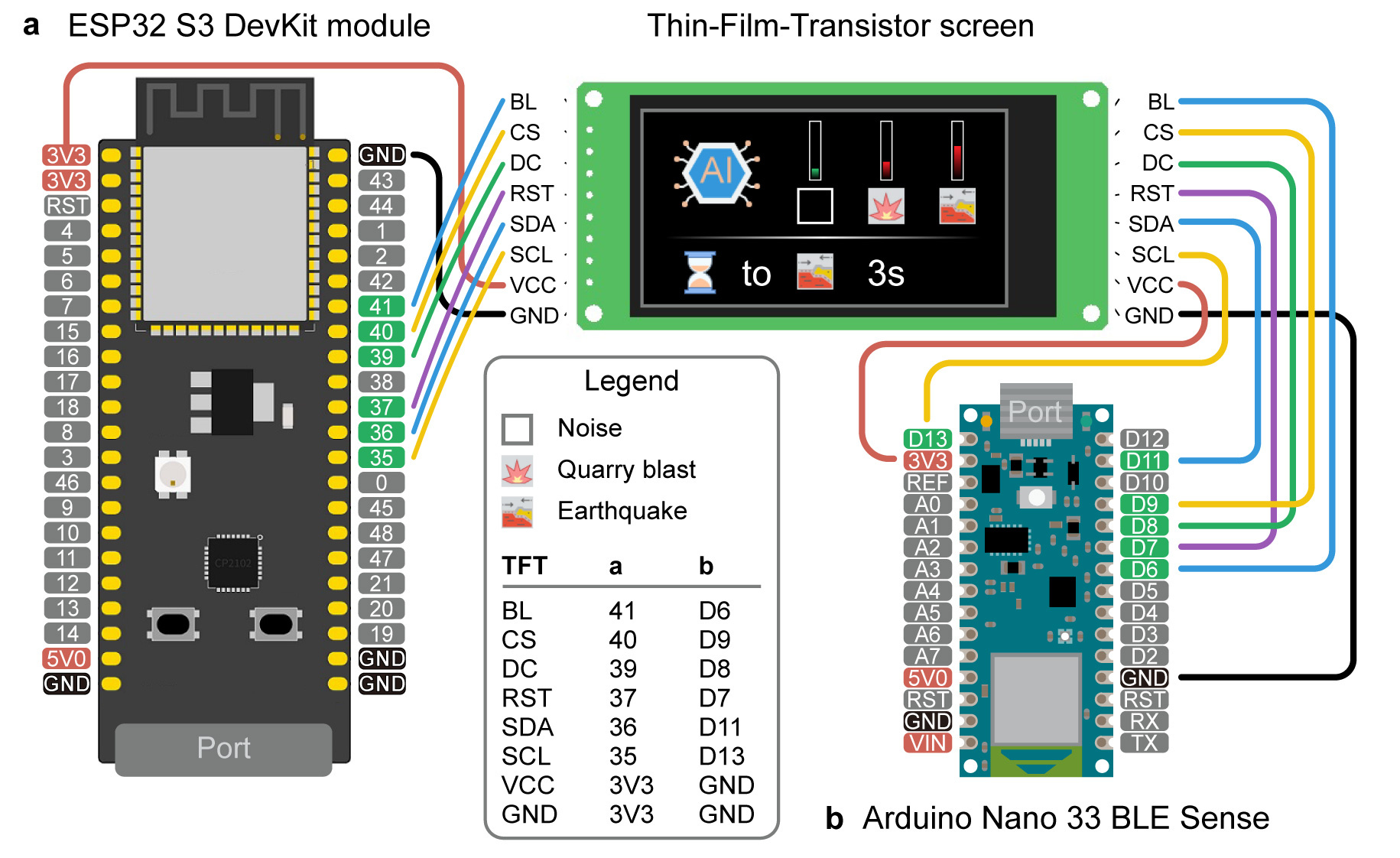


The rapid advancement of artificial intelligence (AI) technologies has led to the development of large deep learning models, which have become a focal point across various industries. However, in the domain of Earth and environmental sciences, these models face significant challenges due to their high computational and data requirements. This limitation hinders their feasibility in extreme application scenarios, such as deep subsurface environments with high temperatures and pressures, remote field settings with limited power supply, and deep space missions.
In such scenarios, edge computing solutions are typically employed for intelligent autonomous research. Our previous work explored the potential of lightweight machine learning models, demonstrating that single-board computers, such as the Raspberry Pi 4B, could efficiently identify key seismic reflection features of marine gas hydrates [1,2]. A recent study has further shown the exceptional performance of tiny AI models in real-time seismic signal discrimination, offering new insights for edge intelligence computing [3].
Our research focuses on the real-time identification of seismic signal sources. We propose a tiny neural network model that can be directly deployed on microcontrollers, requiring minimal computational resources (approximately 10 KB memory) and capable of running efficiently on low-power (around 200 MHz) and low-cost (approximately $6) general-purpose microcontrollers. Compared to traditional large deep learning models, this tiny model achieves higher inference performance with a fraction of the size and energy consumption.
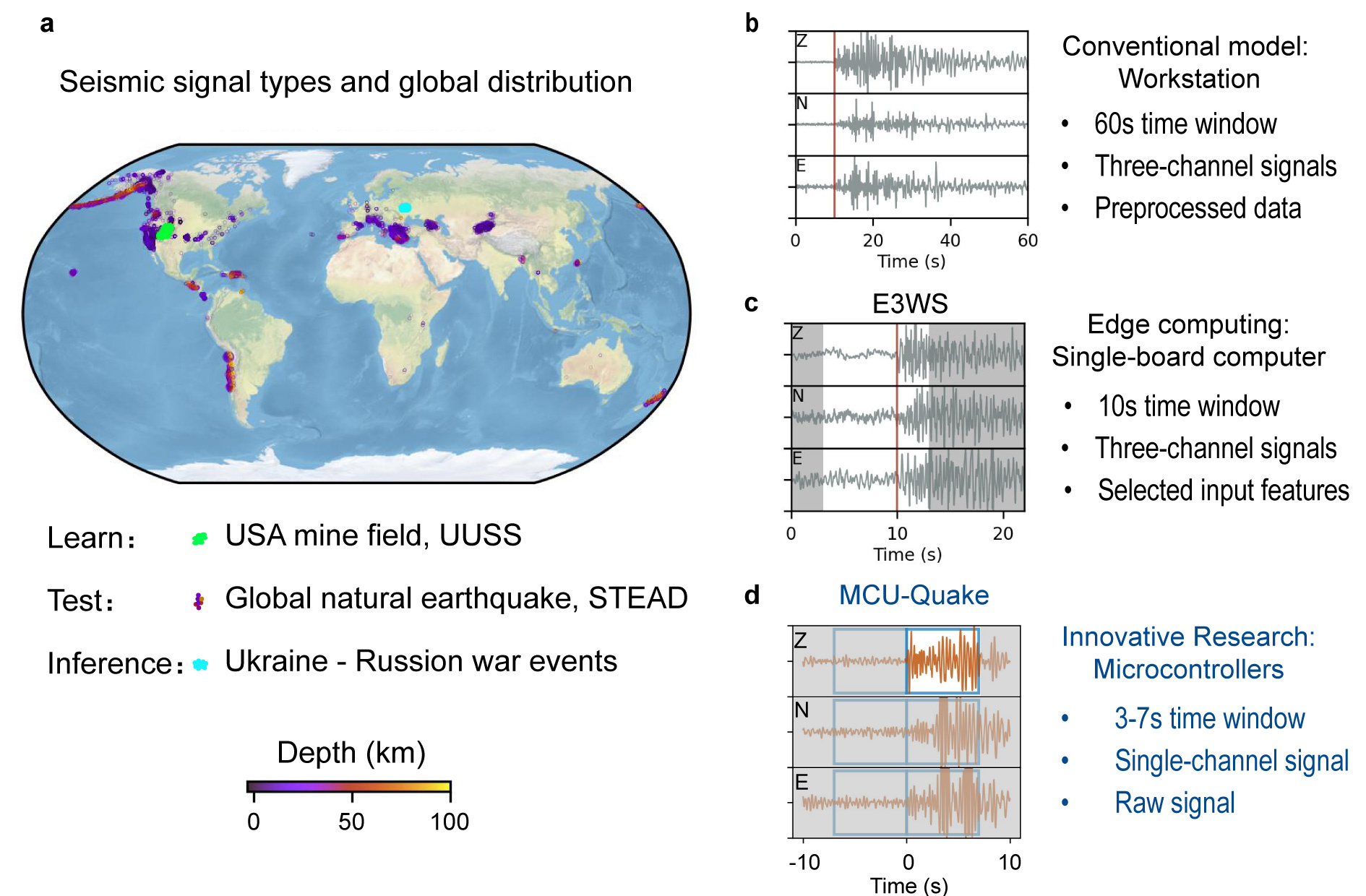
To validate its effectiveness in real-time discrimination tasks involving environmental noise, artificial explosions, and natural earthquakes, we conducted case studies using datasets from mine blasts in Utah, USA (UUSS), global natural earthquake data (STEAD), and monitoring data from the Russia-Ukraine battlefield (Figure 1a). Our model achieves real-time inference using single-channel seismic signals over just a few seconds (Figure 1d), unlike conventional large models that require workstation-level processing of long-duration three-channel signals (Figure 1b and 1c).
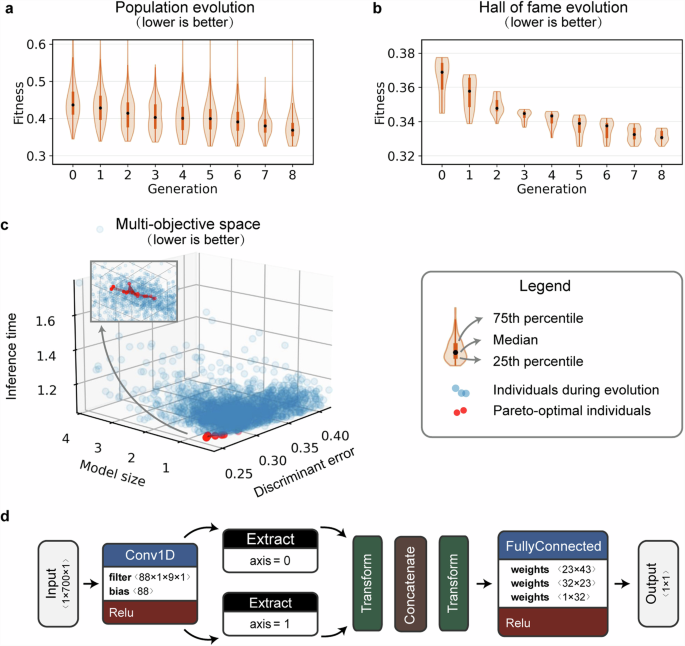
We developed an optimization algorithm based on evolutionary principles, employing swarm optimization to achieve multiple conflicting objectives: minimal parameters, high performance, and low latency. This algorithm integrates cloud platform distributed computing for the evolution and iterative refinement of neural network models, ensuring that Pareto-optimal model individuals maximally represent the hidden feature distributions of different types of seismic sources.
A key highlight of this research is the tiny model named MCU-Quake, which contains only 2,693 parameters. Trained on data from mine explosions and local natural earthquakes in Utah, USA, the model encodes knowledge for identifying environmental noise, artificial explosions, and natural earthquakes as floating-point numbers (Figure 2). The critical data features learned by the model are also applicable to global natural earthquake datasets and have provided typical inferences for ambiguous seismic signals during the Russia-Ukraine conflicts.
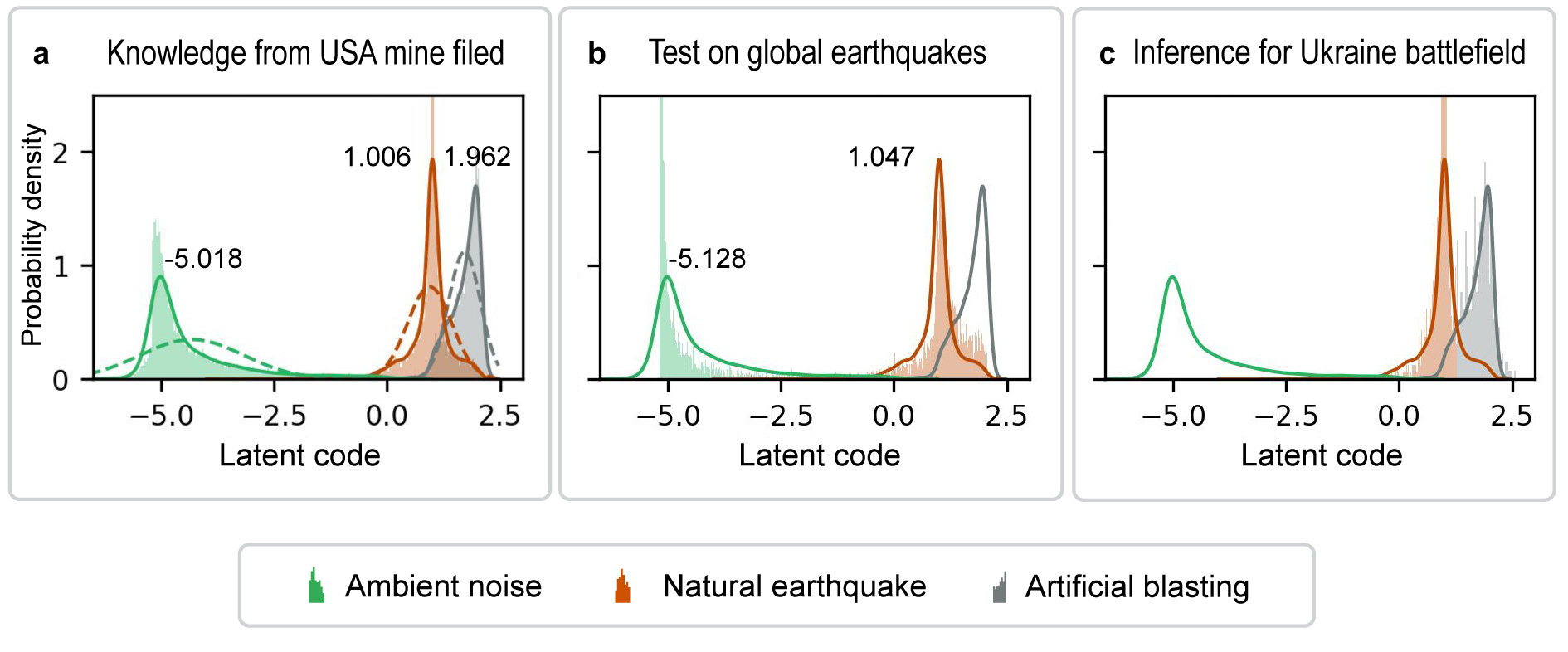
Figure 2. Key feature extraction by MCU-Quake for different seismic signal datasets. (a) North American mine field data used for training. (b) Global natural earthquake data used for test. (c) Russia-Ukraine war zone data used for inference.
Notably, when deployed on microcontrollers with extremely limited computational resources, only classical STA/LTA methods and MCU-Quake can achieve real-time seismic signal classification. The efficiency of MCU-Quake is demonstrated by its ability to complete inference for each second of data in about 128 milliseconds on an Arduino Nano 33 with a CPU clock frequency of just 64 MHz (Video in [3]).
This study highlights the broader application potential of AI-powered edge computing technologies, particularly in Earth and environmental sciences. Tiny intelligent models can be effectively deployed on legacy computing devices, extending their impact and utility. Integrating these miniature smart sensing nodes with GPS, environmental sensors, and other sensing technologies can provide comprehensive information fusion, intelligent monitoring, and autonomous decision-making services. The efficiency and versatility of miniaturized deep learning techniques offer attractive solutions for researchers and practitioners in Earth and environmental sciences.
References:
- Geng, Z. & Wang, Y. Automated design of a convolutional neural network with multi-scale filters for cost-efficient seismic data classification. Nat Commun 11, 3311 (2020). https://www.nature.com/articles/s41467-020-17123-6
- Case study on Raspberry Pi 4B. https://github.com/gzoutlook/SeismicPatchNet_v1
- Geng, Z. et al. Real-time discrimination of earthquake signals by integrating artificial intelligence technology into IoT devices. Communications Earth & Environment 6, 73 (2025). https://www.nature.com/articles/s43247-025-02003-y
Follow the Topic
-
Communications Earth & Environment
An open access journal from Nature Portfolio that publishes high-quality research, reviews and commentary in the Earth, environmental and planetary sciences.

Related Collections
With Collections, you can get published faster and increase your visibility.
Hazards in Mountain Regions
Publishing Model: Open Access
Deadline: Nov 02, 2026
Carbon Dioxide Removal
Publishing Model: Hybrid
Deadline: Jan 16, 2027




Please sign in or register for FREE
If you are a registered user on Research Communities by Springer Nature, please sign in