General technoeconomic analysis for electrochemical coproduction coupling carbon dioxide reduction with organic oxidation
Published in Electrical & Electronic Engineering

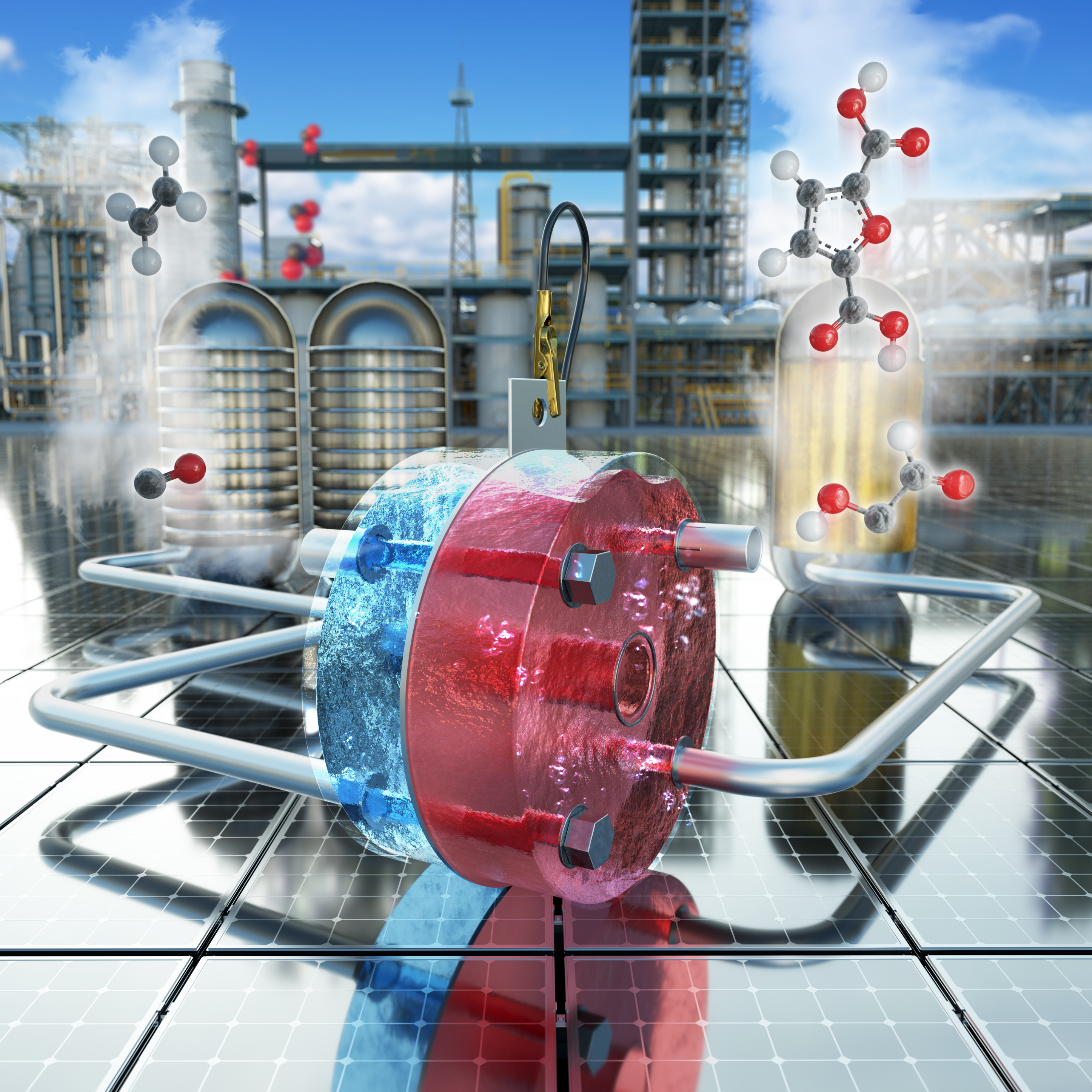

In order to response the climate change including global warming, ocean acidification, and ecosystem destruction, carbon dioxide mitigation technologies recently draw great attention. The renewable energy and carbon neutral hydrogen applications in petrochemical industries can be one of the solution mitigating CO2 emission for chemical production. However, the demand for chemicals such as syngas, alcohol, and ethylene which can be used as reagents to create plastics and transportation fuels is difficult to satisfy without fossil fuel-based petrochemical processes. Therefore, electrochemical carbon dioxide reduction reaction (CO2RR) processes have been rising to be promising techniques for producing clean chemicals (especially petrochemical precursors such as ethylene) and utilizing renewable energy.
Yet modern chemistry is incapable of substituting conventional petrochemical processes that require extremely high efficiency and economic feasibility. The main criticism of implementing CO2RR processes is beginning to be shouldered by its nonproductive paired oxidation reaction: oxygen evolution reaction (OER) regarding valueless oxygen gas and high oxidative potential. Recently, novel approaches have been introduced involving electrolysis in coupling CO2RR and organic oxidation reactions (OORs) to produce value-added products at anode side. To illustrate, the oxidation of biomass-derived 5-hydroxymethylfurfural (HMF) to 2,5-furandicarboxylic acid (FDCA), renewable building blocks that can substitute for terephthalic acid (PTA), can be implemented as an anode reaction with lower overpotential. Economics of this sustainable chemicals production, however, is impacted by variations in product combinations and process design.
Here, we report an extensive technoeconomic analysis for a range of technologies and coproduction processes in a paper appearing in Nature Communications. A fully automated process synthesis framework is developed to analyze 295 electrochemical coproduction combinations (i.e., 16 cathode and 18 anode reactions with 7 cascade processes) through 132,768 process simulations. The synthesized conceptual process design includes electrolyzer systems, separation systems, recycling systems, and various utility systems, thereby securing analytical reliability. The levelized costs of chemicals (LCC), which represents the minimum selling price without a margin, is newly defined and used to estimate the profitability. Finally, we identify the global sensitivity of current density, Faraday efficiency, and overpotential, which indicates which parameter has to be addressed first to achieve paradigm shift in industry.
The result highlights the promise that coupling the CO2RR with the value-added OOR can secure significant economics. Especially for the CO2RR, formic acid, n-propanol, acetaldehyde, allylalcohol, glycolaldehyde, and ethylene glycol are strongly recommended. For the OOR, FDCA, 2-furoic acid, ethyl acetate, lactic acid, formic acid, glycolic acid, and oxalic acid are excellent candidates. Since difficulty of separation high volatile products such as acetone and formaldehyde are less favorable, which are ranked similarly to OER. Other products not mentioned are also promising from the perspective of the abatement of the use of fossil fuels, ecofriendly processes, and sustainability.
Long term vision of our team is the commercialization of electrochemical carbon dioxide reduction processes to arouse the paradigm shift of chemical industry. The impact of our work and actual large-scale demonstration in the near future will boost the technology investment under the belief that this is where we must go forward. What if humanity migrates to Mars someday? We believe that onsite chemical productions will be realized with this technology!
Our team enjoyed lots of benefits from clean energy research center at KIST during the course of our work. In particular, I want to emphasize the contributions of Dr. Jongguel Na and Dr. Hyung‐Suk Oh. We shared grateful time on technoeconomic analysis and electrochemistry. Dr. Bora Seo very kindly gave us scientific insights on the CO2RR-OOR coproduction process. Finally, I am grateful for the support and philosophical discussion of all our colleagues in KIST, and I hope that the world's largest e-chemical plant operated in KIST can be announced very successfully near future!
Follow the Topic
-
Nature Communications
An open access, multidisciplinary journal dedicated to publishing high-quality research in all areas of the biological, health, physical, chemical and Earth sciences.

Related Collections
With Collections, you can get published faster and increase your visibility.
Women's Health
Publishing Model: Hybrid
Deadline: Ongoing
Tumor Microenvironment Crosstalk and Therapeutic Implications
Publishing Model: Hybrid
Deadline: Nov 02, 2026