Global delta systems illustrate how societies can decouple from their ecosytem services
Published in Earth & Environment



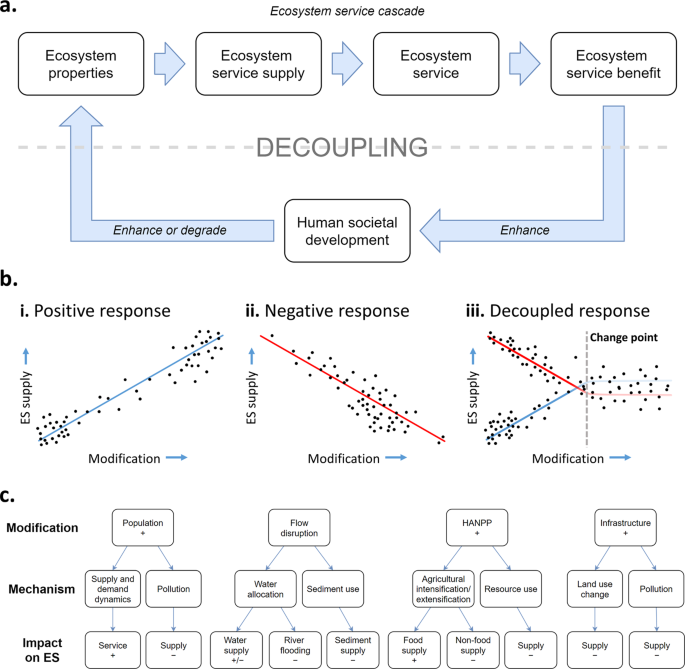

Our new paper emerged from an interest in two topics: deltas and decoupling. My PhD at the University of Zurich focused on river deltas. Deltas may not be the most obvious topic to explore in Switzerland, but these systems represent a rare confluence of importance and interest, the social and the ecological, and local and global significance. Much studied for their morphology, which can counter-intuitively expand to meet rising sea levels, deltas are increasingly investigated regarding the risks and hazards global change presents to their growing populations. However, as social-ecological systems, deltas have mostly been examined individually. We wanted to see if global patterns could be identified in the modification of deltas away from their natural states. The accelerating public availability of spatially explicit global data gave us an avenue to do so, providing indicators for the many ways that societies can modify deltas, as well as the ecosystem functions and services that this modification may impact.
Ecosystem services, the goods and services that nature provides people, represent a critical part of the story of deltas. The potent combination of flat fertile ground, fresh water and rich fisheries have promoted delta development from the cradles of civilisation to modern day megacities. But how do ecosystem services respond in turn to development? It probably depends on the particular service – we might expect humans to prioritise services such as food production at the expense of others, further, impacts on one service are likely to interact with others. However, as deltas become further modified as urban and industrial hubs, we hypothesised that these relationships between modification and ecosystem services would break, or decouple.
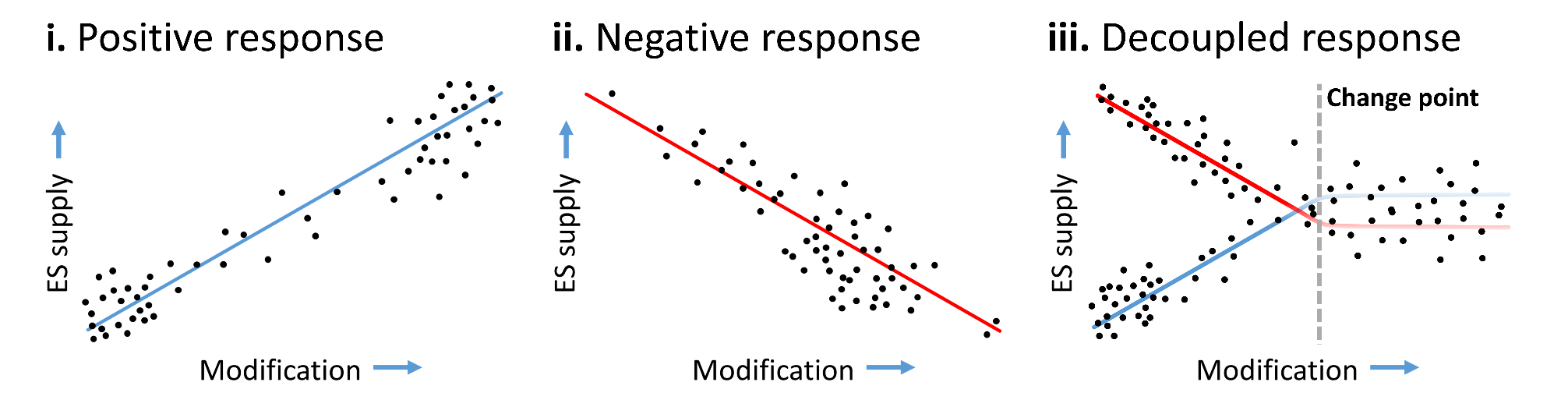
Decoupling of societies from their local ecosystems may be shown by a change point in response curves between modification and ecosystem service (ES) supply.
We constructed a dataset of the 235 large global deltas, using each as an observation, and assessed the response curves between modification and ecosystem services. And indeed many of these modification – ecosystem service responses appeared to decouple, in particular as built infrastructure increased. Decoupling, as a term, is used in different ways in different disciplines. We use it to indicate the shift from a direct relationship between modification and ecosystem services, to no relationship or a reversed relationship. But how could we explain these decoupled response curves? The work of Cumming et al. (2014) and its follow ups have been of a lot of interest to the Earth System Science group at the Department of Geography, and provided us with a conceptual framework. These papers propose that social-ecological systems can develop from a ‘green-loop’, where societies are directly linked to their local ecosystems, to a ‘red-loop’, where they obtain their services externally through trade. These can be seen as analogues to coupled and decoupled systems, that we suggest can be identified by the changing response curves we found. While we expected these curves based on previously proposed and explored relationships (e.g. Maskell et al., 2013; Peng et al., 2017; Stott et al., 2015), it was exciting to display them across global systems, and surprising given the relatively low levels of modification at which decoupling was indicated. This builds on the previous work of project supervisor Maria J. Santos, which explores the correlation of delta cropland and population over the past 300 years to find a set of ‘living’ deltas where cropland area and population size correlate, and a set of ‘locked-in’ deltas where they do not (Santos and Dekker, 2020). In sum, we believe adding ecosystem properties and services to deltas gives us a more comprehensive understanding of the processes that maintain and change these locally and globally important social-ecological systems.
This study was supported/funded by the University Research Priority Program on Global Change and Biodiversity of the University of Zurich. More details can be found in our article “The relationship between ecosystem services and human modification displays decoupling across global delta systems”. Link: https://doi.org/10.1038/s43247-022-00431-8
Image - Irrawaddy delta from International Space Station, Visible Earth, NASA https://www.visibleearth.nasa.gov/images/145066/glint-of-the-irrawaddy-delta/145066f
References
Cumming, G. S., Buerkert, A., Hoffmann, E. M., Schlecht, E., Von Cramon-Taubadel, S., & Tscharntke, T. (2014). Implications of agricultural transitions and urbanization for ecosystem services. Nature, 515(7525), 50–57. https://doi.org/10.1038/nature13945
Maskell, L. C., Crowe, A., Dunbar, M. J., Emmett, B., Henrys, P., Keith, A. M., … Smart, S. M. (2013). Exploring the ecological constraints to multiple ecosystem service delivery and biodiversity. Journal of Applied Ecology, 50(3), 561–571. https://doi.org/10.1111/1365-2664.12085
Peng, J., Tian, L., Liu, Y., Zhao, M., Hu, Y., & Wu, J. (2017). Ecosystem services response to urbanization in metropolitan areas: Thresholds identification. Science of the Total Environment, 607–608, 706–714. https://doi.org/10.1016/j.scitotenv.2017.06.218
Santos, M. J., & Dekker, S. C. (2020). Locked‑in and living delta pathways in the Anthropocene. Scientific Reports, 10(19598). https://doi.org/10.1038/s41598-020-76304-x
Stott, I., Soga, M., Inger, R., & Gaston, K. J. (2015). Land sparing is crucial for urban ecosystem services. Frontiers in Ecology and the Environment, 13(7), 387–393. https://doi.org/10.1890/140286

Follow the Topic
-
Communications Earth & Environment
An open access journal from Nature Portfolio that publishes high-quality research, reviews and commentary in the Earth, environmental and planetary sciences.

Related Collections
With Collections, you can get published faster and increase your visibility.
Ecological resistance and resilience under global change
Publishing Model: Open Access
Deadline: Apr 07, 2027
Hazards in Mountain Regions
Publishing Model: Open Access
Deadline: Nov 02, 2026