


Introduction
In our recent study, published in Nature Communications, we have developed a microscopic factory for little walkers: a biped factory. We use an external magnetic field to assemble paramagnetic colloidal spheres into colloidal rods of a chosen length which leave the factory once they are grown-up. It is a new approach to control the lengths and the position of magnetic colloidal rods, made possible with a topologically protected form of transport.
Basics of transport
Paramagnetic particles are placed above a periodic magnetic pattern made of regions of positive and negative magnetizations normal to the pattern. A uniform external field of constant magnitude is superimposed to the non-uniform magnetic field generated by the pattern. The orientation of the external field varies in time, performing loops, and driving the colloidal motion. During one temporal period, the minima move one or more spatial periods, and the particles are transported following the minima of the periodic magnetic potential. After one loop the orientation of the magnetic field returns to its initial value. During loops that wind around specific orientations, minima of the magnetic potential cross from one unit cell to the adjacent. Once the loop ends, the particle is in a position equivalent to the initial one but in a different unit cell. The motion is topologically protected in the sense that the precise shape of the loop is irrelevant. All loops falling into the same class cause motion in the same direction, making the transport robust against internal and external perturbations1,2.
The symmetry of the pattern (e.g. square vs. hexagonal) and the particle properties play important roles in determining the specific orientations of the external field that control the motion. Hence, particles with different properties above periodic magnetic patterns, such as for example bipeds (colloidal rods built from single colloids) of different lengths, can be transported in different directions independently using periodic patterns3.
However, in periodic patterns, all particles that belong to the same topological class (e.g. identical paramagnetic particles or rods of the same length) are transported along the same direction, independently of their absolute position above the pattern which imposes several limitations on the transport. These limitations are overcome here using a metamorphic, i.e. nonperiodic pattern.
How to build microwalkers
In this work we use a metamorphic pattern which is locally periodic but looks different in different positions, changing from C6 to S6 symmetry when moving along the perpendicular direction. As the direction of the transport is different in C6 or S6 pattern1 and hence, the direction of transport depends on the particle position. With a properly designed loop, different particles can be transported in different directions so that they then assemble and join to form rods with different lengths. These rods can then walk on the magnetic pattern as bipeds.
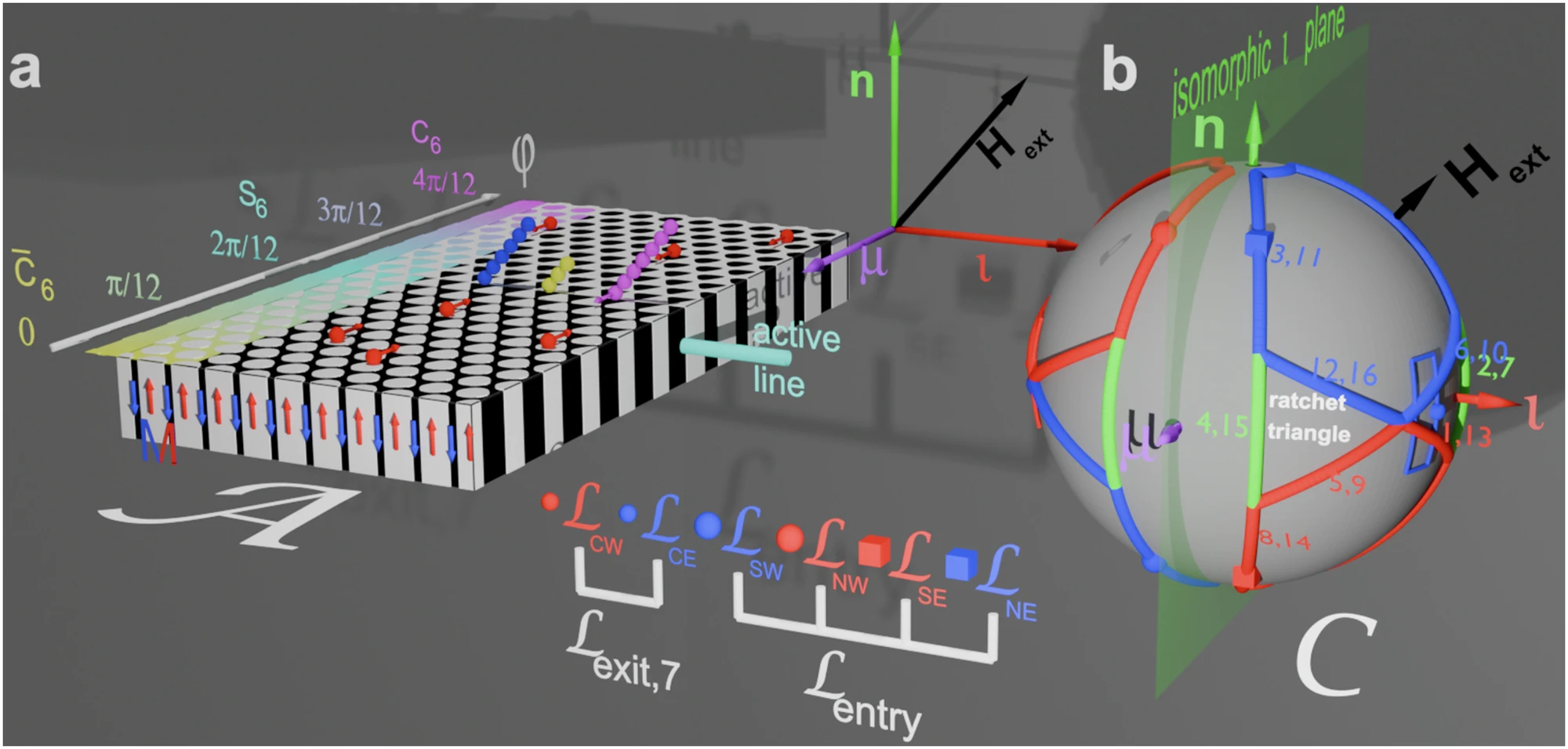
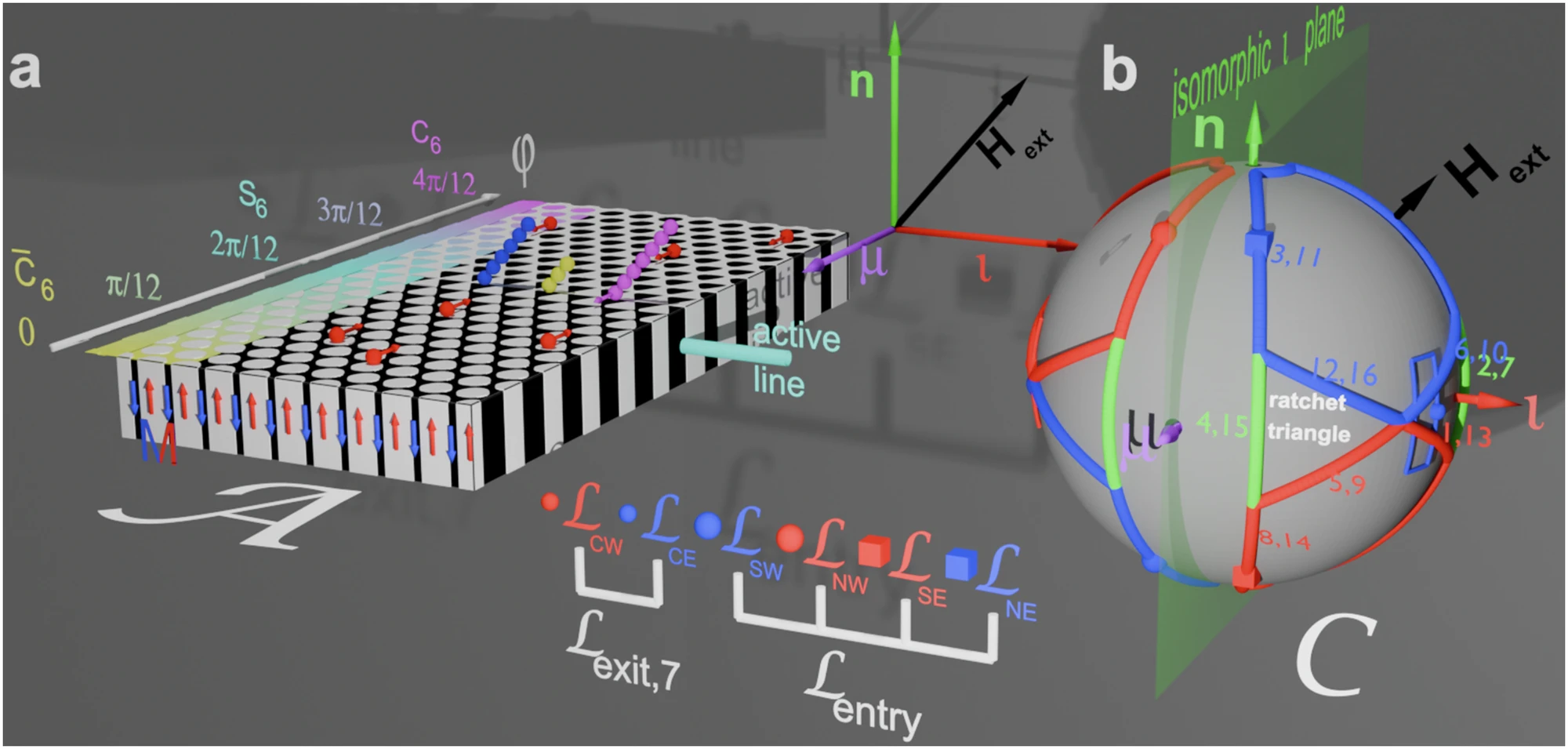
- a) Magnetic metamorphic pattern consisting of domains of positive (white) and negative (black or colored) magnetization. Single colloidal particles (red) move to the active line of the pattern and make bipeds of different lengths. b) The two magnetic loops used in the experiments. One loop moves the microspheres toward the line and the other loop moves the outgrown bipeds away.
The loop consists of two parts: One part, the so-called entry loop, makes the initially randomly distributed colloidal spheres move from all directions to a specific line, the so-called active zone of the pattern, where they meet and assemble. The other part, the exit loop, then makes outgrown bipeds, i. e. those of a specific length, walk away whereas all shorter bipeds stay in the active zone.
This works in the following way: The fences, which determine the mentioned points that the loop has to wind around, are different for bipeds of different lengths. This makes it possible to design a loop that has different winding numbers with respect to the fences for differently sized bipeds, which therefore react differently to the loop. To facilitate the problem of finding a proper exit loop we choose the entry loop and the exit loop to have certain symmetries with respect to the pattern such that we know for sure that only the exit loop transports particles away from the active zone, so the effect of the entry loop can be neglected.
In the experiments, we were able to produce bipeds of six different lengths with this system. Videos can be found on the website of the article.
Summing up, what we find interesting about the system is this: The same loop makes particles in different locations and with different lengths walk in different directions. Hence one could argue that the decision where to go is made by the particles themselves, and the magnetic loop can be seen as a polyglot – a single command which has different meanings in different languages.
References:
- Loehr, J., Loenne, M., Ernst, A., de las Heras, D. & Fischer, T. M. Topological protection of multiparticle dissipative transport. Nat. Commun. 7, 11745 (2016).
- de las Heras, D., Loehr, J., Loenne, M. & Fischer, T. M. Topologically protected colloidal transport above a square magnetic lattice. New J. Phys. 18, 105009 (2016)
- Mirzaee-Kakhki, M. et al. Simultaneous polydirectional transport of colloidal bipeds. Nat. Commun. 11, 4670 (2020).

Follow the Topic
-
Nature Communications
An open access, multidisciplinary journal dedicated to publishing high-quality research in all areas of the biological, health, physical, chemical and Earth sciences.

Related Collections
With Collections, you can get published faster and increase your visibility.
Women's Health
Publishing Model: Hybrid
Deadline: Ongoing
Tumor Microenvironment Crosstalk and Therapeutic Implications
Publishing Model: Hybrid
Deadline: Nov 02, 2026