How a Friendly Gut Microbe May Protect African Children from Infections
Published in Microbiology, Biomedical Research, and Immunology






Uncovering the hidden role of Prevotella stercorea in early-life immunity
"In the hottest, most remote corners of Africa, discovery and wonder coexist."
Fieldwork in The Gambia's North Bank
The rural Upper River Region (URR) of The Gambia in West Africa has long been one of the country's most neglected regions—underdeveloped in infrastructure but rich in warmth, hospitality, and resilience. It also bears some of the highest child morbidity and mortality indices nationwide.
During the summer months, temperatures in the study villages can reach 45°C. I vividly remember marathon community sensitization talks under that relentless heat. On one occasion, at the final village of the day, I suddenly felt lightheaded mid-sentence and thought, "My goodness, I'm about to create a scene here." I paused strategically, took a sip of water, and steadied myself—while the villagers, entirely in their element, smiled on cheerfully.
The IHAT-GUT children we worked with were absolutely adorable, and fieldwork in this environment remains one of my most nostalgic research experiences. From Yorrobawol Health Centre, our operational base, I would often watch herders watering large herds of cattle at a nearby well. Using an ingenious system of rotating donkeys to power a pump, the cattle appeared to understand the routine—drinking in turn before trotting off happily into the shimmering heat.
Conducting microbiome research in rural Africa is not for the faint-hearted. Maintaining cold chains under intense heat, navigating seasonal floods, and transporting biological samples across rivers were routine challenges. I owe special credit to Mr. Bakary Baldeh, our Nurse Coordinator—an exceptionally meticulous and efficient leader who oversaw adverse event data collection and participant care—and to Famalang Camara, who led the field team. Before the construction of the Basse bridge, we relied on ferries to cross the river, and roads were often deeply gullied or transformed into muddy lakes during the rainy season. Yet under these conditions, the team consistently delivered stool samples on time. Their commitment and endurance made this study possible.
"Behind every dataset was a story of endurance, collaboration, and hope."
The Discovery
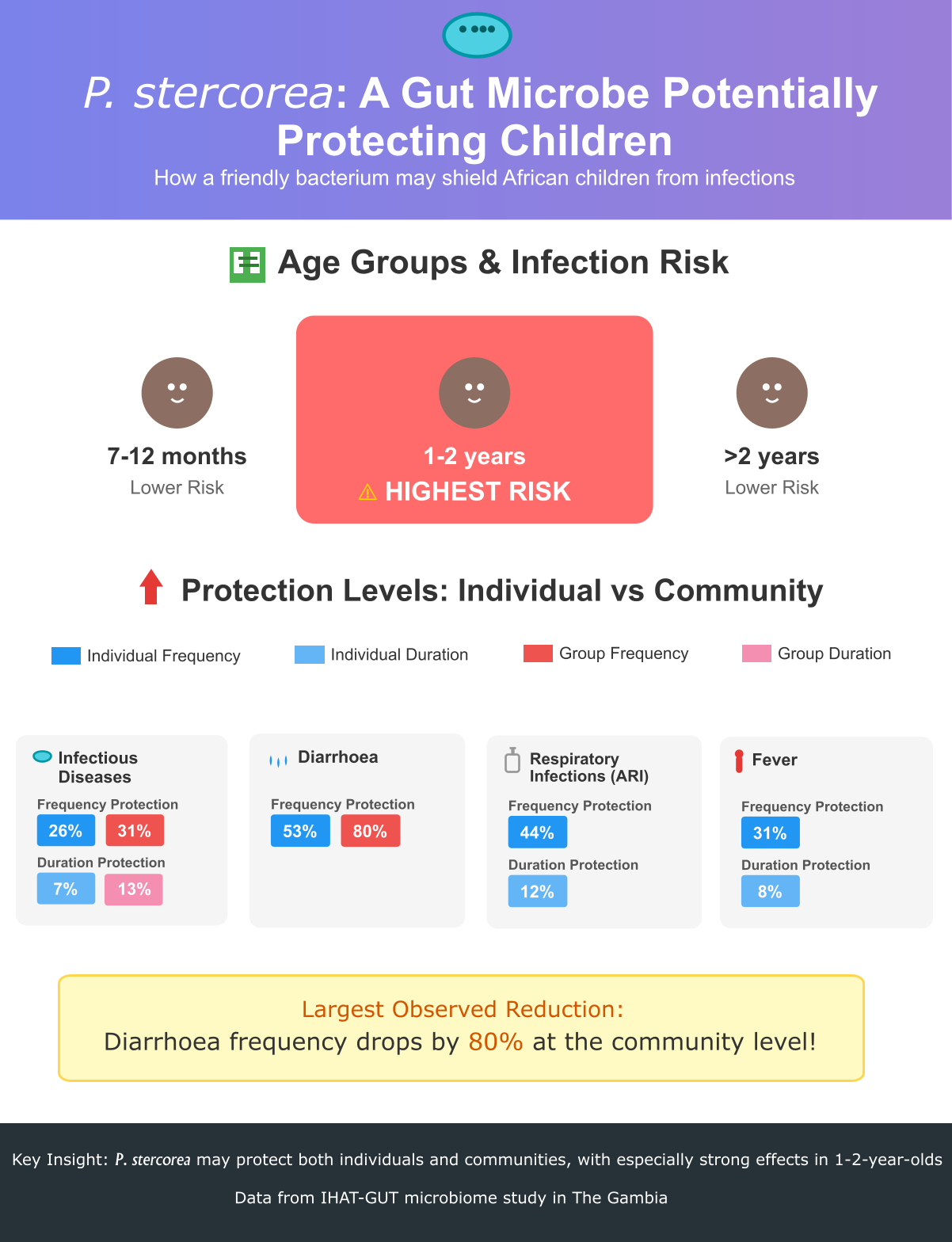
When we began analyzing the IHAT-GUT data, we were mapping the overall diversity and maturity of the gut microbiome in these children who experience frequent infections—diarrhoea, fever, and acute respiratory illnesses. Traditionally, the particularly high infection burden among 1–2-year-olds has been attributed mainly to behavioural factors such as exploration and mouthing objects. We weren't looking for a single microbial champion, but as the sequencing results came back, one specific bacterium kept appearing with a clear, statistically protective signal: Prevotella stercorea.
It was a true "a-ha" moment. This common microbe, abundant in rural African populations but long regarded as just another commensal, emerged as a potential protective ally. The patterns we observed were striking and consistent across multiple infection types. At the individual level, children with higher P. stercorea abundance experienced 53% fewer diarrhoea episodes, 44% fewer respiratory infections, and 31% fewer fevers. Illness duration was also shorter by 8–12%. Overall, these children had 26% fewer infectious disease episodes and 7% shorter illness durations.
A Community Shield
What made the findings particularly compelling was a pattern that emerged when we examined community-level effects. While individual protection was substantial, the benefits appeared to magnify at the population scale. In communities where P. stercorea was more prevalent, diarrhoea frequency dropped by a remarkable 80%—far exceeding the individual-level protection of 53%. Overall infectious disease frequency fell by 31% at the community level compared to 26% individually, and illness durations shortened by 13% versus 7% at the individual level.
This dual protection—individual and communal—suggests something fascinating: P. stercorea may not only benefit its host but also contribute to reducing transmission across communities, acting as a form of microbiome-based collective immunity. Interestingly, this protective pattern was most pronounced in the very age group at highest risk: the 1–2-year-olds. This alignment suggested that microbiome composition may help explain why some children weather this vulnerable developmental window better than others.
More Than Just a Passenger
What makes P. stercorea special? Our research suggests it's not a benign passenger but an active community worker. It belongs to a group of bacteria that excel at breaking down dietary fiber that human bodies cannot digest. This process releases short-chain fatty acids (SCFAs)—powerful molecular communicators that strengthen the gut barrier to prevent pathogens from crossing into the bloodstream and train the immune system to be both strong and balanced. In essence, P. stercorea helps fortify a child's primary defense against the harsh realities of their environment.
"A single gut bacterium may offer a new layer of protection—one that arises from cooperation rather than competition."
Implications and The Road Ahead
This discovery reinforces a crucial point: when preventing infection in high-burden settings, we need to look beyond the immediate pathogen and consider the microbial ecosystem that underpins health. From a clinical and public health perspective, the findings are profoundly encouraging. They point to a biological layer of protection that complements hygiene, nutrition, and behavioural interventions.
The community-level effects are particularly important for policymakers. The findings suggest that promoting beneficial gut bacteria like P. stercorea could offer scalable, low-cost strategies for improving population health—through targeted nutrition using local foods that encourage its growth, next-generation probiotics tailored for African populations, or integrating microbiome health into broader malnutrition and infection prevention programs.
For us as researchers, the journey reinforced a timeless lesson: the smallest organisms can exert outsized influence. Our findings add to growing evidence that long-standing microbial relationships may play an underappreciated role in shaping immune resilience, particularly in environments where infectious pressure remains high.
In The Gambia's North Bank—under its blinding sun, red dust, and quiet determination—a microscopic partner offered a powerful reminder that immunity may begin in the gut, and protection can emerge from enduring partnerships between microbes and humankind.
About the Author
Dr Ogochukwu Ofordile is a medical researcher at the Medical Research Council Unit The Gambia at the London School of Hygiene and Tropical Medicine and lead author of the Prevotella stercorea study. His work explores how early-life gut microbiome ecology shapes infection risk and immune development in high-burden settings, with a particular focus on African child health.
Keyword Tags: Microbiome immunity, Prevotella stercorea, Child health and infection, Africa and global health, Gut microbiota and immunity

Follow the Topic
-
Nature Communications
An open access, multidisciplinary journal dedicated to publishing high-quality research in all areas of the biological, health, physical, chemical and Earth sciences.

Related Collections
With Collections, you can get published faster and increase your visibility.
Women's Health
Publishing Model: Hybrid
Deadline: Ongoing
Tumor Microenvironment Crosstalk and Therapeutic Implications
Publishing Model: Hybrid
Deadline: Nov 02, 2026