How a Question About Bladder Cancer Progression Led Us to a Metabolic Vulnerability
Published in Cancer, Protocols & Methods, and Biomedical Research




Metabolism is a complex network of more than 20,000 biochemical reactions. Every cell in our body constantly orchestrates these pathways to transform nutrients into energy and the building blocks required for cellular structures, to eliminate waste, and to dynamically adapt cellular behavior to environmental cues.
It is well established that metabolic deregulation is a universal hallmark of cancer, playing a pivotal role in tumor initiation, progression, and chemoresistance. For us researchers, these metabolic alterations represent a golden opportunity: they are a gateway to identifying novel diagnostic/prognostic biomarkers and therapeutic vulnerabilities to cure tumors or overcome resistance to conventional therapies.
The journey of our paper started with a fundamental question: What specific metabolic rearrangements occur during the progression of bladder cancer? Answering this is crucial. It could provide the molecular markers needed to improve patient stratification, directing individuals to more effective, targeted, and less toxic or invasive treatments, the very core of precision medicine.
Embracing Complexity: A Systems Biology Approach applied to metabolic network
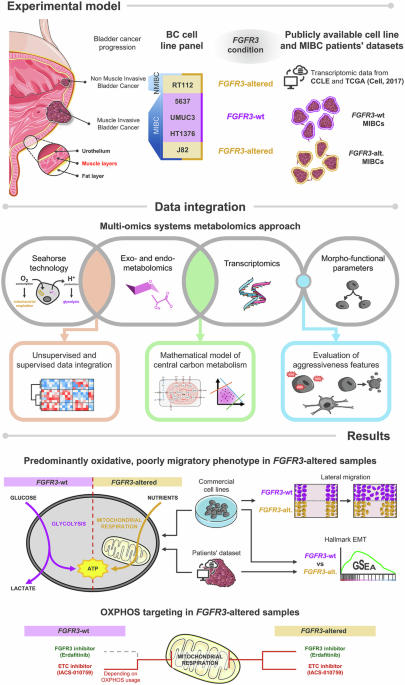
To address this question, we assembled a panel of human bladder cancer cell lines representative of different stages and grades of tumor progression. Given the inherent complexity of metabolic networks, a conventional approach wouldn't suffice. We decided to use a systems biology approach applied to a metabolic network, a systems metabolomics approach, able to profile as many molecular components as possible on a genome-wide scale:
- Transcriptomics: Analyzing mRNA expression encoding metabolic enzymes and their upstream regulators.
- Metabolomics: Capturing the actual metabolic state through extracellular flux analysis (MS-based endometabolomics, NMR-based exometabolomics and Seahorse technology).
To extract meaningful knowledge from these massive multi-omics datasets without introducing bias, we utilized a quantitative computational platform combining biostatistics and genome-scale mathematical modeling of metabolism. This allowed us to predict metabolic fluxes in an untargeted and completely unbiased manner.
The "Eureka" Moment: When Data Forces You to Pivot
As often happens in scientific research, our data had a surprise in store for us. The functional and computational analyses revealed metabolic rearrangements that did not neatly correlate with tumor staging or progression. This unexpected hurdle forced us to go back to the drawing board and rethink our initial hypothesis.
We began exploring specific genetic alterations within our cell panel that could explain the observed metabolic behaviors. And then... Eureka! We discovered a striking correlation with one of the most frequent oncogenic lesions in bladder cancer: alterations in FGFR3 (Fibroblast Growth Factor Receptor 3). While FGFR3 is already a clinically validated drug target in bladder cancer (using pan-FGFR inhibitors like Erdafitinib), patients frequently suffer from low complete response rates and the rapid emergence of resistance—a common flaw of therapies directly targeting signaling pathways.
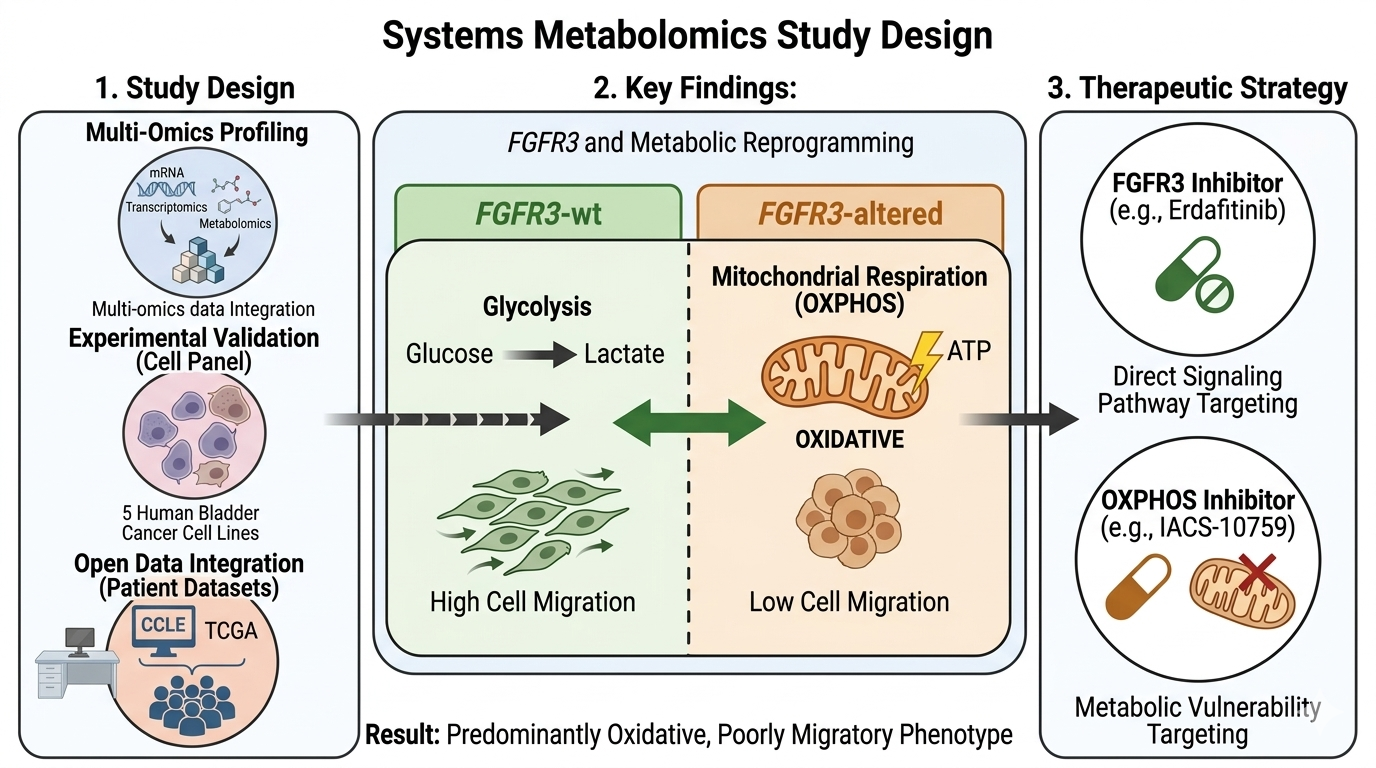
(Note: This image tag acts as a conceptual placeholder for cellular bioenergetics and metabolic fuel shifting, illustrating how cells dynamically switch power sources).
Our systems metabolomics approach revealed that FGFR3 oncogenic activation drives a distinct metabolic reprogramming, forcing bladder cancer cells into a state of strict dependence on mitochondrial oxidative phosphorylation (OXPHOS). Remarkably, this predominantly oxidative, poorly migratory phenotype occurs regardless of tumor aggressiveness or stage.
The Power of Peer Review and Open Data
During the review process, thanks to the insightful and constructive feedback from the reviewers, we were able to significantly strengthen the message of our paper. We demonstrated that this FGFR3-driven metabolic rewiring could be successfully cross-validated using our computational tools on publicly available patient datasets. This served as a powerful reminder of how vital open data sharing is within the scientific community, allowing us to validate our findings from five cell lines across a much larger, clinically relevant patient cohort.
Our discovery paves the way for a promising therapeutic strategy: combining FGFR3 targeting with OXPHOS inhibitors (such as IACS-10759) to exploit this metabolic vulnerability in FGFR3-altered bladder tumors, potentially preventing or overcoming resistance.
The Research Continues...
Of course, in science, every answer gives rise to new questions. We have now circled back to our original inquiry: Is there a distinct metabolic signature that separates muscle-invasive (MIBC) from non-muscle-invasive bladder cancer (NMIBC)?
To answer this, we are currently shifting from classic 2D cultures to advanced three-dimensional (3D) cellular models, which far better mimic the true architecture of an in vivo tumor mass. Furthermore, we are validating our multi-omics findings with spatial resolution analysis on bladder cancer histological specimens.
The loop isn't closed yet, and the research continues!

Follow the Topic
-
Communications Biology
An open access journal from Nature Portfolio publishing high-quality research, reviews and commentary in all areas of the biological sciences, representing significant advances and bringing new biological insight to a specialized area of research.

Related Collections
With Collections, you can get published faster and increase your visibility.
Healthy Aging
Publishing Model: Open Access
Deadline: Dec 31, 2026
DNA repair and human disease
Publishing Model: Hybrid
Deadline: Oct 31, 2026


