Hydrogen detection via resonant neutron reflectometry
Published in Materials


Hydrogen, the most abundant element in the Universe and the smallest atom in the periodic table, is able to intercalate into many different materials and change their physical and chemical properties. It can either occupy interstitial voids of a crystalline lattice, be accumulated into defects such as grain boundaries and dislocations in polycrystalline materials or be stocked into bigger cavities in porous materials. In addition, hydrogen can change the chemical bonds of the structure and the electronic states of the valence electrons. For many years the interest rose mostly on how much hydrogen can be stored or transported into different materials, mostly for energy and environment related issues, such as hydrogen storage, fuel cells, hydrogen sensing and many more.
More recently however the frontiers have widened up with studies on the possibility to use H intercalation as a mean to tune the physical properties of the host material. Some application-oriented examples are the tunable magnetic anisotropy in all-solid-state devices , tunable magnetic exchange coupling through Fe/V and Fe/Nb multilayers and tunable spin magnetic state in Cr/V heterostructures via hydrogen uptake. Other important recent examples are the finding of colossal resistive effect in perovskite nickelates tuned by H absorption and desorption and the discovery that H incorporation increases the superconducting transition temperature Tc of iron-based superconductors. In many cases, as in this last cited, a small concentration of hydrogen absorbed is sufficient to significantly change the physical properties. It is hence crucial to be able to quantify the absorbed H precisely. However, the measurement of small hydrogen concentrations in materials and in particular in thin films is indeed challenging and only few techniques can be employed to do so.
Resistivity or optical measurements are indirect methods that can be used, but still require the comparison with some other technique to calibrate the actual absorbed H concentration. Some direct techniques are nuclear methods, such as Elastic Recoil Detection Analysis or Rutherford Back Scattering, and x-ray and neutron scattering methods. While the nuclear methods can reach very high sensitivity, they are up to some extent destructive, and cannot be performed in hydrogen atmosphere. Scattering methods are on the other hand non-destructive and allow for in situ experiments. The study of reflected x-ray or neutron radiation at various small angles (θ<1°) on the flat surface of thin films (reflectometry) can give access to many depth dependent information, such as thickness and scattering potential of all the thin layers. This scattering potential is different for each material depending on the atoms present and their packing density. The X-rays interact with electronic clouds and hence hydrogen, with its one electron, is almost invisible to X-ray reflectivity. Neutrons on the other hand interact strongly with hydrogen, which will significantly affect the scattering potential of the host matrix and hence change the neutron reflectivity (NR). For this reason NR was widely used for the study of hydrogen uptake in various systems. Nevertheless, it has some limitations, as the need of fitting the data to recover physical parameters such as the scattering potential and thickness. In particular for small hydrogen concentrations, below 5%, the thickness changes can be very small, as well as the contrast induced by the absorption of hydrogen, meaning a hard determination of the exact hydrogen concentration.
In order to overcome these limitations, it is possible to enhance neutron reflectometry with a resonator, or waveguide structure, that allows to have a strong peak ensured by the neutron resonance condition. The method proposed in this work shows the possibility to correlate precisely the position of the resonance peak with the hydrogen concentration inside the thin film.
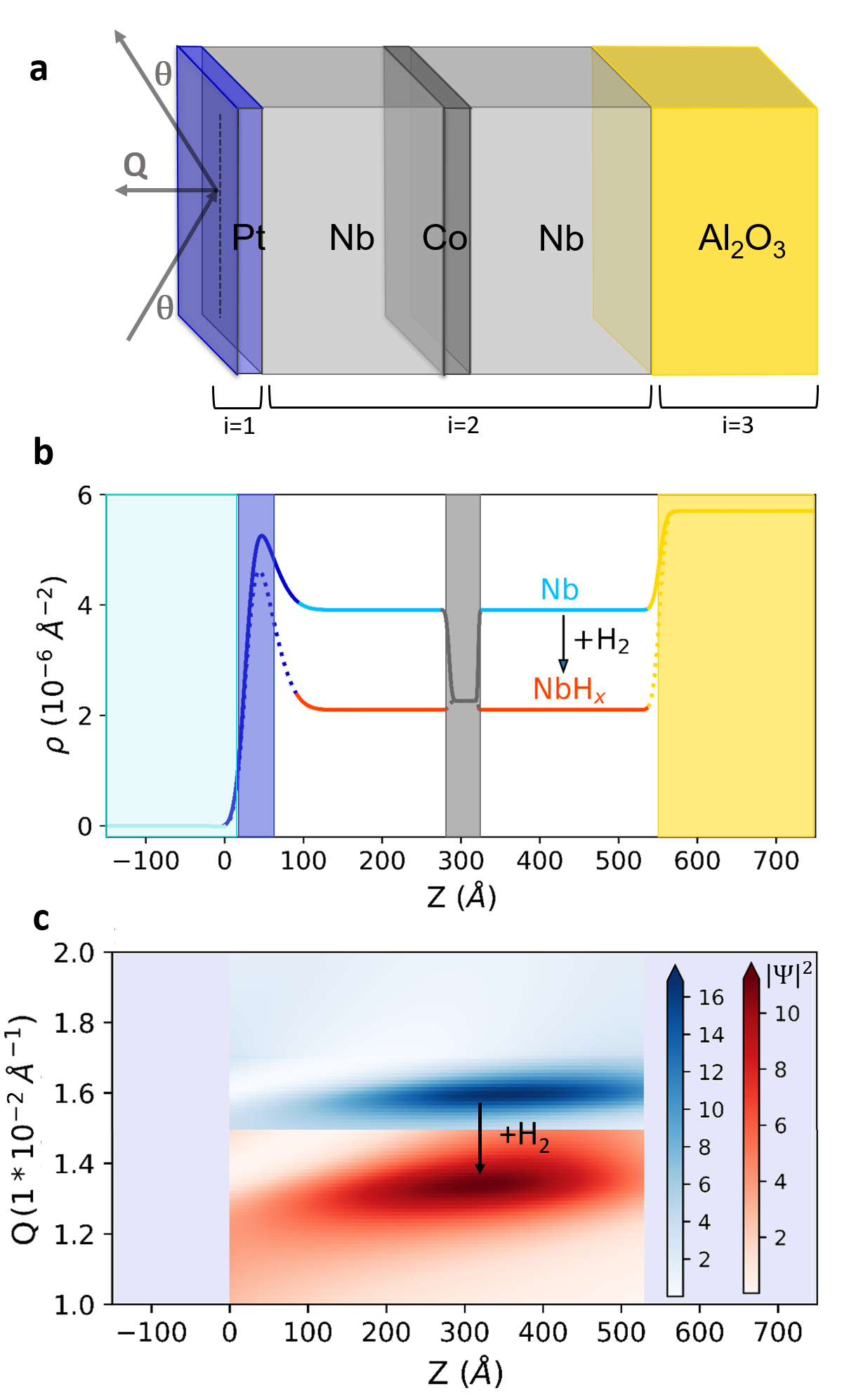
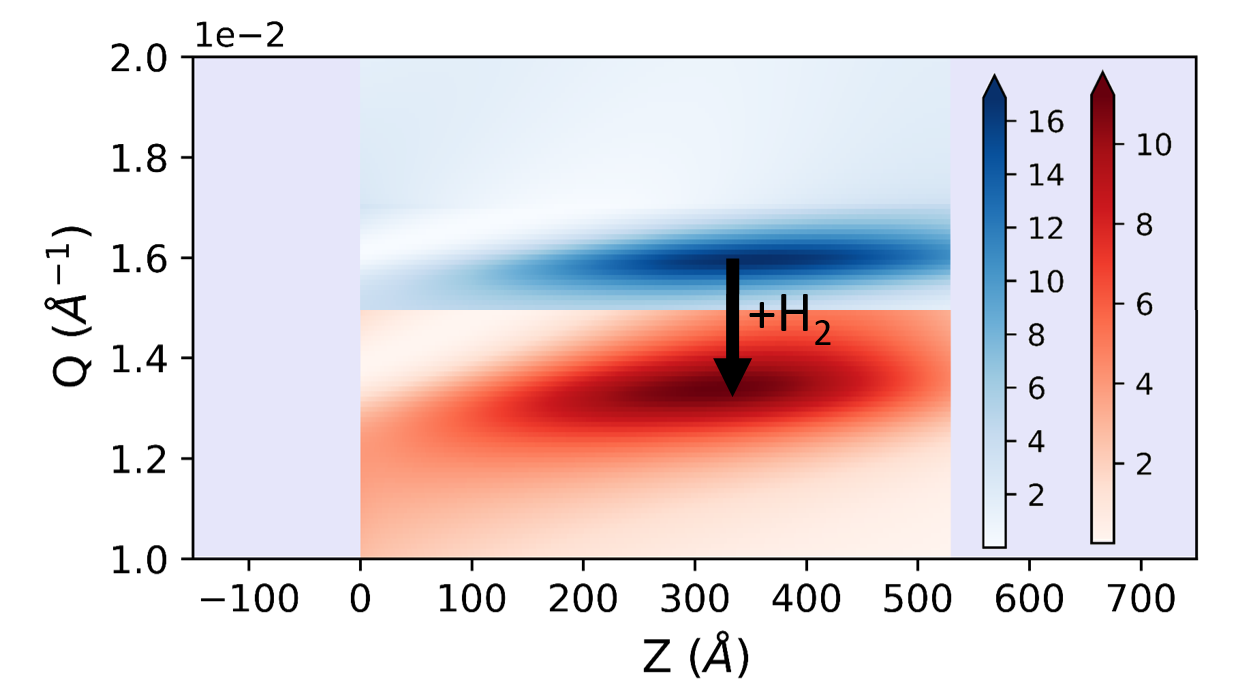
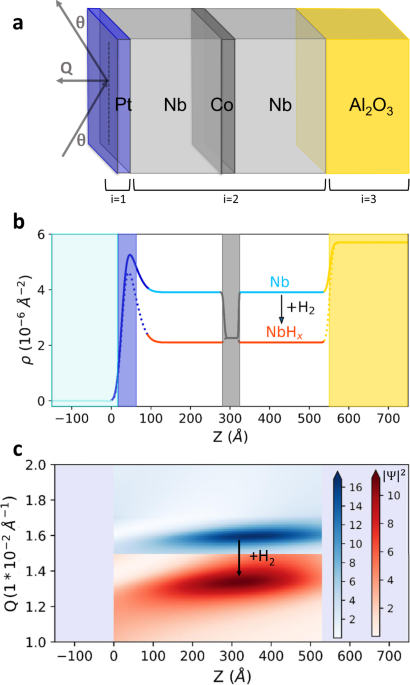
For the method's proof of principle samples of composition Al2O3/Nb(25nm)/Co(3nm)/Nb(25nm)/Pt(3nm), sketched in Fig.1.a, were considered. The middle layer was chosen to be niobium, which is a well-known hydrogen absorber. The Co inserted in between Nb layers acts as the label magnetic layer needed to trace position of the resonance. The structure was capped by Pt(3nm) layer in order to enable the splitting of H2 molecules at the surface and diffuse H atoms to the underneath layers. The scattering potential of all layers versus sample depth forms a potential well, as shown in blue line in Fig.1b. Due to this well the neutron density is resonantly enhanced at the depth of the middle layer and momentum transfer Qres, as shown in the blue area of Fig.1c. The relation between the incoming angle of radiation and Q is shown in Fig.1a.
When H is absorbed in the system, it greatly reduces the scattering potential of niobium, as shown in the red line of Fig.1b, and as a consequence the resonant field will be modified, with a shift at lower Qres , as shown in Fig.1c in red. We showed that the shift in resonance position is directly proportional to the hydrogen absorbed, allowing for quantitative measurement without the need of measuring and fitting the whole reflectivity curve.
The resonant neutron reflectometry, or RNR, thus consist in tracking the resonance position Qres while H is absorbed in the sample. This was done in two different modes, one by making a series of consecutive short Q-scans around the resonance (inset of Fig.2a), which allowed to study the full kinetics of absorption with a time resolution of around 8 minutes, as shown in Fig.2a. The other mode consisted in staying at fixed Q and measure the variation in reflected intensity, which was in turn translated to hydrogen content cH as shown in colored dots in Fig.2b. This mode allowed to reach a time resolution of few seconds and a sensitivity of around 1 atomic % of hydrogen. In situ electrical transport measurement (black dots) showed a remarkable correlation with RNR, confirming the validity of RNR versus a well known hydrogen detection method.
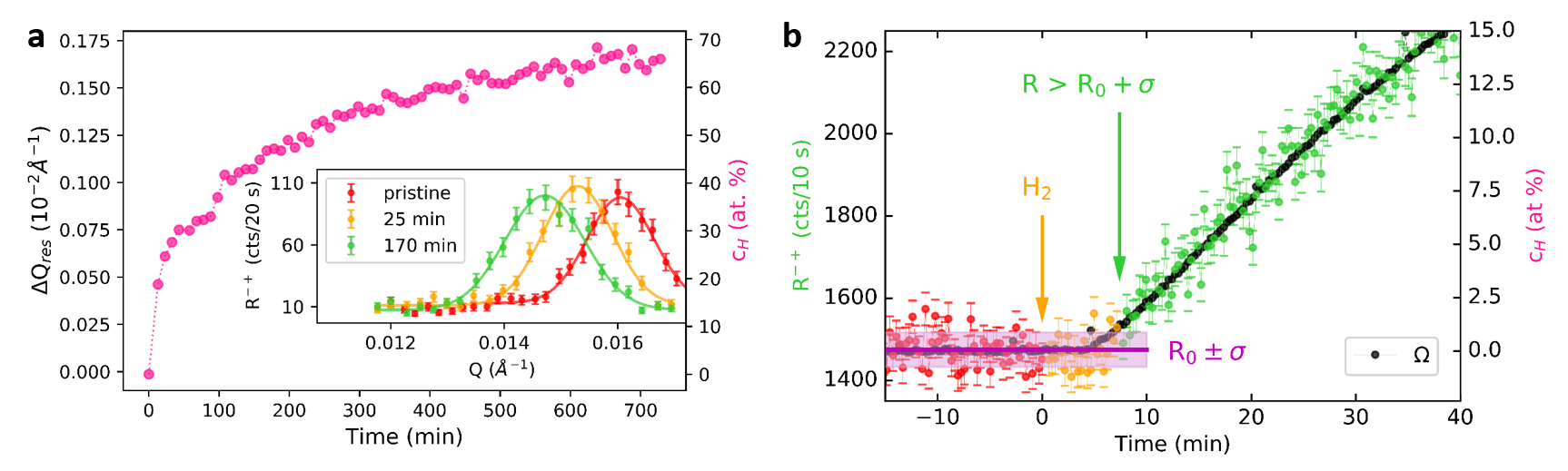
Figure 2: Resonant neutron reflectometry. a. Time evolution of the resonance peak and corresponding hydrogen concentration. Inset: shift of the resonance peak during H absorption with Q-scans. For clarity, only a small selection of the measured curves are reported, b. Time evolution of the reflected intensity at fixed Q before (red points), and during H absorption (yellow and green dots). Black dots indicate the simultaneous resistance measurement.
Even considering its drawbacks, such as neglecting thickness changes upon H loading, RNR offers a solid improvement with respect to previously used reflectometry methods, as it allows detection of smaller amounts of H and the study of faster kinetics of absorption, without the drawback of the fitting of the data. This method has a two-fold potential:
- to detect very small H quantities and the effect they have on physical properties, such as superconductivity or magnetic states.
- to study very fast kinetics of absorption in hydrogen storage materials.
For further information, please read our published article in Nature Communications, https://www.nature.com/articles/s41467-022-29092-z

My research interest lays mostly in material science, in particular the modification of electronic properties of thin films via electron or proton doping. The materials studied in my research range from hydrogen storage materials such as metal hydrides, to transition metal oxides, such as manganites and cuprates. The primary technique of investigation used are neutron and x-ray reflectometry, combined with other complementary techniques.
Follow the Topic
-
Nature Communications
An open access, multidisciplinary journal dedicated to publishing high-quality research in all areas of the biological, health, physical, chemical and Earth sciences.

Related Collections
With Collections, you can get published faster and increase your visibility.
Women's Health
Publishing Model: Hybrid
Deadline: Ongoing
Tumor Microenvironment Crosstalk and Therapeutic Implications
Publishing Model: Hybrid
Deadline: Nov 02, 2026