In‑Operando X‑Ray Imaging for Sobering Examination of Aqueous Zinc Metal Batteries
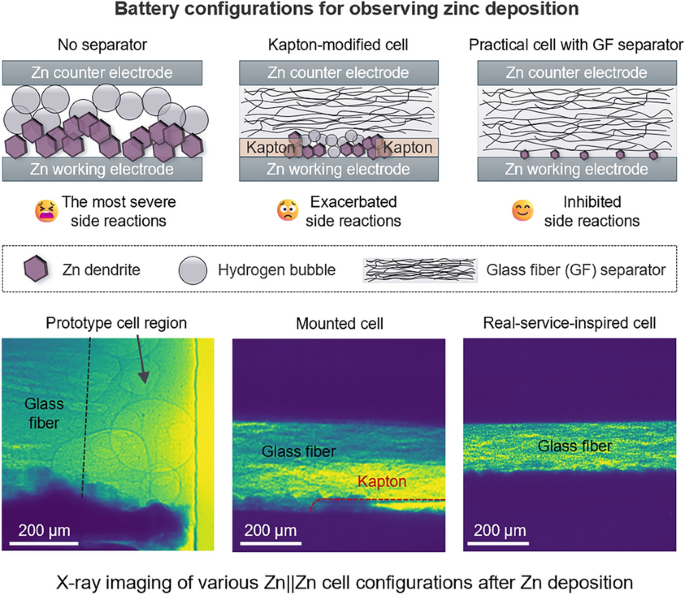
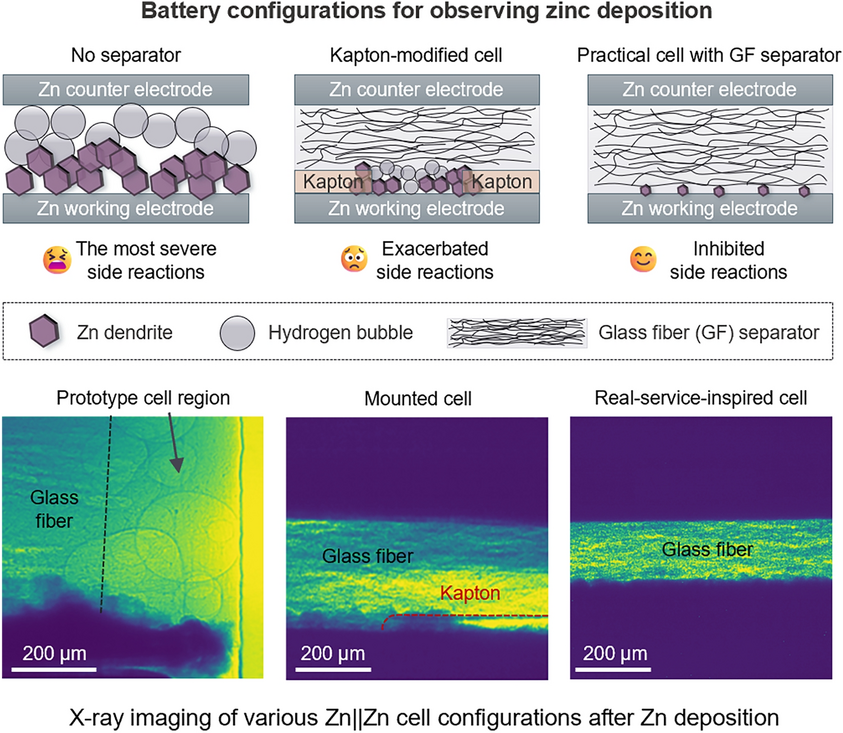

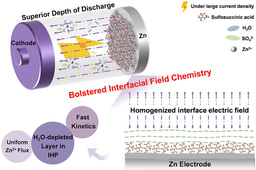
As aqueous zinc metal batteries (AZMBs) move from lab curiosities toward commercial packs, the true culprits behind early failure have remained blurred by over-simplified test cells. A UCL–SCUT–Imperial team led by Dr. Guanjie He and Dr. Haobo Dong now delivers the clearest real-time pictures yet, using high-energy synchrotron X-ray radiography to watch Zn plating, dendrites and hydrogen bubbles inside configurations that actually mimic coin, pouch and prismatic formats. Their findings flip the conventional wisdom: when cells are densely packed—as they would be in your pocket—the anode is far better behaved than textbook “open” cells suggest, and cathode-side decay steals the limelight.
Why This Matters
- Real-World Relevance: Most optical or AFM studies introduce artificial gaps for easy viewing; the new work keeps the tight electrode-to-separator stack intact, letting electric fields and ion flux stay uniform.
- Triple-Phase Suppression: Eliminating free gas pockets starves the hydrogen-evolution reaction (HER) of its favorite meeting place, cutting bubble counts and dendrite nucleation by an order of magnitude.
- Shifted Failure Target: Post-mortem electrode swapping in Zn||MnO2 coin cells shows that inserting a fresh cathode instantly revives capacity, while a fresh Zn anode does not—pointing to cathode corrosion and contact loss as the true life-limiters under practical loads.
- Design Guide: Engineers can now safely dial down anode over-sizing and focus instead on cathode coatings, current-collector alloys and edge-seal geometry to reach 2,000+ cycles.
Innovative Setup & First Glimpse
- 30 keV Monochromatic Beamline (Diamond I13-2): 6.5 µm voxel size, 0.5 s exposure, capturing 2D movies at up to 5 Hz—fast enough to catch the instant a bubble detaches or a dendrite bridges.
- Three Cell Geometries Benchmarked: – Prototype: No separator, wide electrolyte gap—HER “champagne” event, severe dendrites. – Mounted: Kapton window for local view—edge discharge intensified, earlier short-circuit. – Real-service-inspired: GF separator pressed tight, no artificial voids—negligible HER, minimal dendrites, 25 h reversible cycling vs. <5 h for the others.
- Electrochemical Fingerprint: Chronoamperometry decomposition reveals 2D-to-3D diffusion transition in only 1.5 s for the dense cell (vs. >50 s for open cells), signaling uniform nucleation and a stable interface.
Future Outlook
The imaging platform is now being coupled with phase-contrast tomography to quantify cathode current-collector detachment and electrolyte dry-out in 3D. Expect the next wave of AZMB chemistries—V2O5, MnO2 and even NASICON cathodes—to be screened first in this “truth-telling” cell, slashing trial-and-error by directly visualizing where and when the real damage occurs.

Editor of Nano-Micro Letters, which is an Open-Access, peer-reviewed journal reported papers that have at least one dimension ranging from a few sub-nanometers to a few hundreds of micrometers. The journal is published by Springer Nature and indexed by SCI, EI, SCOPUS, Pubmed, etc. The 2025 JCR Impact Factor is 38.5. The 2025 CiteScore is 58.9.
Follow the Topic
-
Nano-Micro Letters
Nano-Micro Letters is a peer-reviewed, international, interdisciplinary and open-access journal that focus on science, experiments, engineering, technologies and applications of nano- or microscale structure and system in physics, chemistry, biology, material science, and pharmacy.