Insights on the impending 79 CE ‘‘Pompeii’’ eruption of Vesuvius (Italy)
Published in Earth & Environment


There must be a reason why in 1971 the Pink Floyd decided to record their legendary ‘‘Live at Pompeii’’ concert film in the amphitheatre of the ancient Roman town, at 10-km distance from Vesuvius. In that event, the amphitheatre was voluntarily kept empty, so the silhouette of the volcano was the only impressive presence on the skyline. The surreal atmosphere at the concert was utterly evocative!
Vesuvius brought destruction and death at Pompeii during the eruption occurred in 79 CE. What is surprising is that although the ‘‘Pompeii’’ eruption was a huge volcanic event classified as ‘‘Plinian’’ (among the most catastrophic natural events), the Pompeiians did their daily things until the first phases of the eruption. Before eruption, chronicles tell that precursory phenomena took place in the Vesuvius area, such as ground surface uplift and felt earthquakes. These might have alerted the population, but it had nothing to do with our modern definition of ‘‘alert’’ of an impending eruption. The paper entitled ‘‘Magma reservoir growth and ground deformation preceding the 79 CE Plinian eruption of Vesuvius’’, published in Communications Earth & Environment, endeavors to scale such surprise down, considering that the eruption occurred two millennia ago.
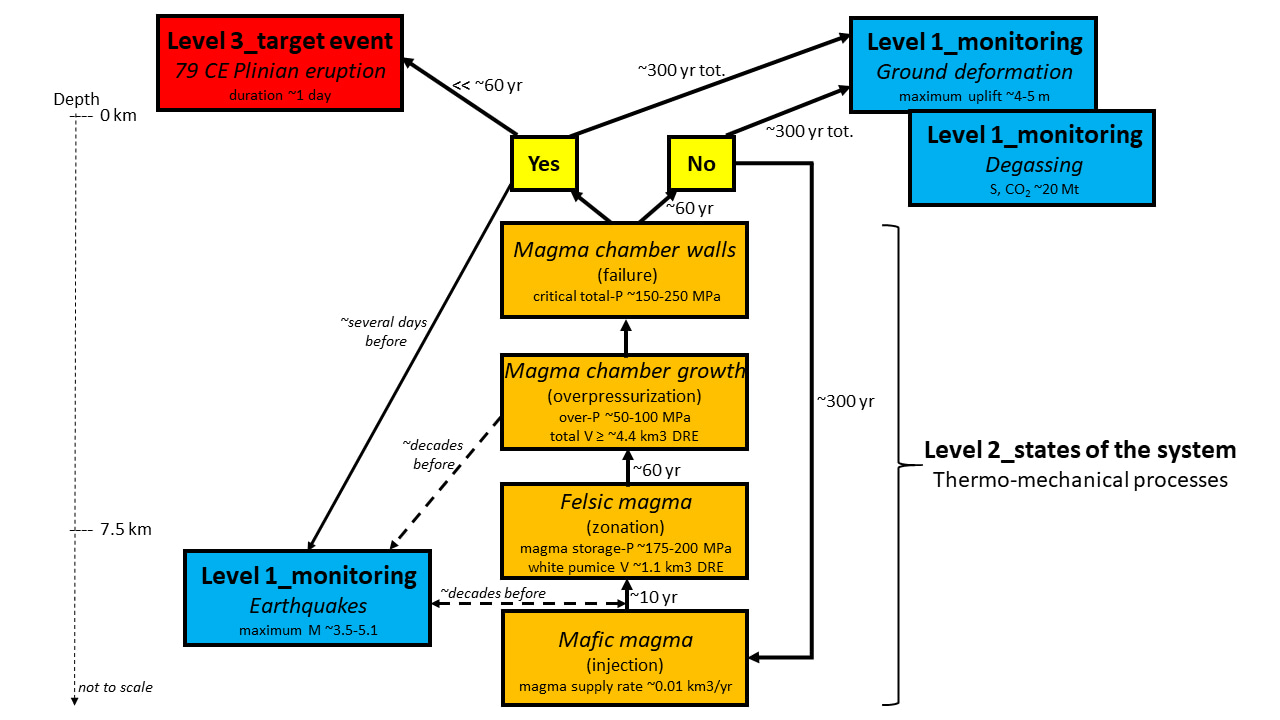
Our investigation relies on the FEM (Finite Element Method) modelling, informed by the stratigraphic, petrological, paleoenvironmental and archaeological findings. Results can be synthesized with a conceptual scheme for retrospective forecasting of the ‘‘Pompeii’’ eruption of Vesuvius (Fig. 1). The suggested conceptual scheme consists of three levels that categorize the volcanic activity as follows:
- level 1, including monitoring data based on the surveillance activities before eruption, which in this case are retrospective observations (e.g., ground deformation in archaeological sites);
- level 2, including the different processes (states) occurring at the scale of the magmatic system, i.e. the thermo-mechanical processes acting in the volcano feeding system before eruption;
- level 3, including the actual observed target event(s), which in this case are the different phases of the ‘‘Pompeii’’ eruption.
In particular, level 2 describes the actual engine of the eruption and includes the possible preparatory processes, making connections between – and providing physical explanations for – the other two levels; however, it represents the less constrained level. In this paper, the states of the system are constrained by the FEM modelling and petrological data, thus providing a physical explanation (magma reservoir growth) to level 1, i.e. to what occurred before the ‘‘Pompeii’’ eruption (ground deformation in particular).
The conceptual scheme (Fig. 1) reads from bottom to top, intuitively following the magma rise toward the surface, and describing an iterative process of discrete injections of the deeper mafic magma into the shallower felsic magma reservoir. Such injections allow the modelled reservoir to expand and build up an overpressure on its walls until an impending eruption state. The FEM modelling results allow quantifying the ground deformation as a surveillance parameter, while the historical chronicles and volatile content data are considered for reconstructing the general seismic and degassing effects preceding the ‘‘Pompeii’’ eruption.
In the simulations, as the differently-shaped reservoirs (prolate, oblate and spherical) grow and build up their overpressure, the time-dependent uplift values are not drastically different among shapes (maximum ~4-5 m), while the final overpressure values differ significantly (maximum ~50-100 MPa), the latter directly affecting the eruption probability. Indeed, this implies that the irreversible switch to the impending ‘‘Pompeii’’ eruption state might have occurred on the short-term (level 1), giving a pre-alarm not enough to save lives still present in the Vesuvius area until the first eruption phases (level 3). Although these results are constrained by archaeological records related to ground elevation changes, complementary data (e.g., historical, geomorphological and geochemical) would eventually refine such retrospective scheme for this iconic Plinian eruption. Looking at the future, the current geophysical (tomographic, gravimetric), volcanological, geochemical/petrological and modelling integrated studies and long-term monitoring activities are necessary to better understand the geological structures underneath Vesuvius (including the magma reservoir shape) and their effects prior to the next eruption (level 2).
As the preparatory phases of a Plinian eruption can run on the long-term, the FEM modelling results help reconstructing the thermo-mechanical processes inside – and related effects outside (e.g., ground deformation) – the volcano, to be coupled with all other possible effects (e.g., seismic, degassing).
Finally, this paper highlights the importance of the multiparametric surveillance at active volcanoes, since a combination of different processes and related parameters is necessary to forecast an impending eruption state. While a ground surface uplift might have characterized the unrest conditions on the long-term, a significantly higher frequency of relatively small seismic events (with respect to background) might have occurred some weeks before the ‘‘Pompeii’’ eruption. Geochemically, a pre-eruption degassing of sulphur and carbon dioxide might have occurred on the long-term, with a few tens of megatonnes over the total recharge period.
An accurate communication on the timescales of the different volcanic processes and their effects can indeed help keeping the population aware of what occurred in past eruptions, to be more prepared for the next one. For the ‘‘Pompeii’’ eruption, the magmatic system recharged in a time span of a few hundreds of years (long-term), but the irreversible switch to impending eruption was of the order of several days (short-term), then the ‘‘Pompeii’’ eruption lasted just one day!
Follow the Topic
-
Communications Earth & Environment
An open access journal from Nature Portfolio that publishes high-quality research, reviews and commentary in the Earth, environmental and planetary sciences.

Related Collections
With Collections, you can get published faster and increase your visibility.
High-resolution modeling for Earth system
Publishing Model: Open Access
Deadline: Feb 07, 2027
Soil microbiomes and carbon sequestration under global change
Publishing Model: Hybrid
Deadline: Mar 18, 2027