Integrated morphometric and machine learning-based flood risk assessment in the Rangit river sub-watersheds, Eastern Himalayas
Published in Social Sciences, Earth & Environment, and Computational Sciences
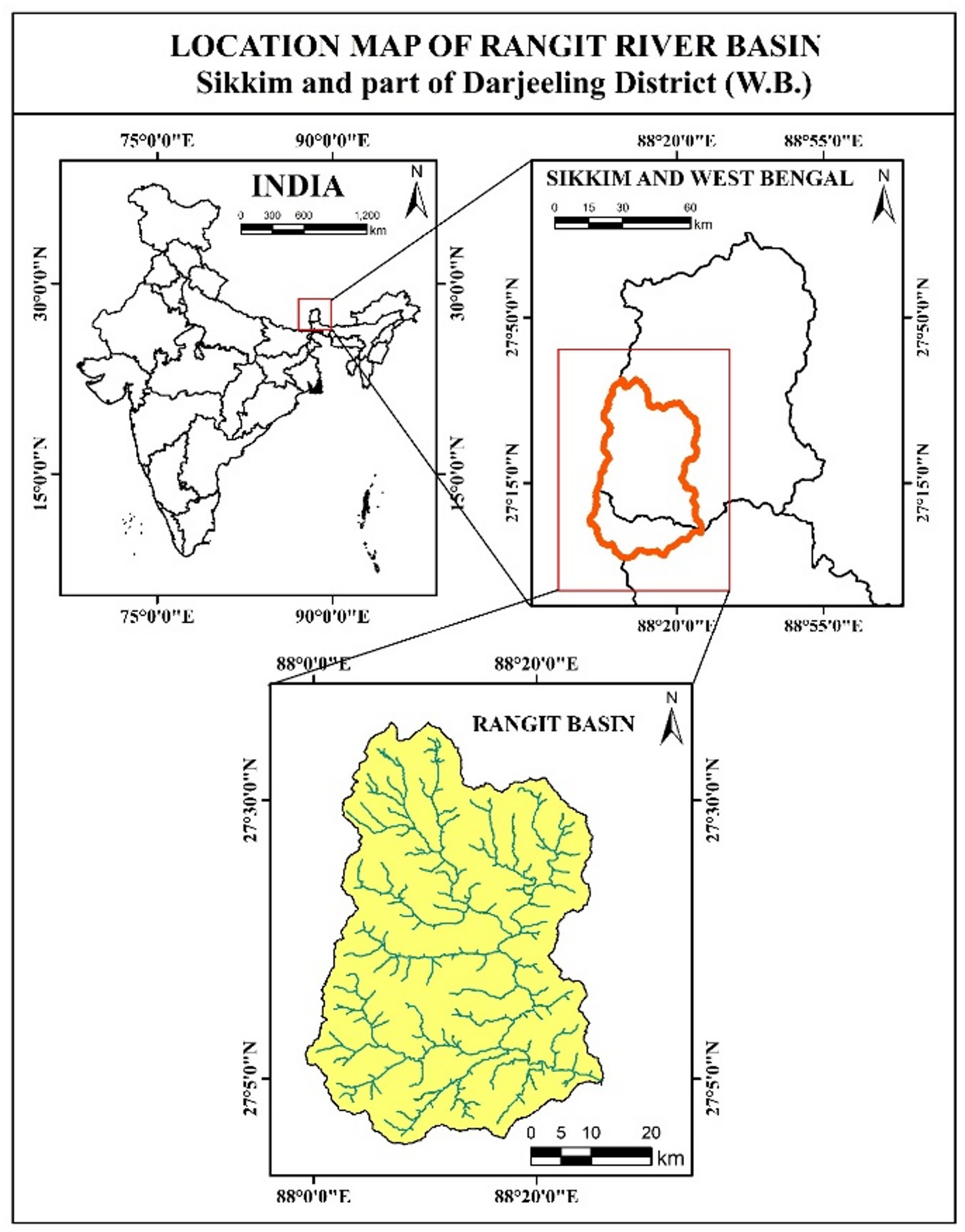

The Himalayan River systems are extremely dynamic, with drivers being tectonic activity, glacial melt, and extensive monsoonal rainfall, and thus are prone to catastrophic flooding. The solutions to these problems must be resolved through an integrated approach incorporating multiple studies on geological, hydrological, and climatic aspects to develop effective flood mitigation strategies for the Himalayan River basins. The current research project intends to express the Rangit River Basin’s contemporary geo-hydro morphological character through the analysis of several morphometric behaviours.
There aren’t many comprehensive studies on the Rangit River Basin that include evaluations of morphometric analysis and hydro-morphological changes brought on by shifting climatic conditions and growing human demands. Furthermore, little is known about how these variables combine sustainable water resource management and flood risk zones in the region. Furthermore, many studies lack a link between morphometric analysis and floods and do not use modern modelling tools for predicting flood risk zones. A cohesive method for examining the relationship between morphometric analysis and hydro-morphological changes in river basins is lacking in current research. By using an integrated technique that integrates field data with machine learning models to create flood risk maps and evaluate vulnerabilities, this work closes these gaps. By addressing these important gaps, the study provides unique options for sustainable water resource management and resilience in the Rangit River Basin of the Himalayan area.
The Rangit basin extends through parts of the states of Sikkim and West Bengal. Its western boundary is the Kingdom of Nepal. The northern and eastern margins of the basin lie within Sikkim, while the southern borderline cuts through the Darjeeling district of West Bengal. It covers 2134.07 sq km, representing 62.2% in the part of the west district, 24.4% in the south district in Sikkim and 13.4% of Darjeeling district in West Bengal. The longitudinal Singalila range divides the basin west from Nepal and another ridge joining the summits of Narshing, Karsang, Bhaledunga, and Tendong makes the divider line of the basin in the south district of Sikkim.
For the purpose of figuring out the natural and climatological aspects of the specific river basin region, the assessments of areal, linear, and relief aspects based on Aster DEM produced by contour and spot height are significant. The results of the research indicate that the basin hosting the fifth-order stream has moderate to steep slope high terrain, as shown by the elongation ratio, stream frequency, relief ratio, bifurcation ratio, length of overland, drainage density, and hypsometric curve. The variety of vegetation, rock, and soil types emphasizes the basin area’s ecological value, which includes a variety of plant and animal species and their interactions with the natural environment. The landscape and geology of the land affect the shape of the drainage. In the geographic research area, the drainage pattern is dendritic, and this pattern mostly occurs where the river channel follows the terrain’s slope, where numerous contributing streams are linked together at an acute angle to form tributaries of the main river. The term “dendritic river basin” denotes a landform that can be in an equilibrium mature stage or an in-equilibrium youthful stage. Long overland flows specify that the soil has important infiltration and percolation rates. The form of the drainage basin is less elongated, and peak flows have shorter durations and shorter runoff distances. After analyzing all the morphometric parameters and ranking the priority zones, it shows that SW1 falls under a high priority zone, thereafter SW4 and SW5 fall under a medium priority zone, and SW2, SW3 and SW6 fall under a low priority zone. Hence, high-priority zones will need more attention for flood control than other priority zones. As per the Random Forest Machine Learning model, SW1 and SW6 are the two sub-watersheds with the highest risk of flooding out of the six. This gives a broad-scale assessment of flood susceptibility, but the Flood Risk Zonation map focuses on specific flood-prone areas within each sub-watershed. This detailed mapping helps identify precise locations that are more vulnerable to flooding, which is critical for local-level flood management and mitigation planning. This research improves flood mitigation efforts by identifying high-risk zones for infrastructure development, early warning systems, and effective disaster responses. It also encourages sustainable land-use planning and climate-adaptation strategies to improve long-term resilience. Therefore, GIS is an effective instrument for computing and examining a variety of morphometric characteristics for the basin.

Prolay Mondal is an Assistant Professor of Geography at Raiganj University. He holds a Ph.D. from Visva-Bharati, specializing in eco-geomorphology, remote sensing, and GIS-based environmental studies.
Follow the Topic
-
Discover Applied Sciences
This is a multi-disciplinary, peer-reviewed journal for the disciplines of Applied Life Sciences, Chemistry, Earth and Environmental Sciences, Engineering, Materials Science and Physics, fostering sound scientific discovery to solve practical problems.

Related Collections
With Collections, you can get published faster and increase your visibility.
Engineering: Intelligent Manufacturing: IoT, AI/ML, Robotics, and Smart Materials in Industry 4.0/5.0
This collection aims to drive transformative innovation in the field of advanced manufacturing by exploring the powerful convergence of emerging technologies such as the Internet of Things (IoT), Artificial Intelligence and Machine Learning (AI/ML), Additive Manufacturing (AM), Shape Memory Alloys (SMAs), and next-generation Robotics. These technologies are reshaping the industrial landscape by enabling intelligent decision making, adaptive production strategies, human–machine collaboration, and seamless connectivity in manufacturing environments.
The objective of the collection is to examine how smart and data-driven manufacturing ecosystems can accelerate product development, enhance customization, improve sustainability, and enable rapid reconfiguration from conceptual design to fully functional product deployment. Emphasis is placed on intelligent materials, cyber-physical production systems, real-time monitoring, predictive maintenance, automated assembly, and closed-loop process optimization.
This collection welcomes high-quality original research articles, case studies, and comprehensive reviews that highlight cutting-edge advancements, practical implementations, and future opportunities in:
Smart factories and Industry 4.0/5.0 manufacturing practices
AI/ML-driven process control, design optimization, and defect analysis
Additive manufacturing innovations, including novel materials and hybrid systems
Application of SMAs and responsive materials in adaptive structures
IoT-enabled sensing, monitoring, and supply chain connectivity
Robotics and automation solutions for efficiency, quality, and human–machine integration
Submissions relevant to sustainable, energy-efficient, and environmentally responsible manufacturing are highly encouraged. Through this interdisciplinary focus, the collection seeks to advance the state of knowledge and support the development of intelligent, scalable, and resilient future manufacturing systems.
This Collection supports and amplifies research related to SDG 6, SDG 7, SDG 8, SDG 9, SDG 11and SDG 12.
Keywords: Advanced Manufacturin; Smart Materials; Internet of Things (IoT); Artificial Intelligence; Machine Learning; Additive Manufacturing; Shape Memory Alloys; Industry 4.0; Smart Factories; Cyber Physical Systems; Predictive Maintenance; Robotics and Automation; Sustainable Manufacturing; Digital Twin Technology; Intelligent Process Optimization
Publishing Model: Open Access
Deadline: Feb 21, 2027
Engineering: Machine Learning, AI, and Deep Learning Applications in Microwave Engineering: Devices and Communication
This Collection is dedicated to highlighting the application of Machine Learning (ML), Artificial Intelligence (AI) and Deep Learning (DL) in the field of Microwave Engineering: Devices and Communication. It will concentrate on AI/ML/DL approaches in Microwave Engineering, which includes new breakthroughs, design and performance techniques of various Microwave Devices like Antennas, Filters, Couplers etc. Starting with single/multiband antennas, this topical collection will showcase the application of AI/ML/DL in the design and/or performance features of wideband to super wideband antennas including Multiple-Input-Multiple-Output (MIMO) antenna structures suited for wireless communication.
It will also focus on the use of AI/ML/DL in various aspects of Terrestrial and/or Satellite-based Microwave Communication: Processes, Algorithms and Protocols.
Publishing Model: Open Access
Deadline: Dec 31, 2026


